What is Keyword Difficulty?


What is Keyword Difficulty? A Complete Guide for SEO Success
Keyword research is the bedrock of any successful SEO strategy. You can have the most beautifully designed website and the most compelling content, but without a smart keyword strategy, your efforts may never get the visibility they deserve. At the heart of this strategy is a powerful metric that separates potential wins from hopeless battles: keyword difficulty.
If you’ve ever started a new blog or tried to improve your search rankings, you’ve likely encountered this term. It’s often presented as a single number on a scale from 0 to 100, but what does that number actually mean? And more importantly, how can you use it to your advantage?
This complete guide will demystify keyword difficulty, explaining what it is, how it’s calculated, and how you can use it to build a winning SEO content plan. We’ll dive into how major tools like Ahrefs and Moz calculate their scores, provide a framework for what constitutes a “good” score, and debunk common misconceptions.
What is Keyword Difficulty?
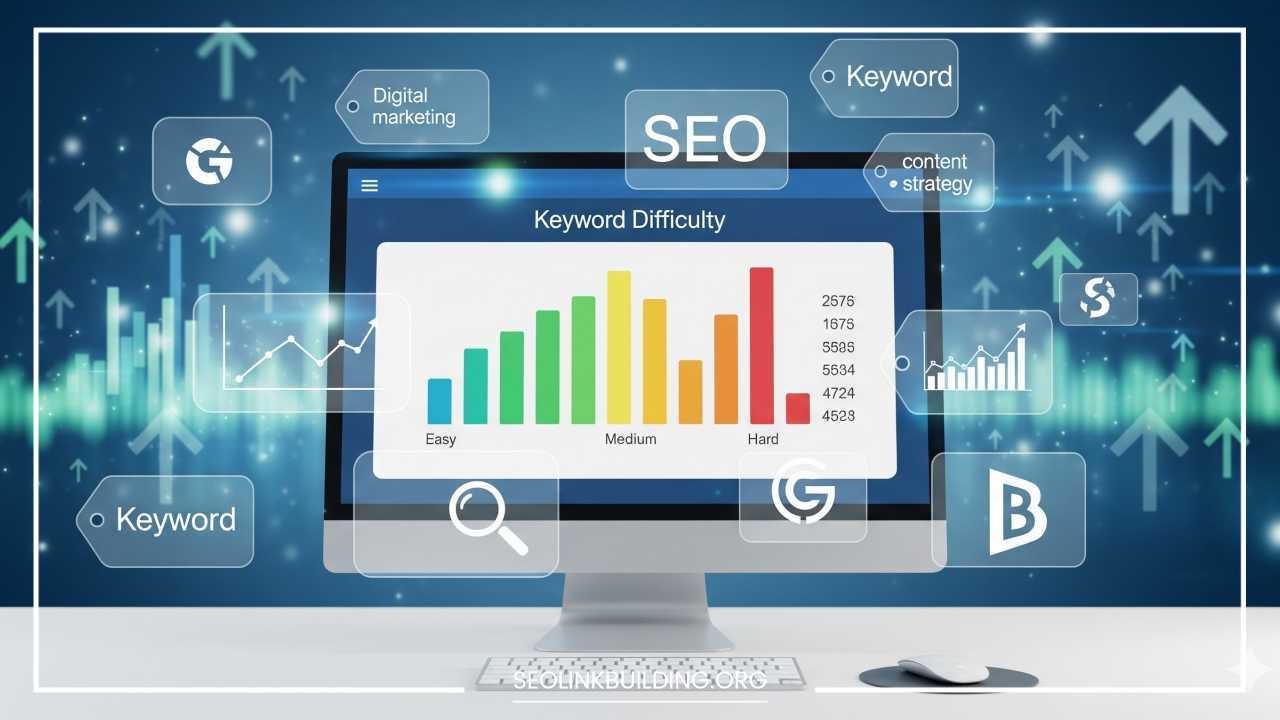
At its simplest, keyword difficulty (KD) is a metric that estimates how hard it will be to rank on the first page of Google for a specific keyword. Think of it as a competition score. A high score means the top-ranking pages for that keyword are highly authoritative and well-established, making it tough to break into the top 10. A low score suggests the competition is weaker, offering a greater opportunity to rank.
While the concept is straightforward, it’s crucial to understand that keyword difficulty is not an exact science. It is a predictive metric created by SEO tools to simplify a complex reality. These tools — such as Ahrefs, Moz, SEMrush, and Ubersuggest — each have their own proprietary formulas for calculating this score. This is why a keyword might have a KD score of 25 in one tool and 40 in another.
The primary purpose of this metric is to help you prioritize your keyword research. It allows you to quickly sort a list of potential keywords and identify the “low-hanging fruit” — terms with a healthy search volume but relatively low competition. By focusing on these opportunities, you can start building organic traffic and domain authority, which in turn will help you compete for more difficult keywords down the line.
It’s also essential to remember that keyword difficulty is just one piece of the puzzle. It should always be used in combination with other metrics like:
- Search Volume: The estimated number of monthly searches for a keyword.
- Search Intent: The user’s goal when typing a query (e.g., informational, transactional, navigational).
- Cost Per Click (CPC): The average price advertisers pay for a click on an ad for that keyword.
A keyword with a low difficulty but a search volume of 10 might not be worth your time, just as a high-difficulty keyword with a massive volume might be a long-term goal for an established site.
How is Keyword Difficulty Calculated?
The magic behind the keyword difficulty score lies in the algorithms of SEO tools. While the exact formulas are closely guarded trade secrets, the general principles are well-known and based on analyzing the top 10 results in Google’s search engine results pages (SERPs).
The most significant factor influencing a keyword’s difficulty score is the backlink profile of the competing pages. A backlink (or inbound link) is a link from one website to another. In Google’s eyes, a backlink is like a vote of confidence. When a high-authority site links to another, it signals to Google that the linked-to page is trustworthy and valuable. The more high-quality backlinks a page has, the more authority it possesses, and the harder it is to outrank.
Here are the key factors that these tools analyze to calculate a keyword’s difficulty:
- Domain Authority (DA) / Domain Rating (DR) of Competing Pages: This is a score (usually 0–100) that predicts how well a website will rank on average. Moz calls its metric Domain Authority, while Ahrefs calls it Domain Rating. The higher the authority of the sites ranking on page one, the higher the keyword difficulty score.
- Page Authority (PA) / URL Rating (UR): This is a similar metric, but it applies to a specific page rather than the entire domain. A page that has many high-quality backlinks pointing to it will have a strong Page Authority and be very difficult to outrank.
- Number of Referring Domains: This metric, heavily used by Ahrefs, counts the number of unique websites linking to a page. A single site with 100 links is less valuable than 100 different sites each with one link.
- Content Quality and Relevance: While this is harder for tools to measure programmatically, they can analyze the content of the top-ranking pages to gauge its comprehensiveness and relevance to the search query.
- SERP Features: The presence of SERP features like featured snippets, video carousels, or “People Also Ask” boxes can influence difficulty. While these don’t directly add to a site’s backlink profile, they indicate a high level of competition and that Google has already selected a preferred format for the results, which can make it harder to rank organically.
Comparison of How Major Tools Calculate It:
| Feature | Ahrefs | Moz | SEMrush |
| KD Calculation | Primarily based on the number of referring domains to the top 10 ranking pages. Ahrefs’ backlink index is one of the largest, making this a highly respected metric. | Based on the linking root domains to the top 10 results. It also uses Moz’s proprietary Domain Authority and Page Authority scores. | A proprietary algorithm that considers the domain strength of the top 20 pages in the SERP. |
| Score Scale | 0-100 | 0-100 | 0-100 |
| Key Takeaway | Ahrefs’ score is heavily influenced by the raw number of sites linking to the competition, making it a reliable indicator of the link-building effort required. | Moz’s score reflects the overall authority of the top-ranking sites. It’s often considered more intuitive for beginners. | SEMrush integrates multiple factors, including on-page optimization, to provide a more holistic view of a keyword’s competitiveness. |
How to Check Keyword Difficulty
The most common way to check keyword difficulty is by using a dedicated SEO tool. While they all have their nuances, the basic process is similar. Here is a step-by-step guide using some of the most popular platforms.
Using Ahrefs
- Log in to Ahrefs and navigate to the Keywords Explorer tool.
- Enter your target keyword into the search bar. You can enter multiple keywords at once.
- Select your target country and click “Search.”
- Analyze the results page. The first thing you’ll see is the Keyword Difficulty (KD) score in a prominent box. It will be accompanied by a color-coded scale and a brief explanation (e.g., “Easy: You’ll need backlinks from around 10 websites to rank in the top 10″).
- Scroll down to the SERP overview. This section shows you the top-ranking pages, their Ahrefs Domain Rating (DR), their URL Rating (UR), and the number of referring domains and backlinks they have. This granular data allows you to manually verify how tough the competition really is.
Using Moz
- Log in to Moz and open the Keyword Explorer.
- Enter a keyword or phrase and select a country.
- Click Analyze.
- View the Difficulty Score. Moz provides a score from 0-100, which is based on the average Domain Authority and Page Authority of the top 10 results.
- Examine the SERP Analysis. Similar to Ahrefs, Moz shows you the DA, PA, and other metrics for each of the top-ranking pages, providing context for the overall difficulty score.
Other Tools
- SEMrush: Use the Keyword Magic Tool to input a keyword and see its difficulty score. SEMrush also has a “Difficulty” filter that lets you easily find keywords within a specific competition range.
- Ubersuggest: A great free option (with paid upgrades). You can enter a keyword and see a “Keyword Difficulty” score, along with volume, CPC, and a competition rating.
- Mangools (KWFinder): This tool is known for its intuitive interface and its own proprietary KD score. It visually shows you how competitive a keyword is, making it easy to understand at a glance.
Free vs. Paid Tools: While some free tools and browser extensions offer a quick look at keyword difficulty, they often use a limited data set. For serious SEO, a paid subscription to a robust tool like Ahrefs, Moz, or SEMrush is essential to get the most accurate and actionable data.
How to Find Keyword Difficulty for Your Niche
Keyword difficulty is a relative metric. What is considered “easy” for an established site like Forbes.com might be “impossible” for a brand new niche blog. The key is to find keywords that are easy for you to rank for.
- Analyze Your Own Authority: Before you start, get a realistic sense of your site’s current Domain Authority (Moz) or Domain Rating (Ahrefs). This score is your baseline. Your goal is to find keywords where your site’s authority is at least in the ballpark of the competition.
- Conduct Competitor Analysis: Identify 3-5 of your top competitors. Use SEO tools to analyze their backlink profiles, domain authority, and what keywords they are currently ranking for. This will give you a benchmark for what is achievable in your niche.
- Filter by Difficulty and Volume: Use the filtering features in your SEO tool to find the sweet spot: keywords with a healthy search volume and a low to moderate difficulty score. For a brand new site, you might filter for keywords with a KD under 20 and a search volume over 100.
- Go Long-Tail: Long-tail keywords are phrases of three or more words that are highly specific. For example, instead of targeting “coffee maker,” you might target “best single-serve coffee maker for small apartments.” Long-tail keywords almost always have lower difficulty and higher intent, making them perfect for building initial traffic.
What is a Good Keyword Difficulty Score?
The term “good” is entirely subjective and depends on your website’s domain authority, age, and available resources. However, we can use a general framework to guide your decision-making.
Here is a breakdown of what typical keyword difficulty score ranges mean:
- 0–20: Very Easy. These keywords are a goldmine for new websites and blogs. The top-ranking pages often have low authority or are forums and social media sites. Target these to build initial traffic and brand authority.
- 21–40: Low Competition. This is the sweet spot for many small-to-medium-sized businesses. You can often rank for these keywords with a high-quality, comprehensive article and a few strategic backlinks.
- 41–60: Moderate Competition. To rank for these keywords, you’ll need a solid content strategy and some link-building efforts. They are a good target for established websites with growing authority.
- 61–80: Competitive. These are keywords where you’ll be competing with big players in your industry. Ranking here requires significant resources, including link-building campaigns and top-tier content.
- 81–100: Very Competitive. This is the exclusive playground of highly authoritative, well-established domains like Wikipedia, Amazon, and major news outlets. New websites should not even attempt to rank for these keywords. They are long-term, aspirational goals.
How Much Keyword Difficulty is Good for SEO?
The “right” amount of keyword difficulty to target is a function of your own site’s power. A smart SEO strategy isn’t about avoiding high-difficulty keywords entirely; it’s about matching the difficulty to your site’s ability to compete.
Examples:
- New Website (DA/DR < 10): Focus on keywords with a KD of 30 or less. Your goal is to build traffic and domain authority by going after the low-hanging fruit. This is your initial content strategy.
- Established Blog (DA/DR 30-50): You can start targeting keywords in the 40-60 range. At this level, you have enough authority to compete with some of the bigger players, but you still need to be strategic with your content and link building.
- High Authority Domain (DA/DR 70+): You have the power to compete for keywords with a KD of 70 or more. Your resources should be allocated to creating the definitive, pillar-content for these highly competitive terms.
Your content strategy should be a mix of these. The majority of your content should target low to moderate difficulty keywords to ensure a steady stream of traffic. You can then reserve a smaller portion of your resources for a few high-difficulty “moonshot” keywords that could yield massive traffic if you succeed.
Are Moz Keyword Difficulty Scores Accurate?
Moz’s Keyword Difficulty score is a well-respected metric that has been a staple in the SEO community for years. It’s calculated based on the Domain Authority and Page Authority of the top 10 ranking pages.
Pros:
- Intuitive: The DA/PA metrics are easy to understand and provide a good proxy for a site’s overall authority.
- Good for beginners: The tool is very user-friendly and makes it simple to grasp the concept of competition.
- Holistic View: The score gives you a quick snapshot of the competition’s overall strength, which is valuable for initial keyword screening.
Cons:
- Proxy for Reality: DA/PA are not Google metrics. They are Moz’s best guess. While a good estimate, they can sometimes differ from how Google’s algorithm actually views a site.
- Less Granular: The score doesn’t directly tell you why a keyword is difficult. For that, you need to manually analyze the SERP for backlink numbers and content quality.
Overall, Moz’s KD score is a very reliable estimate that is best used in conjunction with manual SERP analysis and other metrics.
Moz vs. Ahrefs: Which Keyword Difficulty Tool is More Accurate?
The debate over which SEO tool is “more accurate” is a perennial one, and the answer largely depends on your specific use case. While both tools provide a KD score on a 0-100 scale, they are built on different foundations.
| Feature | Moz | Ahrefs |
| KD Calculation | Uses Domain Authority & Page Authority based on linking root domains. | Uses the number of referring domains to the top-ranking pages. |
| Data Size | Moz’s backlink index is large and accurate but generally considered smaller than Ahrefs’. | Ahrefs boasts one of the largest backlink indexes in the world, which many believe gives it an edge in calculating link-based difficulty. |
| UI/UX | Often seen as more beginner-friendly and aesthetically clean. | Data-rich and professional, but can feel overwhelming to newcomers due to the sheer amount of data. |
| Additional Metrics | Offers proprietary Spam Score, Link Intersect, and on-page optimization suggestions. | Provides estimated clicks, keyword trends, SERP history, and a wealth of backlink analysis tools. |
Which is more accurate? Many SEO professionals consider Ahrefs’ Keyword Difficulty score to be more precise because it is tied directly to the number of referring domains, a metric that most closely correlates with the link-building effort required to rank. A higher KD in Ahrefs usually means you need more high-quality backlinks.
However, Moz provides a fantastic, user-friendly experience and its DA score is a widely used benchmark. The best practice is to use both tools or at least cross-reference your findings. If a keyword is difficult in Ahrefs (high KD) and the competition has high authority in Moz (high DA), you can be confident that it’s a tough keyword to rank for.
Keyword Difficulty Myths and Misconceptions
Despite its usefulness, keyword difficulty is often misunderstood. Here are a few common myths and the truth behind them:
- “High KD = Impossible”: Not true. A high KD means it will be very difficult and require significant effort, but it’s not impossible, especially for a site with high authority. Great content and a smart link-building strategy can still win.
- “Low KD = Easy Win”: Also not true. A low KD means the competition’s backlink profiles are weak. But what if all the top-ranking pages have incredible, comprehensive content that perfectly matches user intent? You still have to create a better piece of content to outrank them.
- KD Doesn’t Account for Search Intent or Content Quality: This is a crucial point. A tool’s KD score is based on authority metrics. It doesn’t tell you if the content is good or if it matches what the user is looking for. A keyword for which all the top results are outdated or low-quality is a massive opportunity, even if the KD score is high.
Best Practices for Using Keyword Difficulty in SEO Strategy
Now that you understand what keyword difficulty is and how to check it, here’s how to integrate it into a practical, winning SEO strategy.
- Start with Long-Tail, Low-KD Keywords: When building a new website or starting a new content pillar, focus on low-difficulty, long-tail keywords. This is your foundation. As you start ranking for these terms, you will build organic traffic and domain authority.
- As Your Site Grows, Raise the Bar: As your site’s domain authority increases, you can begin to target more difficult, higher-volume keywords. Use a mix of low and medium difficulty keywords to ensure a steady flow of traffic while working toward bigger goals.
- Use KD as a Filtering Tool, Not the Final Decision-Maker: Don’t let a single number dictate your entire content strategy. Use KD to filter your keyword lists down to manageable sizes, but then manually analyze the top-ranking pages to understand the true competition.
- Combine with Other Metrics: Always use keyword difficulty in conjunction with search volume, search intent, and a manual SERP analysis. A high-volume keyword with low difficulty is a great opportunity. A low-volume keyword with high difficulty is a waste of time.
Final Thoughts
Keyword difficulty is a powerful and essential metric for anyone serious about SEO. It provides a quick and effective way to estimate the competition and prioritize your efforts, saving you countless hours that might otherwise be spent chasing unwinnable keywords.
However, it’s not a silver bullet. The best SEOs understand that keyword difficulty is a guide, not a rule. They use it to inform their decisions but never let it overshadow the importance of creating high-quality, relevant content that genuinely helps their audience. By mastering the art of balancing keyword difficulty with search volume and user intent, you can build a robust content strategy that drives sustainable organic traffic and delivers long-term SEO success.
Start by finding a handful of low-difficulty keywords in your niche, create the best content you possibly can, and watch your rankings and traffic grow.