Wix SEO Optimization: 10 Tips to Rank on Google


Wix SEO Guide: 10 Proven Optimization Tips
There is a persistent myth in the digital marketing community that some website builders are fundamentally incapable of performing well in search engine results. For years, a common refrain among web developers and traditional marketers was that Wix was bad for SEO. In the early days of the platform, flash-based architecture and rigid URL structures created genuine technical challenges for search engine crawlers. However, the modern web landscape looks entirely different. Today, Wix has transformed into an SEO powerhouse, offering sophisticated, enterprise-grade infrastructure that supports the most demanding optimization strategies.
Modern websites built on this platform benefit from rapid global content delivery networks, automated technical execution, and comprehensive structured data support. If your website is not ranking, the issue is no longer the platform; it is the execution of your optimization strategy.
This comprehensive guide delivers an actionable roadmap for maximizing your organic visibility. Whether you are a small business owner looking to capture local customers, a blogger aiming for global reach, an ecommerce merchant driving sales, or an agency managing client portfolios, these ten strategies will help you unlock the full ranking potential of your website. By mastering these platform-specific adjustments and fundamental search engine guidelines, you can improve Wix SEO performance and secure sustainable organic traffic.
Is Wix Good for SEO?
To understand how to approach Wix SEO optimization, it is essential to dismantle the outdated notions surrounding the platform. In its inception, the platform relied on technology that was difficult for search engines to crawl and index. Today, Google treats these sites exactly like websites built on any other Content Management System (CMS), such as WordPress or Shopify. Google search representatives have stated that search engines look at the rendered HTML code of a page, meaning they care about content, structure, relevance, and user experience, rather than the underlying software code used to build the platform.
The platform includes a robust suite of built-in technical features that execute complex tasks automatically. Out of the box, it provides custom meta titles and descriptions, automated canonical tags to prevent duplicate content issues, a streamlined 301 redirect manager, customizable structured data schemas, and instant mobile responsiveness.
When evaluating options, users often debate the merits of different platforms.
| Feature Support | Wix | WordPress | Shopify |
| Technical Automation | Native and automatic | Requires third-party plugins | Native for ecommerce |
| Hosting & Global CDN | Included by default | Must be configured manually | Included by default |
| Structured Data Customization | Advanced native editor | Plugin-dependent | Theme or app-dependent |
| URL Customization Flexibility | Strict prefix rules for blogs/stores | Total structural freedom | Strict mandatory prefixes |
While WordPress offers absolute freedom over every line of code, it requires manual maintenance, regular security updates, and a complex web of plugins that can conflict and degrade site performance. Shopify provides strong options tailored exclusively for commercial stores but lacks flexibility for content-heavy informational blogs. Wix strikes a balance, handling server-side optimization, security patches, and structural maintenance automatically, allowing you to focus your energy entirely on keyword execution, content development, and authority building. Ultimately, your Google ranking depends on the quality of your strategy, not the CMS you choose.
Tip – Do Proper Keyword Research
The foundation of any successful strategy to improve Wix SEO is comprehensive keyword research. Before you adjust a single setting in your dashboard, you must understand exactly how your target audience searches for your products, services, or information. Attempting to optimize your website without keyword data is like driving in a foreign city without a map.
Effective keyword research requires a deep understanding of search intent. Search intent reflects the underlying reason why a user types a query into Google. Intent generally falls into three primary categories: informational (seeking knowledge), navigational (looking for a specific website), and commercial or transactional (ready to buy or investigate a purchase). To secure meaningful organic traffic, your content must align precisely with the user’s intent.
Rather than targeting highly competitive, single-word broad terms, you should focus your initial efforts on long-tail keywords. Long-tail keywords are longer, more specific phrases that typically exhibit lower search volumes but carry significantly lower competition and much higher conversion rates. For instance, instead of trying to rank for the broad term “SEO,” which is contested by multi-billion dollar corporations, a localized or platform-specific approach yields far better results. Targeting phrases like “Wix SEO optimization tips” or “how to rank Wix site on Google” allows you to reach a highly qualified audience looking exactly for what you provide.
To build your keyword repository, leverage industry-standard research tools:
-
Google Keyword Planner: Excellent for discovering search volume trends and commercial intent values directly from Google advertising data.
-
Ahrefs or Semrush: Vital for mapping competitor keyword strategies, uncovering keyword gaps, and calculating keyword difficulty scores.
-
Google Trends: Helpful for identifying seasonal fluctuations in search interest and determining if a particular industry topic is rising or falling in popularity.
Once you compile your list, assign one primary keyword to each specific page on your website. This primary keyword acts as the core thematic anchor for that page. You should also identify three to five related semantic keywords—contextually relevant variations and synonyms—that enrich your content naturally. Avoid using the same primary keyword across multiple pages, as this causes keyword cannibalization, forcing your own pages to compete against one another in Google search results.
Tip – Optimize Your Page Titles and Meta Descriptions
Once you establish your target keywords, you must place them into your HTML meta tags. Page titles (also known as title tags) and meta descriptions are the primary elements that appear in Google search results. These components serve a dual purpose: they provide strong relevance signals to search engine algorithms, and they act as organic ad copy that influences whether a user clicks through to your website or chooses a competitor.
Title tags remain one of the most powerful on-page factors. For maximum algorithmic impact, position your primary keyword near the beginning of the title tag. Search engines accord greater weight to words appearing first in the string. Keep your title tags under 60 characters to ensure they do not become truncated on desktop or mobile search engine result pages.
Meta descriptions do not influence rankings directly, but they heavily dictate your organic Click-Through Rate (CTR). A well-crafted meta description summarizes the core value proposition of the page and concludes with a clear call to action. Keep meta descriptions under 155 characters to maintain visibility across all device types.
The platform simplifies the management of these elements through its intuitive interface. To edit these tags, navigate to your site dashboard, select the specific page you wish to modify, click on the options menu, and select the SEO tab. Here, you can input your customized text and preview how your listing will appear in search results.
Consider this comparison of ineffective versus optimized meta formatting:
-
Ineffective Title: Home | My Business Name
-
Ineffective Description: Welcome to our website. We offer high-quality services to all of our customers. Contact us today to learn more about what we do.
-
Optimized Title: Wix SEO Optimization: 10 Tips to Rank Higher on Google
-
Optimized Description: Learn proven Wix SEO tips to improve your search visibility. Master on-page adjustments, image optimization, and speed settings to drive organic traffic.
The optimized version positions the high-volume primary phrase immediately at the start of the title, establishes a clear value expectation, stays well within length constraints, and features a compelling call to action that boosts clicks.
Tip – Create SEO-Friendly URLs
A clean, logical Uniform Resource Locator (URL) structure provides both human users and search engine crawlers with an immediate understanding of a page’s topic. Unoptimized, messy URLs cluttered with random strings of numbers, dates, or database symbols confuse users and fail to convey relevant topical signals to search engines.
When designing your website architecture, keep your URLs short, descriptive, and highly focused on your primary keyword. Avoid adding filler words such as “and,” “the,” or “for,” which lengthen the URL without adding structural or contextual value.
-
Poor URL Structure:
[mysite.com/page-id-98754/content-version-2](https://mysite.com/page-id-98754/content-version-2) -
Optimized URL Structure:
[mysite.com/wix-seo-optimization](https://mysite.com/wix-seo-optimization)
Always separate individual words within your URLs using hyphens rather than underscores or spaces. Search engines interpret hyphens as word separators, whereas underscores combine words into a single, unreadable string. Ensure all characters remain strictly lowercase to prevent potential server configuration discrepancies or duplicate tracking issues.
The platform allows you to customize the URL slug for any standard page via the Page SEO Settings menu. While it enforces certain structural prefixes for specialized system pages—such as /post/ for blog entries or /product-page/ for ecommerce items—you still retain total control over the defining keyword slug that follows. Keep these slugs brief, clean, and perfectly aligned with the core topic of the asset.
Tip – Improve Site Speed and Core Web Vitals
User experience sits at the very heart of modern search engine discovery. Google penalizes websites that force users to wait for content to load. To quantify performance, search engines evaluate Core Web Vitals—a specific set of real-world metrics that measure visual load speed, interactive responsiveness, and visual stability during page rendering.
Core Web Vitals prioritize three distinct performance areas:
-
Largest Contentful Paint (LCP): Measures the time it takes for the main content of a webpage to load, aiming for 2.5 seconds or faster.
-
Cumulative Layout Shift (CLS): Measures unexpected visual movement of page elements while loading, targeting a score below 0.1.
-
Interaction to Next Paint (INP): Evaluates user interface responsiveness by measuring the delay when a visitor interacts with a page element, requiring a response under 200 milliseconds.
The platform handles significant background engineering to optimize these metrics, routing your data through an advanced global Content Delivery Network (CDN), utilizing server-side caching, and deploying automated lazy loading so elements render only as they enter the user’s viewport. However, bad design practices can still degrade site performance.
To maximize your load speeds, you must actively manage what you upload to your template. Avoid adding massive, uncompressed graphic assets or sprawling background videos. Limit the installation of excessive third-party widgets, tracking scripts, and heavy applications, as each add-on introduces additional code strings that delay page rendering.
Regularly evaluate your performance using Google PageSpeed Insights and monitoring the Experience reports inside your Google Search Console profile. If your visual stability scores suffer, inspect your layout formatting to ensure that decorative elements do not shift around during load cycles.
Tip – Optimize for Mobile SEO
Desktop computing no longer commands the majority of web traffic. Google operates entirely on a system called mobile-first indexing. This means the search engine uses the mobile version of your website’s content, structure, and media layout as the primary baseline to determine your positions in search rankings. If your mobile layout is broken, cluttered, or difficult to navigate, your entire site will struggle to rank, regardless of how perfect the desktop presentation looks.
Mobile optimization requires careful consideration of the physical realities of smartphone usage. Text blocks must feature large, highly legible font sizes that prevent users from needing to pinch or zoom to read content. Interactive buttons, links, and navigation menus must be configured with generous spacing to accommodate finger taps, preventing frustrating accidental clicks. Furthermore, complex multi-column desktop designs must gracefully stack into streamlined, single-column vertical flows on mobile displays.
The platform provides a dedicated mobile editor system that allows you to customize the smartphone user experience independently of your main desktop canvas. While changes to text copy carry over across both displays to preserve message continuity, the mobile editor empowers you to resize over-scaled text blocks, hide non-essential background graphics that delay mobile connections, and reorder structural sections to ensure immediate engagement.
Never publish an update without thoroughly reviewing the layout within the mobile editing view. Test your actual live URLs on multiple physical smartphone devices to guarantee that navigation flows naturally, pop-up elements dismiss easily, and content remains fully accessible.
Tip – Publish High-Quality Content Consistently
No amount of technical optimization can compensate for low-quality content. Search engines aim to serve users the most comprehensive, authoritative, and helpful information available. To succeed with Wix blog SEO, you must commit to an ongoing, strategic content publication model that prioritizes substantive value over superficial keyword frequency.
Google evaluates content using standard quality principles known as E-E-A-T:
-
Experience: Firsthand, practical familiarity with the subject matter.
-
Expertise: Deep knowledge and professional understanding of the field.
-
Authoritativeness: Clear recognition as a leading, credible source of information within your industry niche.
-
Trustworthiness: The absolute integrity, transparency, and accuracy displayed across your website assets.
To demonstrate these traits, avoid publishing brief, shallow articles that merely repeat easily found internet facts. Instead, design a robust blogging strategy focused around topical clusters. A topical cluster model involves creating an exhaustive, foundational pillar page that covers an industry topic broadly, then surrounding it with specialized spoke articles that dive deep into granular subtopics.
For example, if you operate an interior design company, you could publish a comprehensive pillar page regarding home renovation strategies. This page can then link directly out to specific, detailed articles analyzing kitchen lighting layouts, hardwood floor selection guidelines, or small-space color palettes. This structural clustering signals to search engine crawlers that you possess thorough expertise across the entire industry landscape.
When formatting your blog posts, organize your ideas using clear semantic heading hierarchies. Use a single H1 tag exclusively for the main title of your page. Break your underlying content blocks into logical subheadings using H2 tags for primary thematic shifts, and utilize H3 tags for finer details contained within those sections. This clean hierarchical structure helps algorithmic scrapers parse your arguments easily, while allowing human readers to scan your text comfortably.
Tip – Optimize Images for SEO
Visual elements bring your web design to life, but unoptimized image assets present a major obstacle to search performance. Images that lack descriptive naming strings and clear contextual tags remain invisible to search engine crawlers, which cannot view an image visually the way humans do. Proper image optimization unlocks a valuable source of alternative traffic via Google Images search results while improving overall page accessibility.
Image optimization relies on three core practices: descriptive file naming, proper sizing formats, and comprehensive alt text implementation. Never upload images directly from your camera roll that feature default system names like IMG_84732.jpg. Rename the files on your computer prior to upload, using short, lowercase, hyphenated phrases that state exactly what the graphic displays.
-
Incorrect Filename:
DCIM_photo1.png -
Optimized Filename:
modern-wix-seo-dashboard-settings.png
Alternative text (alt text) serves as a descriptive attribute embedded within the HTML code of your image asset. Alt text describes the visual contents of the image to blind or visually impaired visitors using screen-reader software, while providing search engine crawlers with direct context. Write clear, natural alt text that describes the actual image content while naturally integrating your semantic keywords where relevant. Avoid keyword stuffing, which involves packing an image tag with a repetitive list of search terms.
-
Poor Alt Text: “shoes boots running sneakers cheap discount free shipping”
-
Optimized Alt Text: “Man wearing black waterproof running sneakers on a wet concrete trail”
Before uploading media to your media library, run your graphics through file-compression tools such as TinyPNG or Squoosh. These tools significantly reduce raw file sizes without sacrificing visible image resolution. The platform automatically converts uploaded images into modern formats like WebP and serves scaled variations based on the visitor’s screen resolution. However, compressing your original files ensures your storage library remains lightweight and fast.
Tip – Build Internal Links Strategically
Internal linking is the practice of connecting different pages within your own domain using hyperlinks. This simple strategy plays a critical role in technical discovery, architectural hierarchy, and link equity distribution.
When search engine spiders land on your homepage, they follow your internal navigation links to discover, crawl, and index your deeper content pages. If an asset lacks incoming internal links, it becomes an “orphan page” that search engine crawlers struggle to find and index. Strategic internal linking also spreads authority across your site, passing value from high-performing pages down to newer or lower-traffic articles.
To build an internal linking system, connect your relevant educational articles together naturally within the body text of your paragraphs. Always use descriptive anchor text for your hyperlinks. Anchor text refers to the visible, clickable words that hold the link. Avoid using generic phrases that provide zero context to search engines or users.
-
Poor Anchor Text Usage: To learn more about our advanced technical optimization features, please click here.
-
Optimized Anchor Text Usage: Explore our comprehensive technical SEO checklist to fix indexation errors on your domain.
The optimized approach binds the link directly to clear keywords that explain exactly what the target page contains. This provides context to search crawlers and sets clear expectations for users, keeping them engaged on your site longer and reducing bounce rates.
Tip – Use Wix SEO Tools and Integrations
One of the main benefits of using this platform is its integrated ecosystem of native optimization tools and marketing connections. Rather than forcing you to source, install, and configure multiple third-party add-ons, the system provides an all-in-one suite of performance features accessible directly from your main site dashboard.
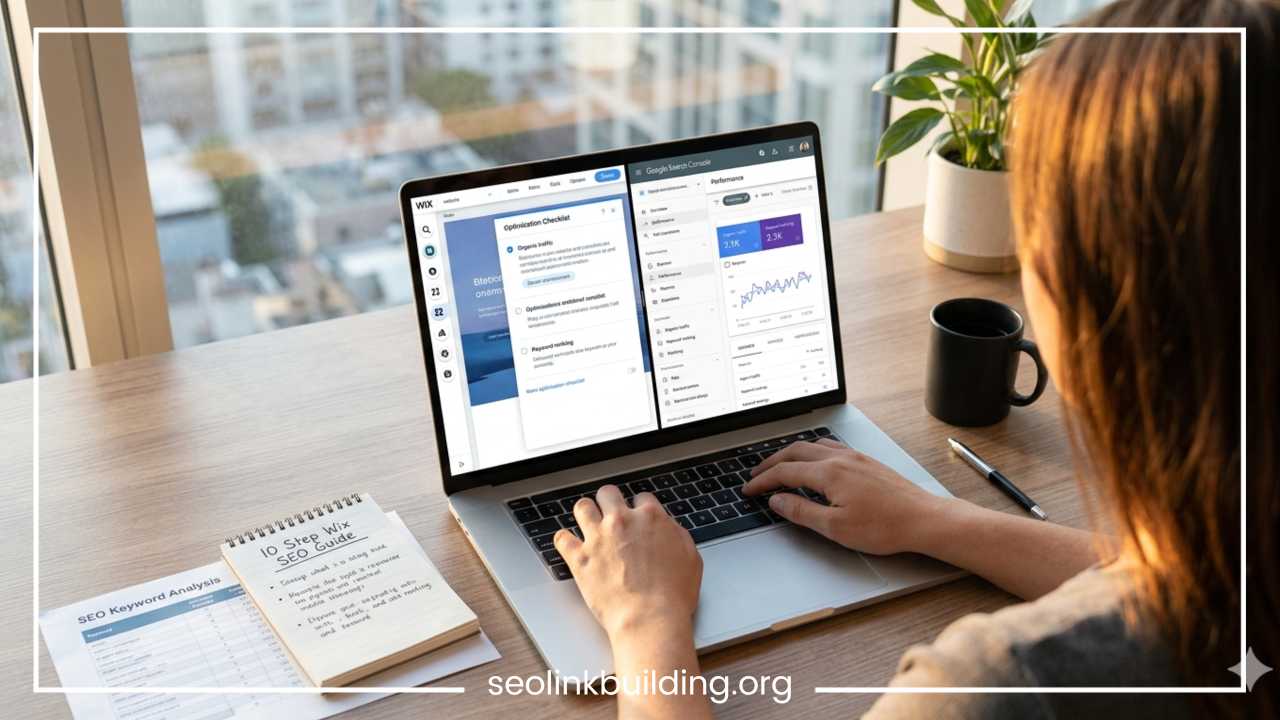
The foundation of this system is the native SEO Setup Checklist. This interactive onboarding tool analyzes your website’s industry focus, physical location parameters, and primary target keywords to generate a customized step-by-step launch plan. Completing this checklist establishes a direct, secure connection with Google Search Console via an instant API integration. This connection allows you to verify your domain and submit your automated XML sitemap directly to Google for indexation within minutes, skipping manual web development steps.
Once your foundational verification is established, the platform continues to generate your sitemap dynamically in the background, updating your structural logs automatically as you publish new blog entries or change your services. This automated handoff ensures that search engine indexers remain continuously informed of your fresh updates without requiring recurring manual file uploads.
As your platform grows, you can leverage advanced configuration settings to scale your efforts:
-
SEO Patterns: Save time by defining automated formulas for title tags, meta descriptions, and open graph social sharing formats across hundreds of product layouts or blog posts simultaneously.
-
URL Redirect Manager: Maintain your authority by setting up seamless 301 redirects when changing old page links, ensuring visitors never hit a broken 404 error screen.
-
Structured Data Markup Editor: Add schema markup to your pages using standard JSON-LD configurations, making your listings eligible for rich snippets like review stars, product price tags, and FAQ drop-downs in search results.
Make sure to connect your dashboard to foundational monitoring tools like Google Analytics and Google Search Console. Google Analytics tracks user behavior, session lengths, and conversion metrics on your site, while Google Search Console monitors keyword impressions, positions, and indexing health. Reviewing this data regularly helps you find high-performing terms to target and technical issues that need fixing.
Tip – Build Backlinks and Authority
On-page configurations and technical adjustments create a strong foundation, but search engines also look at external signals to determine how your site compares to competitors. Google uses backlinks—links from external domains pointing back to your website—as votes of confidence. A site with a strong profile of high-quality backlinks signals authority, trust, and relevance, leading to higher rankings.
When it comes to building backlinks, focus on quality over quantity. A single hyperlink from an established, trusted news outlet or a respected industry website passes more ranking authority than hundreds of low-quality links from spammy forums or link directories. Avoid unethical link schemes or services offering thousands of backlinks for a cheap price. Google’s algorithms easily detect these unnatural patterns and can penalize your domain, removing you from search results entirely.
Focus on white-hat authority building methods to earn clean links:
-
Guest Posting: Write high-quality educational articles for respected publications in your niche, adding a natural link back to your resource page within the content.
-
Digital PR: Share original insights, business milestones, or localized trend reports with journalists and industry bloggers looking for expert commentary.
-
Linkable Assets: Design highly detailed infographics, comprehensive free calculators, or original research studies that other webmasters will naturally want to cite in their own articles.
-
Local Citations: If you serve a local area, secure listings in reputable regional directories such as Google Business Profile, Yelp, and localized business chambers.
Building authority takes time, patience, and consistent effort. Focus on creating valuable resources that genuinely help your industry. As your brand visibility grows, external websites will naturally start linking to your content, raising your overall search authority.
Common Wix SEO Mistakes to Avoid
Even experienced marketers can hit ranking plateaus by making simple mistakes during site management. To keep your visibility growing steadily, watch out for these common optimization pitfalls:
-
Publishing Duplicate Content: Copying paragraphs word-for-word across multiple pages or pasting text directly from manufacturer descriptions confuses search crawlers and limits your visibility. Always write original content for every page.
-
Neglecting Image Accessibility: Leaving your image files unnamed or missing alt text hurts your user experience and keeps your graphics from showing up in Google Images.
-
Creating Thin Pages: Launching multiple short pages that only contain a few sentences creates “thin content.” Search engines prefer comprehensive pages that answer a search query thoroughly.
-
Ignoring Mobile Formatting Details: Forgetting to check your site layout in the mobile editor view can lead to oversized text blocks or overlapping links that frustrate smartphone visitors.
-
Keyword Stuffing: Artificially forcing your primary keyword into your paragraphs over and over looks unnatural to readers and triggers quality filters that drop your rankings.
-
Allowing Heavy Page Elements: Uploading huge, raw images or unnecessary background apps slows down your site speed and hurts your Core Web Vitals scores.
Summary of Actionable Next Steps
To help you stay organized as you optimize your site, keep this practical checklist in mind for your pages:
-
[ ] Research target keywords using professional research tools to match search intent.
-
[ ] Write custom title tags under 60 characters with your primary keyword at the beginning.
-
[ ] Craft engaging meta descriptions under 155 characters that include a clear call to action.
-
[ ] Clean up your page URLs to ensure they are short, lowercase, and separated by hyphens.
-
[ ] Compress all image files and write descriptive alt text before publishing them.
-
[ ] Connect your site to Google Search Console using the native SEO Setup Checklist.
-
[ ] Link related articles together using clear, descriptive anchor text.
-
[ ] Review your mobile layout layout inside the mobile editor to ensure text and buttons flow correctly.
Building organic search visibility is a long-term strategy that requires steady attention and consistent updates. The platform gives you all the tools and infrastructure needed to compete for top spots on search engine result pages. By applying these ten optimization tips, avoiding common mistakes, and regularly creating helpful content, you can improve your rankings and build a steady stream of organic traffic for your business. Start by optimizing your core pages today, track your performance numbers every month, and let your search authority grow.
Frequently Asked Questions
Why is my Wix website not showing up on Google search?
If your website is not appearing in search engine results, it is usually due to an indexation delay or a setting that blocks search crawlers. First, ensure you have completed the native setup checklist and connected your site to Google Search Console to submit your XML sitemap. Next, navigate to your site dashboard, open your advanced SEO settings, and verify that the toggle for “Let search engines index this page” is turned on. If your site is brand new, it can take anywhere from a few days to a few weeks for Google to crawl and display your pages in search results.
How long does it take to rank a Wix website on Google?
Securing a competitive ranking on search engine result pages typically takes between three to six months of consistent optimization. SEO is a long-term strategy, and the exact timeline depends on the target keyword difficulty, the quality of your helpful content, and the authority of your competitors. While technical tasks like updating title tags or submitting an XML sitemap happen quickly, building up your brand authority and earning high-quality backlinks requires steady, ongoing effort before you see a significant boost in organic traffic.
Can you do advanced technical SEO on a Wix site?
Yes, the modern platform fully supports enterprise-grade technical optimization. Users have complete access to custom structured data tools, allowing you to inject customized JSON-LD schema markup directly into individual pages or apply them across entire page categories using patterns. Additionally, you can manually customize canonical tags, manage complex URL redirects using the native 301 redirect manager, modify robots.txt files, and customize your open graph tags for social media platforms.
Is Wix SEO better or worse than WordPress for small businesses?
Neither platform is inherently better or worse for search visibility, as Google treats the rendered HTML of both platforms equally. WordPress offers complete access to the underlying website code and a vast ecosystem of third-party plugins, but it requires regular manual updates, security patches, and hosting configuration. Wix automates the technical foundation by handling server maintenance, secure hosting, and image conversion automatically. For small businesses, this automation removes technical barriers, allowing owners to focus entirely on keyword research and content creation.
How do I fix slow loading speed on my Wix mobile site?
To improve your Core Web Vitals and boost mobile performance, you must optimize the content you upload to your page templates. Start by running all your images through compression tools like TinyPNG to reduce their file sizes before uploading them to your media library. Next, open your mobile editor view to hide heavy decorative elements, large video backgrounds, or complex animations that delay mobile network connections. Finally, limit the use of external third-party widgets and tracking scripts, as each app adds extra code that slows down your mobile page rendering.