10 Easy DIY SEO Optimization Tips to Increase Traffic Fast

Easy DIY SEO Optimization Tips to Increase Traffic Fast
Search Engine Optimization, or SEO, is often painted as a dark art practiced only by those with deep pockets and complex coding skills. For years, the narrative has been that if you want to rank on the first page of Google, you need a massive budget and a dedicated agency. This is a myth that prevents thousands of talented bloggers and small business owners from ever reaching their true potential.
The reality is that SEO remains one of the most effective, sustainable ways to grow an audience. While the algorithms governing search engines become more sophisticated every day, the core principles of what makes a website “good” in the eyes of Google have remained remarkably consistent. It isn’t about “tricking” a machine; it is about proving to that machine that your content is the most helpful, relevant, and accessible answer to a user’s question.
This guide is designed for the DIY enthusiast. Whether you are a solo founder, a hobbyist blogger, or a small business owner, you don’t need to be a technical genius to see significant growth. By focusing on high-impact, fast-acting tactics, you can bypass the “paralysis by analysis” that many beginners face. We are stripping away the jargon to provide you with ten actionable strategies that you can implement today.
These tips focus on “Quick Wins”—changes that take minutes or hours to apply but can result in noticeable shifts in your traffic and rankings. If you have been waiting for a sign to take control of your digital presence, this is it. SEO does not have to be expensive, and it certainly does not have to be a mystery.
What Makes SEO Work Fast?
In the world of digital marketing, “fast” is a relative term. Unlike paid advertising, where traffic starts the second you enter your credit card details, SEO usually takes time to mature. However, there is a distinct difference between long-term authority building and quick-win optimization.
Long-term SEO involves building thousands of backlinks and establishing a brand over years. Quick-win SEO, on the other hand, is about finding the “low-hanging fruit.” This means identifying the errors you are currently making that are holding your content back, or finding small gaps in the market that your competitors have overlooked.
Core Principles of Fast SEO
To see results quickly, you must align your website with three core pillars:
1. Search Intent: You must understand what the user actually wants when they type a query. If someone searches for “how to bake a cake,” they want a recipe, not a history of wheat farming. Matching intent is the fastest way to lower your bounce rate and improve rankings.
2. Relevance: Your content must be tightly focused on your chosen topic. Google needs to be able to categorize your page easily. If your page is a “mish-mash” of unrelated ideas, it will struggle to rank for anything specific.
3. Technical Accessibility and User Experience (UX): If a search engine cannot crawl your site, it cannot index it. Similarly, if a user lands on your site and it takes ten seconds to load, they will leave. Improving these technical aspects provides an immediate signal to Google that your site is high-quality.
By focusing on these principles through the following ten tips, you are essentially “cleaning the windows” of your website, allowing Google to finally see the value you have been providing all along.
Tip #1: Find Low-Competition Keywords
The biggest mistake DIY SEOs make is trying to rank for broad, highly competitive terms like “shoes” or “marketing.” Unless you are a multi-billion dollar corporation, you will likely never rank for those terms. The secret to fast traffic is finding “Long-Tail Keywords.”
What are Long-Tail Keywords?
These are longer, more specific phrases that users search for. For example, instead of “coffee,” a long-tail keyword would be “best organic decaf coffee beans for espresso.” While fewer people search for this specific phrase, the people who do search for it are much more likely to click on your link because it matches exactly what they need.
How to Find Them for Free
You do not need expensive software to find these gems. Use these DIY methods:
-
Google Autocomplete: Start typing your main topic into the search bar and see what Google suggests. These suggestions are based on real searches people are performing right now.
-
“People Also Ask” (PAA) Boxes: Look at the middle of the search results page. These questions are a goldmine for subtopics to cover in your article.
-
Google Related Searches: Scroll to the very bottom of the results page to see a list of similar searches.
Example: If you run a gardening blog, don’t just write about “tomatoes.” Search for “why are my tomato leaves turning yellow in pots.” If you find a specific question like that with few high-quality answers, you have found a low-competition keyword ready for the taking.
Tip #2: Match Search Intent Exactly
Search Intent is the “Why” behind a search query. Google’s entire business model relies on satisfying this intent. If you write the best article in the world but it doesn’t match the user’s intent, you will never rank on page one.
The Four Types of Intent
-
Informational: The user wants to learn something (e.g., “how to fix a leaky faucet”).
-
Navigational: The user is looking for a specific site (e.g., “Facebook login”).
-
Transactional: The user wants to buy (e.g., “buy iPhone 15 pro”).
-
Commercial Investigation: The user is comparing products (e.g., “best laptops for students”).
How to Analyze Intent
The easiest way to do this is to search for your keyword and look at the top three results. Are they listicles? How-to guides? Product pages? If the top three results are all “Top 10” lists and you have written a 5,000-word philosophical essay, you are not matching intent. You must mirror the format and depth that Google is already rewarding.
Example: If you target the keyword “best CRM software,” and every top result is a comparison table of 15 different apps, don’t write a deep dive into just one app. Create a comparison guide that helps the user choose, because that is clearly what they are looking for.
Tip #3: Optimize Your Title Tags for Clicks
Your Title Tag is the blue link that appears in search results. It is the first impression you make on a potential visitor. Even if you are ranked at position #3, a better title can convince more people to click on your site than the sites ranked at #1 or #2. This is known as increasing your Click-Through Rate (CTR).
How to Write Titles for Clicks
-
Include Your Keyword: Ensure your main keyword is near the beginning.
-
Use Power Words: Words like “Proven,” “Easy,” “Complete,” or “Free” attract attention.
-
Use Numbers: “7 Ways to…” or “50% Increase in…” performs significantly better than text-only titles.
-
Keep it Under 60 Characters: Anything longer will be cut off by an ellipsis (…) in the search results, making it look messy.
Example:
-
Weak Title: SEO Tips for Beginners.
-
Optimized Title: 10 Easy DIY SEO Tips to Boost Your Traffic (Step-by-Step).
Tip #4: Improve Meta Descriptions
The meta description is the short snippet of text below your title in the search results. While Google has stated that meta descriptions aren’t a direct “ranking factor,” they are a massive “clicking factor.”
Think of your meta description as your website’s “ad copy.” Its only job is to sell the click. If you leave this blank, Google will pull a random sentence from your article, which often looks disjointed and unappealing.
Writing Compelling Summaries
-
Be Descriptive: Briefly explain exactly what the user will find on the page.
-
Add a Call to Action (CTA): Use phrases like “Read more,” “Learn the secret,” or “Download our free guide.”
-
Keep it Under 155 Characters: This ensures the full message is visible on mobile and desktop devices.
Example: “Stop struggling with low website traffic. Our DIY SEO guide reveals 10 simple tactics you can use today to outrank your competitors. Read the full guide here!”
Tip #5: Use Proper Heading Structure
Once a user clicks on your site, you need to keep them there. Proper use of headings (H1, H2, H3 tags) is vital for both human readability and search engine understanding.
Why Structure Matters
Search engines use your headings to understand the hierarchy of your content. Your H1 tag is your main title (you should only ever have one H1 per page). H2s are your main sub-points, and H3s are the details within those sub-points.
For the user, headings make the page “scannable.” Most people do not read every word on a webpage; they scan the headings to see if the content is relevant. If they see a wall of text with no breaks, they will hit the “back” button—this sends a “bounce” signal to Google, which can hurt your rankings.
Best Practices
-
Use keywords in your H2s: Don’t overdo it, but naturally including your keyword or related terms in headings helps Google confirm the topic.
-
Follow a logical order: Don’t jump from an H2 to an H4. Keep it organized like an outline for a book.
Tip #6: Add Internal Links Strategically
Internal linking is one of the most underrated DIY SEO tactics. An internal link is simply a hyperlink that points to another page on your own website.
What Internal Linking Does
-
Helps Google Crawl Your Site: Links act as paths for search engine “spiders” to discover new pages.
-
Distributes “Link Juice”: If you have one page that is performing very well and getting lots of traffic, adding a link from that page to a newer, lower-ranking page can “pass” some of that authority along.
-
Keeps Users on Your Site: By suggesting related articles, you increase the “time on site,” which is a positive signal to search engines.
Anchor Text Best Practices
“Anchor text” is the clickable word or phrase of the link. Avoid using generic phrases like “click here.” Instead, use descriptive text that tells the user and Google what the destination page is about.
Example: Instead of saying “To learn about keyword research, click here,” say “Read our full guide on how to perform keyword research for more details.”
Tip #7: Optimize Images for SEO
Images make your content engaging, but if they aren’t optimized, they can actually harm your SEO by slowing down your site or remaining “invisible” to search engines.
File Size and Page Speed
Large image files are the #1 cause of slow websites. Before uploading an image, use a free tool to compress it. Aim for file sizes under 100kb whenever possible. Smaller files load faster, and faster sites rank higher.
ALT Text and File Naming
Google cannot “see” an image in the way a human can; it reads the code associated with it.
-
Alt Text: This is a short description of the image. It is used by screen readers for visually impaired users and by Google to understand the image content. Include your keyword here if it’s relevant to the image.
-
File Name: Change “IMG_1234.jpg” to something descriptive like “diy-seo-checklist.jpg.”
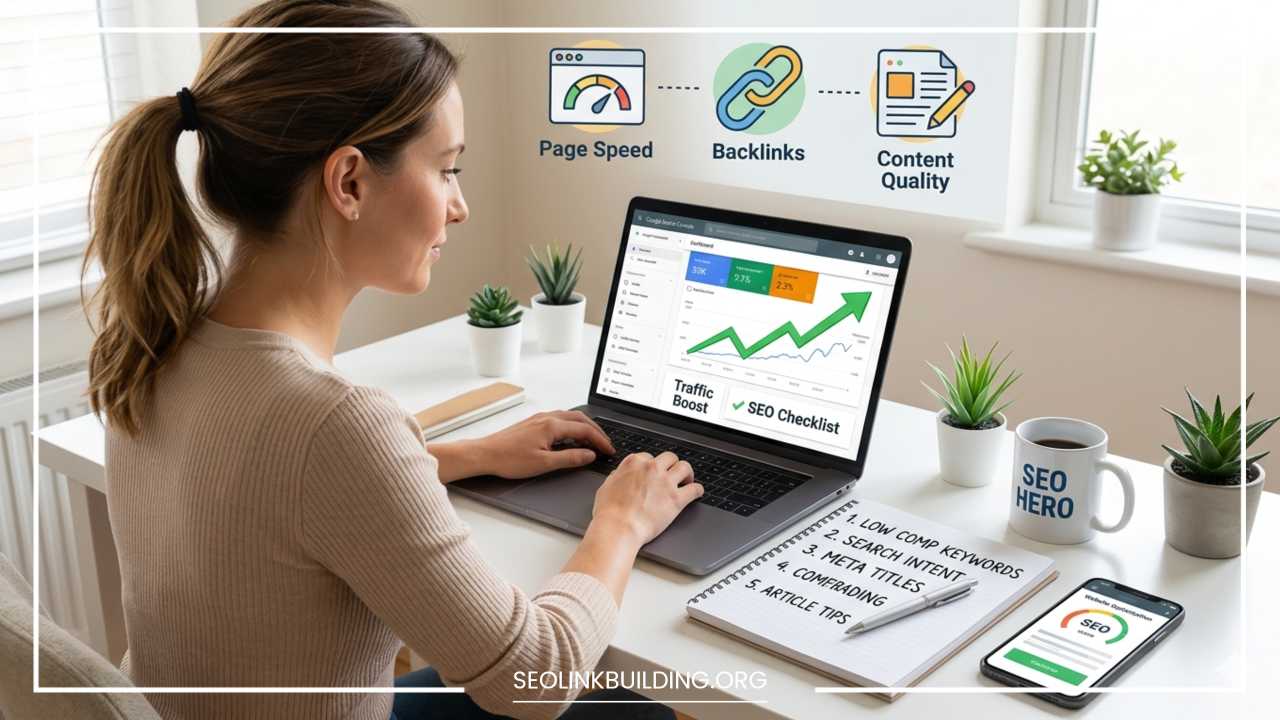
Example: If you have an image of a person checking a website’s analytics, your Alt Text should be “Person analyzing website traffic data for DIY SEO optimization.”
Tip #8: Improve Page Speed
We live in an age of instant gratification. If your website takes more than three seconds to load, you are likely losing half of your potential visitors. Google recognizes this and uses page speed as a significant ranking factor for both desktop and mobile.
Quick Wins for Speed
-
Use a Caching Plugin: If you use a platform like WordPress, a caching plugin creates a “static” version of your site for visitors, which loads much faster than generating the page from scratch every time.
-
Reduce Plugins: Every plugin you add to your site adds a bit of “weight” to the loading process. Delete any plugins you aren’t using.
-
Optimize Your Hosting: If you have done everything else and your site is still slow, it might be time to move away from the cheapest “shared” hosting plans to something more robust.
Improving your speed is a “technical” SEO task, but for most DIYers, it simply involves a few clicks in your website settings or installing a reliable optimization tool.
Tip #9: Update Old Content
This is perhaps the single fastest way to see a traffic spike. Many people think SEO is about constantly publishing new content. In reality, your old content is often a goldmine of untapped potential.
Why “Content Decay” Happens
Information becomes outdated. Links break. Competitors publish better versions of your topic. Over time, a post that used to rank #2 might slip to #12. This is called content decay.
How to Refresh Your Content
-
Check Analytics: Identify pages that used to get traffic but have started to decline.
-
Update Statistics: Replace any old data with current facts.
-
Add New Sections: Look at the “People Also Ask” boxes for that keyword and add answers to those questions in your post.
-
Improve the Media: Add a new video, infographic, or updated images.
-
Re-Promote: Once updated, change the “Last Updated” date and share it on your social channels again.
By showing Google that your content is fresh and accurate, you can often reclaim your top spots within days or weeks.
Tip #10: Make Content Easy to Read
User Experience (UX) is the new SEO. If people enjoy being on your site, they stay longer, share your content, and come back later. Google tracks these behaviors through “User Signals.” If people click your link and immediately leave, Google assumes your content is bad.
Formatting for the Modern Web
-
Short Paragraphs: Limit paragraphs to 2-3 sentences. Large blocks of text are intimidating on mobile screens.
-
Use Bullet Points: Like this list! Bullets help break up information and make key takeaways stand out.
-
Simple Language: Avoid jargon. Write as if you are explaining the topic to a friend. Tools like the Hemingway App can help you simplify your writing.
-
White Space: Don’t be afraid of “empty” space on your page. It gives the reader’s eyes a place to rest and makes the content feel less cluttered.
When you make your content easy to digest, you reduce your “Bounce Rate” and increase “Dwell Time,” both of which are powerful indicators to search engines that your site is a high-quality resource.
Bonus: Use Free SEO Tools
You don’t need to spend hundreds of dollars a month on software to succeed at DIY SEO. There are incredible free tools that provide almost everything a beginner needs.
-
Google Search Console (GSC): This is the most important tool you can use. It tells you exactly which keywords people are using to find your site, which pages are indexed, and if there are any technical errors.
-
Google Analytics: This helps you understand user behavior. Where do they come from? How long do they stay? Which pages do they love the most?
-
Ahrefs/Semrush Free Versions: While these are paid tools, they offer limited free versions that allow you to check your “domain authority” and see a snapshot of your backlinks.
-
Ubersuggest: A great tool for getting keyword ideas and seeing what your competitors are ranking for.
Using these tools turns “guessing” into “strategy.” Instead of writing what you think people want, you can see the data and write what people are actually searching for.
Common SEO Mistakes to Avoid
As you embark on your DIY SEO journey, be careful not to fall into these common traps that can actually lead to penalties from search engines:
-
Keyword Stuffing: This is the practice of repeating your keyword dozens of times in a way that sounds unnatural. Google is smart enough to know what your page is about; write for humans first, and machines second.
-
Ignoring Mobile Users: More than half of all web traffic comes from mobile devices. If your site looks broken or is hard to navigate on a phone, your rankings will suffer.
-
Not Tracking Results: If you don’t use tools like Google Search Console, you won’t know if your efforts are working. SEO is a game of data.
-
The “Post and Forget” Mentality: SEO is an ongoing process. You must monitor your rankings and be willing to tweak your content over time.
Final Thoughts
SEO can feel like a mountain, but you don’t have to climb the whole thing in one day. The beauty of DIY SEO is that it is incremental. Each small change—a better title, a faster image, a clearer heading—adds a layer of “trust” in the eyes of search engines.
You do not need an agency or a massive budget to start seeing your traffic numbers move upward. You simply need the discipline to apply these ten tips consistently.
Your Next Step: Don’t try to do all ten today. Pick two or three of the easiest tips—perhaps optimizing your existing titles or compressing your images—and implement them on your top five most important pages. Once you see the impact of those small changes, you will have the momentum you need to tackle the rest.