Competitor Backlink Analysis: 7 Steps to Steal Their Best Links
In the complex ecosystem of search engine optimization, one factor remains a cornerstone of success: the high-quality backlink. While search algorithms have evolved to prioritize user experience, mobile-first indexing, and topical authority, the backlink remains the ultimate “vote of confidence” in the eyes of search engines. It signals trust, credibility, and relevance. However, for many digital marketers and business owners, the process of link building feels like a shot in the dark—an endless cycle of sending emails into the void and hoping for a response.
The challenge is significant. Cold outreach often results in dismal response rates, and the mantra of “just create great content” is often insufficient. If no one discovers that content, no one can link to it. This is where the strategy of competitor backlink analysis changes the game. Instead of guessing which websites might be open to a partnership, you can look at exactly what is already working for the websites currently outranking you.
By reverse-engineering the backlink profiles of your competitors, you gain access to a proven roadmap. You can identify the exact domains that are willing to link to content in your niche, understand the specific types of media that attract those links, and uncover the unique promotional strategies your rivals are using to dominate the search engine results pages (SERPs). If a high-authority site linked to your competitor, there is a high probability they will link to you too—provided you offer something superior. This guide will walk you through a comprehensive, seven-step process to transform your competitors’ success into your own ranking advantage.
What Is Competitor Backlink Analysis?
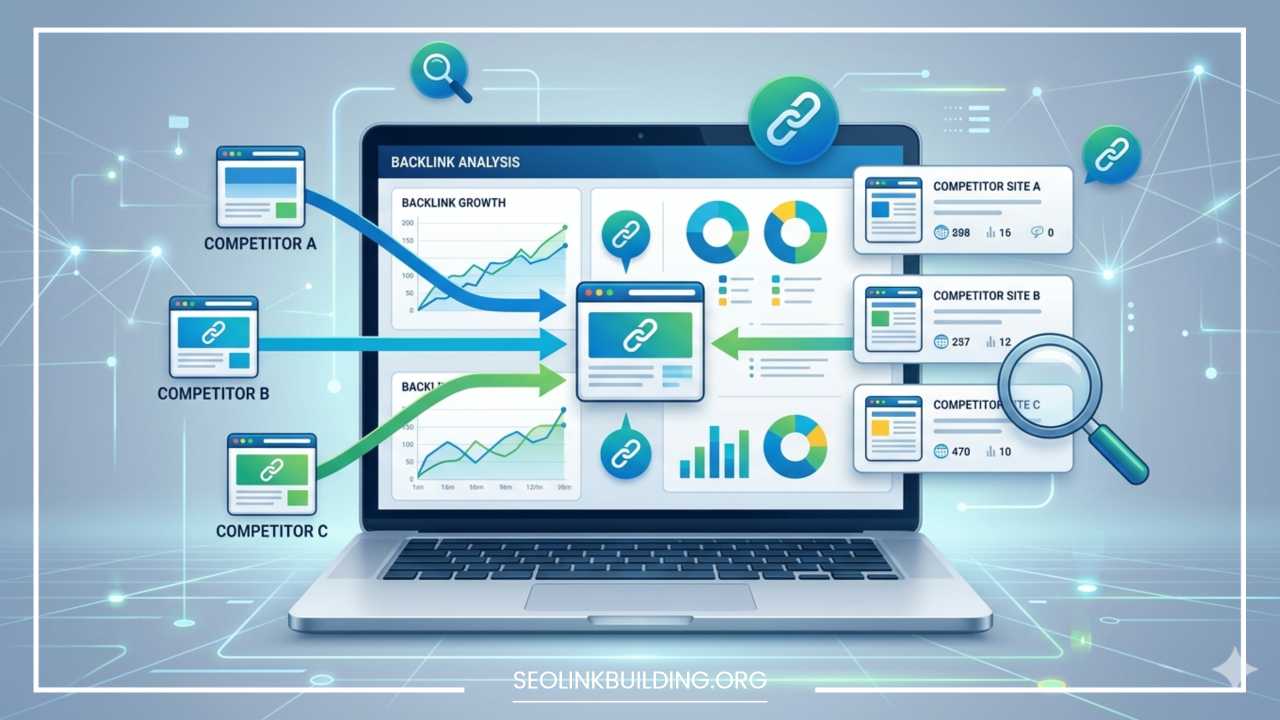
At its core, competitor backlink analysis is the process of identifying, evaluating, and cataloging the websites that link to your rivals. It is a form of digital intelligence gathering that allows you to see the “hidden” architecture behind a competitor’s search engine rankings. While you can easily see their front-end content, their backlink profile reveals the relationships, PR efforts, and authority-building tactics that happen behind the scenes.
To master this, you must first distinguish between two primary types of competitors:
Direct Competitors: These are businesses that sell the same products or services as you. If you sell organic coffee beans, another organic coffee retailer is a direct competitor. Their backlinks often come from industry-specific niche sites, local business directories, and specialized review blogs.
SEO Competitors: These are websites that may not sell what you sell but compete for the same keywords in search results. For example, a major food blog writing about “how to brew organic coffee” is an SEO competitor for your coffee shop. These sites often possess massive, diverse backlink profiles that can be incredibly valuable to analyze for high-authority editorial opportunities.
The beauty of this strategy lies in its logic. If a website has already linked to a competitor, they have signaled three things: they are interested in your topic, they frequently link out to external resources, and they are active participants in your industry’s digital conversation. Think of this process like spying on a rival restaurant’s supply chain. If you know which high-quality farm provides their produce and which food critic gave them a five-star review, you know exactly who you need to talk to in order to achieve similar—or better—success.
Benefits of Competitor Backlink Analysis
The primary benefit of this strategy is the removal of uncertainty. Link building is notoriously time-consuming; by focusing on your competitors’ “won” links, you are essentially skipping the trial-and-error phase of SEO.
1. Discover High-Quality Link Opportunities
You don’t just find any links; you find the links that are actually moving the needle. By filtering for the strongest links in a competitor’s profile, you can prioritize outreach to high-authority domains that have a direct impact on rankings, rather than wasting time on low-value directories.
2. Identify Content That Attracts Links
By seeing which specific pages on a competitor’s site have the most links, you identify “linkable assets.” If a competitor’s “State of the Industry” report has 500 backlinks from news sites, you know that original data is a high-value format in your niche. This allows you to plan your content calendar based on proven demand.
3. Understand Industry Link Patterns
Every industry has its own “link DNA.” Some niches, like software, rely heavily on integration pages and “Best Tools” lists. Others, like fashion or travel, are driven by influencer mentions and visual credit. Analysis reveals these patterns so you can adapt your strategy to match the expectations of your industry’s webmasters.
4. Save Time vs. Cold Outreach
Cold outreach is a numbers game with low yields. Competitor-based outreach is “warm” outreach. You aren’t asking a stranger if they might be interested in your topic; you are contacting someone who has already demonstrated interest in the topic by linking to a rival. This drastically increases your conversion rate.
Analysis provides a reality check. If the top three ranking sites have an average of 1,000 referring domains and you have 20, you have a clear understanding of the “authority gap” you need to close. This helps in setting realistic goals and managing stakeholder expectations regarding how long it will take to rank.
Tools You’ll Need
To perform a professional-grade analysis, you cannot rely on manual Google searches. You need specialized software that crawls the web and indexes billions of links to provide a structured view of the internet’s connectivity.
Essential Backlink Analysis Tools
Ahrefs: Often cited as the gold standard for backlink data. Its “Link Intersect” tool is specifically designed for this process, allowing you to see who links to multiple competitors but not to you.
SEMrush: An all-in-one suite that offers powerful backlink auditing and competitive intelligence. It’s particularly useful for seeing the growth trends of a competitor’s link profile over time.
Moz: Known for creating the Domain Authority (DA) metric. Its Link Explorer tool provides a clean, user-friendly interface for identifying high-value link prospects and analyzing anchor text distributions.
Ubersuggest: A more accessible, budget-friendly option that provides the essential backlink data required for smaller businesses to get started without a heavy monthly investment.
Critical Metrics to Understand
When diving into these tools, you must look beyond the “Total Backlinks” number, which can be easily inflated by spam. Instead, focus on:
Referring Domains: This is the most important metric. It represents the number of unique websites linking to your competitor. Ten links from one site are nowhere near as powerful as one link from ten different sites.
Domain Authority (DA) or Domain Rating (DR): This score (usually 0-100) estimates the “ranking power” of a domain. Targeting sites with a higher DA than your own is the fastest way to grow your own authority.
Anchor Text: This is the clickable text used in a link. Analyzing this tells you which keywords your competitors are trying to associate with their brand.
Link Placement: Is the link in the footer (low value), a sidebar (medium value), or in the middle of a high-traffic blog post (high value)?
Step-by-Step Process to Steal Their Best Links
Step 1: Identify Your Top Competitors
Success starts with accurate targeting. You don’t want to analyze every site in your industry; you want to analyze the ones that are currently winning the race.
Start by listing your top 10 “money keywords”—the terms that directly lead to sales or high-value leads. Search for these terms and note which domains consistently appear in the top three positions. Avoid “unreachable” competitors like Amazon, Wikipedia, or Pinterest. These sites rank due to their massive global scale and brand legacy. Instead, look for sites that are similar to yours in structure but are simply performing better. Aim to identify 3 to 5 core competitors. These sites represent the “attainable” standard you need to surpass.
Step 2: Analyze Their Backlink Profile
Once you have your core competitors, plug their URLs into your chosen tool. Your first goal is to get a “big picture” view of their strategy. Look at their link growth over the last year. Are they gaining links steadily, or did they have a massive spike? A spike often indicates a successful PR campaign or a viral piece of content that you can potentially emulate.
Export the “Referring Domains” list into a spreadsheet. This is your master prospect list. Don’t just look at the homepage; use the “Top Pages” report to see which specific blog posts, tools, or landing pages are responsible for the bulk of their authority. This tells you what kind of “bait” works best in your market.
Step 3: Find Their Best Backlinks
In any backlink profile, there is a lot of “noise”—low-quality scrapers, irrelevant directories, and forum spam. You want to filter this out to find the “signal.”
Apply filters to your list:
Link Type: Set to “Dofollow” only. These are the links that actually pass ranking power.
Domain Strength: Filter for sites with a DA/DR of 40 or higher.
Organic Traffic: This is a secret weapon. A link from a high-DA site that has zero organic traffic is often a sign of a “link farm.” Look for sites that Google clearly trusts enough to send traffic to.
The result is a curated list of high-authority, trustworthy sites that have a proven history of linking to your direct rivals. These are your primary targets.
Now you must perform a “content autopsy.” Visit the actual pages where the links live and determine how they were acquired. Categorizing them helps you understand the “mechanics” of your competitor’s success.
Guest Posts: Did the competitor write an article for this site? This tells you the site accepts outside contributors.
Resource Pages: Is the link on a “Top 10 Tools” or “Useful Links for Small Businesses” page? These are the easiest links to replicate.
Editorial Mentions: Is the competitor quoted as an expert? This suggests they are engaging in digital PR.
Link Gaps: Are there sites that link to all five of your competitors but not you? This is a “low-hanging fruit” opportunity; the site owner clearly likes the topic and is likely just unaware of your existence.
Step 5: Reverse Engineer Their Strategy
This step moves from data to psychology. Why did the site owner choose to link to your competitor?
Did they provide a unique statistic? If so, you need to conduct your own survey or data analysis.
Did they create a better visual? If their link comes from an infographic, you need a superior designer.
Is it a “Skyscraper” post? Did they simply write the longest, most detailed guide on the topic?
Look for the “hook.” If you can identify the specific value proposition that earned the link, you can create a superior version of that value.
Step 6: Replicate (and Improve) Their Links
This is the execution phase. Armed with your targets and your understanding of their strategy, you must now reach out. However, you cannot simply ask for a link; you must earn it by providing an upgrade.
The Upgrade: If a competitor has a “Guide to SEO,” make yours the “Interactive 5,000-Word Masterclass with Video Tutorials.”
The Outreach: Send a personalized email to the webmaster. Mention the specific page where they link to your competitor. Acknowledge the value of that link, but then gently introduce your resource as a more comprehensive or up-to-date alternative.
The Broken Link Method: If you find a site linking to a competitor’s page that no longer exists (404 error), you are doing the webmaster a favor by pointing it out and offering your live page as a replacement.
Step 7: Track & Scale Your Efforts
Link building is a long-term commitment. You must track your progress to see which outreach styles and content types are yielding the best results.
Use a simple CRM or spreadsheet to track:
Domain contacted
Contact person
The “hook” used
Outcome (Link acquired, rejected, or no response)
Over time, you will see patterns. Perhaps guest posting works better for you than resource page outreach. Double down on what works. As you gain authority, you will find that “stealing” links becomes easier because your own site starts to carry the same weight as the competitors you once studied.
Common Mistakes to Avoid
While competitor analysis is a shortcut to success, it is fraught with potential pitfalls for the unwary.
1. Chasing “Toxic” Links
Just because a competitor has a link doesn’t mean it’s helping them. Some competitors use “Black Hat” techniques like buying links from PBNs (Private Blog Networks). If you see a site with thousands of links from irrelevant, low-quality blogs with gibberish content, do not replicate them. Google will eventually catch and penalize these sites, and you don’t want to be caught in the crossfire.
2. Ignoring Contextual Relevance
Relevance is the most important factor in modern SEO. A link from a high-authority gardening site won’t help a software company rank for “cybersecurity.” Search engines look at the topical “neighborhood” of your links. If you replicate links that aren’t relevant to your niche, you are confusing the search engine about what your site is actually about.
3. Copying Without Adding Value
If you reach out to a webmaster and say, “You linked to Competitor A, here is my identical article,” they will ignore you. You are asking them to do work for no benefit. You must give them a reason to update their page. Your content must be more recent, more detailed, better designed, or provide a different perspective.
4. Over-Optimizing Anchor Text
If every link you “steal” uses the exact same keyword as the anchor text (e.g., “Best Pizza NYC”), it looks unnatural to Google’s algorithms. Real people link to things using brand names, URLs, or phrases like “click here” or “this study.” Aim for a natural, diverse anchor text profile.
5. Lack of Persistence
Most link-building campaigns fail not because the strategy is bad, but because the effort is insufficient. Link building has a low response rate. If you contact 10 sites, you might get zero links. If you contact 100, you might get five. You must scale your efforts to see real-world results.
To accelerate your progress and gain an edge over even the most established rivals, consider these advanced tactics.
1. Target “Link Gaps” First
Use a tool like Ahrefs Link Intersect to find websites that link to at least two or three of your competitors but not to you. These are the highest-probability targets in existence. The fact that they link to multiple people in your space proves they are not exclusive to one brand and are actively looking for resources in your niche.
2. Monitor New Links in Real-Time
Don’t just look at historical data. Set up “Backlink Alerts” for your competitors. Whenever they get a new link, you’ll get an email. This allows you to reach out to the same journalist or blogger while the topic is still fresh in their mind. If they just wrote about your competitor’s new product, they might be interested in a “comparison” piece or a follow-up story featuring your brand.
3. Build Relationships, Not Just Links
The most powerful links come from long-term partnerships. Instead of a one-off outreach email, engage with the prospect on social media. Comment on their blog posts. Share their content. By the time you ask for a link or a guest post opportunity, you aren’t a stranger; you’re a recognized member of their community.
4. Use the “Moving Man” Method
Watch for competitors who are rebranding, changing their URL, or shutting down a specific service. When this happens, all their old backlinks will eventually break or point to irrelevant pages. This is the perfect time to reach out to every site linking to that old URL and offer your current, working page as the “new and improved” destination for their readers.
Example Scenario: The Boutique Agency
Let’s look at a hypothetical case study to see these seven steps in action. Suppose you run a boutique digital marketing agency specializing in “Eco-Friendly Packaging.” You are currently on page 4 of Google for your target keyword.
Identify: You find three competitors ranking on page 1.
Analyze: You see one competitor has 45 links from high-end design blogs.
Find the Best: You filter and find that 12 of those links are from “Sustainability Awards” pages.
Categorize: You realize these are “Resource Page” links where the competitor is listed as a top provider.
Reverse Engineer: The competitor got these links because they created a free “Sustainable Packaging PDF Checklist” for designers.
Replicate & Improve: You create a “Sustainable Packaging 101” interactive tool that calculates the carbon footprint of different materials. It is far more useful than a static PDF. You reach out to the 12 design blogs and 40 more like them.
Track & Scale: You gain 15 new high-authority links over two months.
The Result: Because these links come from highly relevant, high-authority design and sustainability sites, your rankings jump from page 4 to the bottom of page 1. You have successfully “stolen” the authority of your competitor’s best sources.
Final Thoughts
Competitor backlink analysis is the most practical, data-driven way to grow your website’s authority and search engine rankings. It moves SEO out of the realm of “magic” and into the realm of strategic intelligence. By understanding that your competitors have already done the hard work of finding willing link partners, you can focus your energy on creating superior content and building better relationships.
The digital landscape is a competition for attention and trust. Links are the currency of that trust. Don’t waste another day wondering how your rivals are outranking you—look at their links and find out for sure. The roadmap to the top of the search results is hidden in plain sight within their backlink profiles.
Your next move is simple: pick one competitor today. Identify their top three most linked-to pages. Spend the next week creating something twice as good, and then reach out to the people who linked to them.