Common SEO Mistakes You Should Avoid

Common SEO Mistakes You Should Avoid
In the digital world, a website is a business’s storefront, and Search Engine Optimization (SEO) is the essential marketing engine that drives traffic to it. Without a robust SEO strategy, even the most beautifully designed and functional website can become a digital ghost town, lost in the vast expanse of the internet. For many businesses, organic search is the most sustainable, cost-effective, and highest-converting source of traffic. It establishes authority, builds trust, and ultimately fuels long-term growth.
Yet, despite its critical importance, countless websites fail to achieve their potential because of easily avoidable errors. These aren’t just minor missteps; they are fundamental flaws that can actively tank rankings, lead to algorithmic penalties, and waste valuable time and resources. From neglecting the basic hygiene of keyword research to making critical technical blunders, these common SEO mistakes act as silent saboteurs. This comprehensive guide will dissect the most prevalent pitfalls and provide a clear, actionable roadmap to help you diagnose, fix, and ultimately, future-proof your website’s search performance. By understanding these mistakes, you can transition from struggling to survive to truly thriving in the search rankings.
Ignoring Keyword Research
The foundation of every successful SEO campaign is meticulous keyword research. This process isn’t just about finding words; it’s about understanding the language, intent, and needs of your target audience. Unfortunately, ignoring keyword research is one of the most destructive SEO mistakes a business can make. It’s akin to opening a store without knowing what products your customers want to buy or what language they speak.
A common pitfall is chasing overly competitive keywords. These are high-volume, generic terms (like “best coffee” or “digital marketing”) dominated by large, established authorities. A new or small website has virtually no chance of ranking for these, leading to wasted content creation and zero traffic. Conversely, another mistake is focusing on irrelevant keywords—terms that bring traffic but not customers. If you sell high-end watches and rank for “cheap digital clocks,” your traffic will spike, but your conversions will be nil, increasing your bounce rate and signaling to search engines that your content doesn’t satisfy the user’s intent.
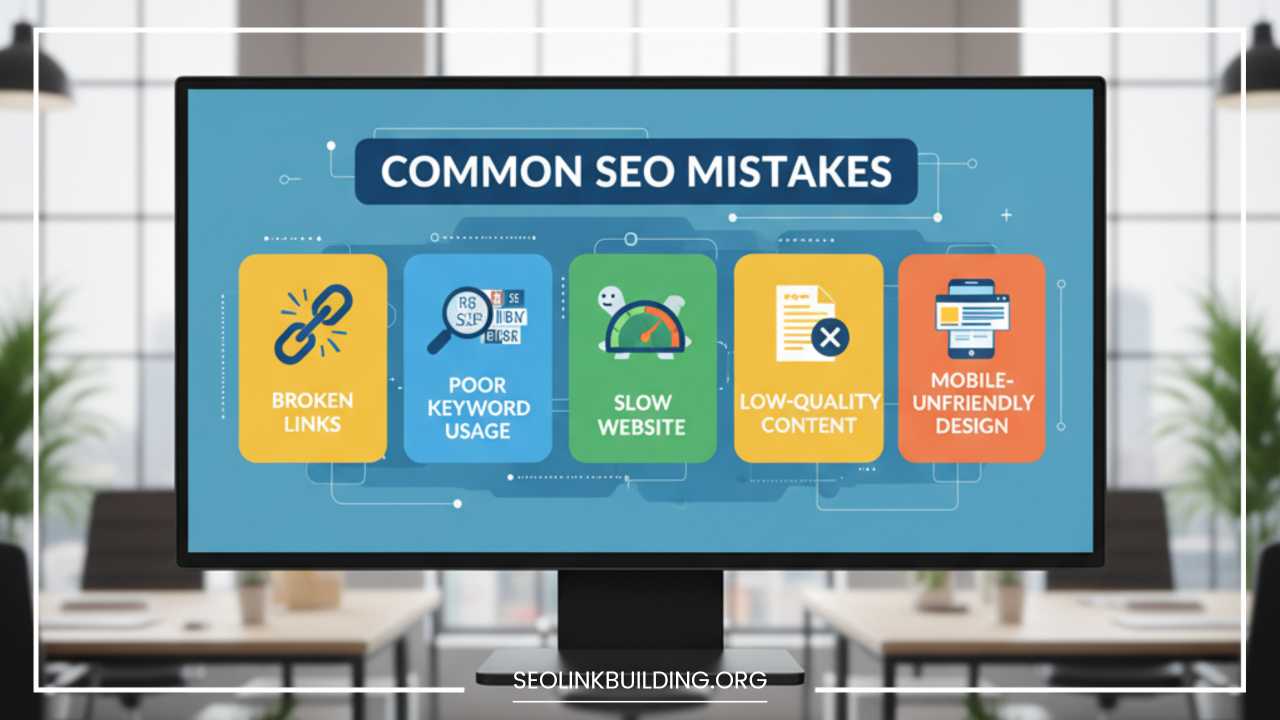
The goal is to find long-tail keywords—longer, more specific phrases (e.g., “manual-wind automatic movement watch repair London”)—that have lower competition, higher conversion rates, and clear user intent. To avoid this foundational mistake, one must use dedicated tools like Google Keyword Planner, Ahrefs, or SEMrush. These tools reveal search volume, competition score, and the cost-per-click, allowing you to prioritize terms that align with your business goals. For example, a wrong keyword strategy might target “yoga.” A right keyword strategy would target “benefits of vinyasa yoga for lower back pain.” The latter is specific, intent-driven, and far more likely to convert. Skipping this crucial step dooms your content before you even write the first word.
Poor On-Page SEO
On-page SEO refers to optimizing the elements on a webpage itself to help search engines understand its content and relevance. Poor on-page optimization is a pervasive mistake that creates unnecessary roadblocks for both search engine crawlers and human users.
The most visible errors often lie in title tags and meta descriptions. The title tag is the most critical on-page ranking factor, yet many sites use duplicates across multiple pages or simply ignore them, letting the search engine generate a bland default. Similarly, the meta description, while not a direct ranking factor, is your site’s advertisement in the search results. A missing or generic description means a lost opportunity to improve your Click-Through Rate (CTR). Every page must have a unique, compelling title tag (containing the primary keyword near the front) and a persuasive meta description.
Another critical mistake is the misuse or outright skipping of header tags ($H1$, $H2$, $H3$ etc.). The $H1$ tag should be reserved for the main topic of the page, acting as the title of your article. Subsequent $H2$ tags should break the content into main sections, and $H3$ tags for subsections, creating a clear, logical hierarchy. Ignoring this structure makes the content difficult to scan and signals to Google that the content lacks organization.
Furthermore, a poor URL structure is a common blunder. Long, messy URLs filled with dates, parameters, and special characters (e.g., www.site.com/p=123&cat=blog?date=2023) are difficult for users to remember and less informative for search engines. The fix is clean, keyword-friendly URLs that are short and descriptive (e.g., www.site.com/seo-mistakes-avoid).
Finally, Image SEO is frequently overlooked. Large, unoptimized image file sizes dramatically slow down your page load speed—a major ranking factor. Worse, failing to include descriptive alt tags makes your images inaccessible to visually impaired users and prevents search engines from understanding the image content. Every image must be compressed and feature a relevant alt text that describes the image and, where appropriate, incorporates a target keyword.
Thin or Low-Quality Content
In the modern SEO landscape, content is king, but it must be high-quality, comprehensive, and genuinely valuable to the reader. One of the biggest mistakes a site can make is publishing thin or low-quality content. Thin content is characterized by a lack of depth, insufficient word count to cover a topic adequately, and offering no unique value compared to competitors. Google’s algorithms, particularly updates focused on E-E-A-T (Experience, Expertise, Authoritativeness, and Trustworthiness), actively penalize websites that fail to provide substantive value.
A related and highly detrimental mistake is keyword stuffing. This is the outdated practice of unnaturally shoehorning a target keyword into the text dozens of times in the desperate hope of ranking higher. Modern search engines are sophisticated enough to recognize this manipulative tactic. It makes the content unreadable for humans and can trigger manual or algorithmic penalties, signaling to Google that you are prioritizing search rankings over user experience. The key is to use keywords naturally and incorporate LSI (Latent Semantic Indexing) keywords—related terms and synonyms—to establish topical authority.
Duplicate content penalties are another risk. This occurs when identical or nearly identical content appears on multiple pages on the same website or is copied wholesale from another website. Google struggles to determine which page is the original, potentially leading to neither page ranking well. While some duplication (like boilerplate text) is unavoidable, large-scale content duplication should be resolved using canonical tags to point search engines to the preferred, original source.
Content that works is in-depth (often 1500+ words for competitive topics), original, thoroughly researched, and written by an identifiable author with expertise. It completely satisfies the user’s search intent. Content that fails is a short, surface-level rehash of information found everywhere else, offers no unique perspective, and focuses solely on selling rather than solving a problem. Prioritizing genuine user value over simple keyword counts is the only sustainable content strategy.
Ignoring Technical SEO
Technical SEO refers to optimizing the infrastructure of your website to help search engine crawlers find, crawl, interpret, and index your content efficiently. Ignoring technical SEO is like building a skyscraper on a cracked foundation—it’s destined to collapse, regardless of how good the interior design (content) is.
One of the most critical factors is site speed and performance. Slow-loading sites deliver a terrible user experience, leading to high bounce rates and low engagement. Since page speed is a confirmed ranking factor, a site that takes more than three seconds to load is actively hurting its rankings. Mistakes include unoptimized code, excessive plugins, and massive image files. Fixing this requires tools like Google PageSpeed Insights and judicious server-side optimization.
Another non-negotiable mistake is a lack of mobile-friendliness. Given that most search traffic now comes from mobile devices, a website that isn’t fully responsive and doesn’t display correctly on a small screen will be heavily penalized by Google’s mobile-first indexing. Your site must adapt seamlessly to any screen size.
Websites also often suffer from broken links ($404$ errors) and crawl errors. Broken internal or external links lead crawlers to dead ends, wasting their crawl budget and frustrating users. Regular audits are necessary to fix these. Furthermore, sitemap and robots.txt mismanagement is a critical error. The sitemap is the map that guides Google to all your important pages, and the robots.txt file tells crawlers what not to crawl (e.g., admin pages). Blocking important pages in the robots.txt or failing to update the sitemap prevents pages from being indexed.
Finally, the switch from HTTP to HTTPS is no longer optional. HTTPS provides security (via an SSL certificate) and is a confirmed, albeit minor, ranking factor. Sites still operating on the less secure HTTP protocol create a significant barrier to trust for both users and search engines. Technical errors create barriers that even the best content can’t overcome.
Poor Internal Linking
Internal linking is the process of linking from one page to another on the same domain. This practice is critical for three main reasons: it helps users navigate the site, it spreads PageRank (or “link equity”) throughout the site, and it helps search engines discover new pages and understand the contextual relationship between different pieces of content. Poor internal linking is a silent killer of SEO success.
A major common mistake is the existence of orphan pages. These are pages that have no internal links pointing to them. To a search engine crawler, an orphan page is invisible, as the crawler has no path to discover it. Such pages will almost certainly never rank, despite their high-quality content. Sites must ensure that every important page is linked to from at least one other relevant, authoritative page.
Another error is having too many or too few links. A page that offers no outbound links is a dead end for the user and prevents the flow of link equity. Conversely, stuffing a page with hundreds of links can overwhelm crawlers and dilute the value of each link. The best practice is to place internal links strategically in the body of the text, only when they are contextually relevant.
Finally, anchor text best practices are often ignored. The anchor text is the visible, clickable text of a hyperlink. A mistake is using generic anchor text like “click here” or “read more.” The best practice is to use descriptive and keyword-rich anchor text that tells the user and the search engine exactly what the destination page is about (e.g., linking the phrase “technical SEO audit” to a technical SEO guide). Thoughtful internal linking can transform a collection of individual pages into a structured, powerful entity.
Neglecting Off-Page SEO
While on-page and technical SEO are about making your own site perfect, Off-Page SEO is about establishing your site’s authority and trustworthiness in the wider digital ecosystem, primarily through backlinks. Neglecting Off-Page SEO means surrendering the competition for authority.
The quality of your backlinks is paramount. A critical mistake is focusing on the sheer quantity of links over their quality. A site with fifty low-quality backlinks (e.g., links from spammy, irrelevant, or penalized websites) is far worse off than a site with five high-quality, authoritative links (e.g., links from established industry leaders, news sites, or universities). Low-quality links can actively harm your site’s ranking and signal to Google that your site is engaging in manipulative practices. The focus must be on earning links through genuine content marketing, outreach, and providing unique value.
Another common oversight is ignoring brand mentions and social signals. While a social media “like” or share isn’t a direct ranking factor, these signals indicate content engagement and can drive traffic, which Google does measure. Furthermore, monitoring unlinked brand mentions—instances where your brand name is mentioned on another site without a hyperlink—and then reaching out to convert those into active backlinks is a highly effective, low-risk strategy that is often neglected.
The biggest off-page mistake is engaging in Black-hat link building risks. This includes buying links, participating in link schemes, or using private blog networks (PBNs). While these tactics may offer a temporary ranking boost, they are easy for Google to detect and almost always result in a severe algorithmic or manual penalty that can take months or years to recover from. Sustainable SEO relies solely on ethical, white-hat link acquisition.
Ignoring User Experience (UX) & Engagement Metrics
Google’s ultimate goal is to satisfy the user, and its ranking factors increasingly reflect this. Therefore, ignoring User Experience (UX) is no longer just a design mistake; it’s a critical SEO failure. Search engines measure how users interact with your site after clicking a search result, and these engagement metrics heavily influence rankings.
Key engagement metrics include bounce rate, dwell time, and Click-Through Rate (CTR). A high bounce rate (users leaving quickly after viewing only one page) and a low dwell time (users spending very little time on the page) signal to Google that the content did not satisfy the user’s query. This almost always leads to a drop in rankings. Conversely, a high CTR in the search results (driven by compelling title tags and meta descriptions) signals relevance and can boost rankings.
Poor navigation is a primary cause of bad UX. If users can’t easily find what they are looking for, they’ll leave. The site architecture should be intuitive, with clear menus, breadcrumbs, and a robust search function.
Aggressive, disruptive elements like intrusive pop-ups and ads also hurt UX and, in some cases, can trigger penalties, especially on mobile devices. While lead generation is important, the execution must be non-intrusive and compliant with Google’s guidelines. The importance of intuitive design for SEO cannot be overstated. A clean, fast, easily navigable website that makes the content easy to consume is a positive signal to search engines. Essentially, if a human user hates your site, Google will eventually figure that out and rank you lower.
Failing to Track SEO Performance
SEO is not a “set it and forget it” endeavor; it requires continuous monitoring, analysis, and adjustment. One of the most common and costly mistakes is failing to track SEO performance and relying on guesswork. Without data, you can’t identify what’s working, what’s broken, or which changes have had a positive or negative impact.
The two indispensable tools for any website owner are Google Analytics and Google Search Console (GSC).
Google Analytics provides crucial data on user behavior, including traffic sources, bounce rates, time on page, and conversions. Failure to properly install and configure Analytics means operating blind, unaware of where your valuable organic traffic is coming from and what those users do once they arrive.
Google Search Console is the direct line of communication with Google. It alerts you to critical issues like security problems, manual penalties, crawl errors, mobile usability issues, and most importantly, it shows you which queries people are using to find your site, which pages are indexed, and your average position in search results. The common mistake is neglecting to check GSC regularly.
The biggest tracking mistake is not monitoring rankings, traffic, or conversion. By failing to use this data to perform simple audits, sites often repeat mistakes or miss opportunities. For example, GSC might show a page is ranking $11th$ for a high-volume keyword. The data-driven fix would be to optimize the title tag and meta description to improve the CTR and push it onto the first page. Data should be the engine that drives your iterative SEO improvements.
Final Thoughts
The landscape of SEO is complex and ever-changing, but the foundation of success lies in avoiding the critical mistakes outlined here. The most critical mistakes are consistently rooted in two areas: neglecting the user (through poor UX and low-quality content) and failing to address technical fundamentals (slow speed, poor on-page optimization, and broken technical infrastructure).
To move forward, encourage readers to audit their site immediately. Start with technical fixes: speed, mobile-friendliness, and crawl errors. Then, focus on content: make it valuable, unique, and comprehensive. Finally, commit to a sustainable off-page strategy that earns, not buys, authoritative links. SEO is a marathon, not a sprint, and avoiding these common pitfalls is the surest way to ensure your website has the longevity and authority needed to dominate the search results for years to come. Start your audit today; the rankings you save will be your own.