Push vs. Pull Marketing

Push vs. Pull Marketing: A Strategic Guide to Reaching Your Audience
1. Introduction
In the dynamic world of marketing, businesses constantly seek effective strategies to connect with their target audience and drive sales. The sheer volume of available approaches can be overwhelming, making the choice of the right marketing strategy a critical determinant of success. At its core, marketing involves communicating value to potential customers, but how this communication is initiated and received defines two fundamental methodologies: push and pull marketing.
This article will delve into the distinct characteristics, applications, and benefits of both push and pull marketing, offering a comprehensive understanding of when and how to leverage each for optimal results. We will explore their core definitions, key differences, advantages and disadvantages, real-world examples, and ultimately, how to integrate them into a powerful, balanced marketing strategy.
2. What is Push Marketing?
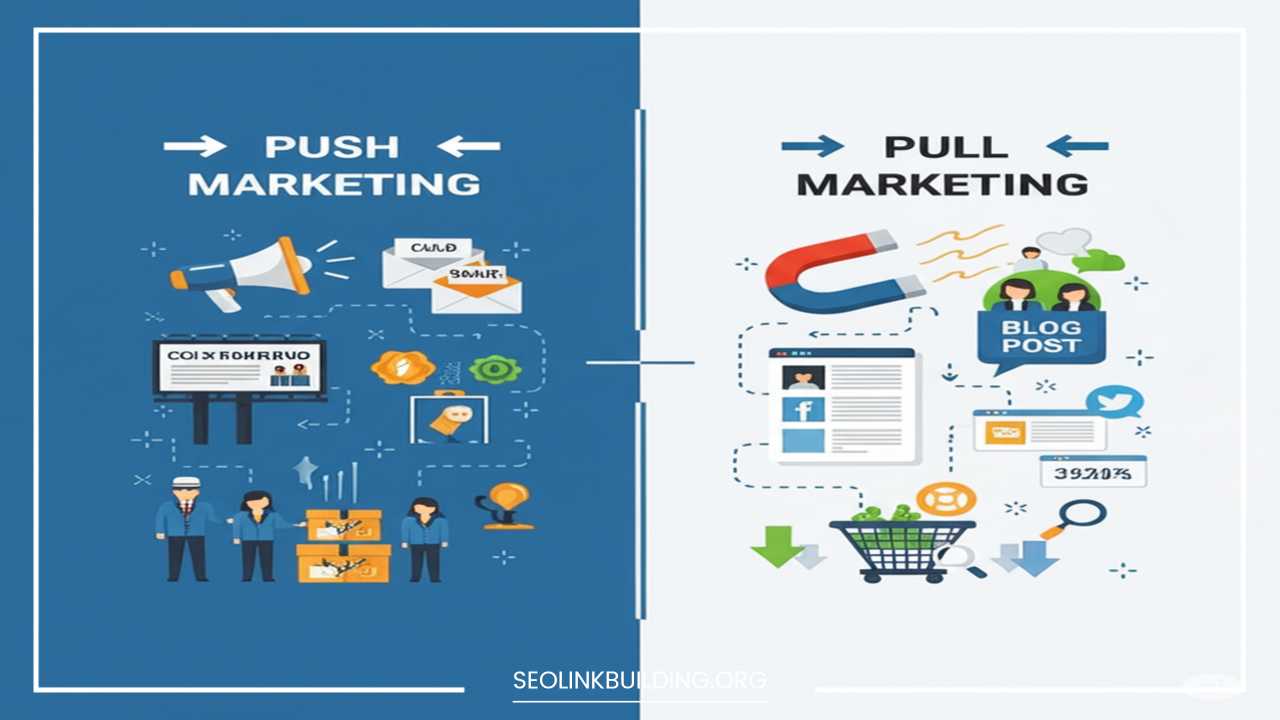
Push marketing is a proactive marketing strategy where businesses “push” their products or services directly to consumers, often without them actively seeking out the offering. The primary aim is to create demand by bringing the product to the customer rather than waiting for the customer to come to the product.
Key characteristics of push marketing include its direct nature, often relying on interruption to capture attention. It’s typically characterized by a top-down approach, where the company controls the message and its distribution.
Common tactics employed in push marketing are varied and often involve traditional advertising channels. These can include trade shows and exhibitions, where businesses showcase their products directly to potential buyers; direct sales, through telemarketing or door-to-door sales; email marketing, sending promotional messages to a curated list; and display ads, such as banner ads on websites or traditional print advertisements. Other forms include TV and radio commercials, billboards, and direct mail.
The target audience approach in push marketing is often broad, aiming to reach as many potential customers as possible within a defined demographic or geographic area. It’s about broadcasting a message to generate immediate interest and action.
Businesses typically employ push marketing in specific scenarios. It’s highly effective for product launches, especially for new or innovative products that consumers may not be actively searching for yet. It’s also frequently used for inventory clearance or when a business needs to move products quickly, as it can generate rapid sales. Furthermore, for businesses operating in highly competitive markets with similar products, aggressive push marketing can help differentiate and gain market share.
3. What is Pull Marketing?
In contrast to push marketing, pull marketing is a reactive strategy designed to attract customers to a product or service through valuable content and engaging experiences. Instead of directly pushing an offering, pull marketing aims to “pull” customers in by making them actively seek out the brand and its solutions. The underlying philosophy is to create demand by being easily discoverable and providing solutions to consumer problems.
Key characteristics of pull marketing revolve around its inbound nature. It’s customer-centric, focusing on building relationships and providing value before a purchase is made. It emphasizes organic reach and a softer, more subtle approach to persuasion.
Common tactics for pull marketing are primarily digital and content-driven. These include Search Engine Optimization (SEO), which involves optimizing website content to rank higher in search engine results, making the brand more visible to those actively searching for relevant information. Content marketing, through blogs, articles, videos, e-books, and webinars, provides valuable information that addresses customer needs and pain points. Social media marketing leverages platforms to engage with audiences, share content, and build communities. Influencer marketing, where brands collaborate with individuals who have a strong following, taps into existing trust and credibility. Other pull tactics include public relations, online reviews, and referral programs.
How pull marketing builds long-term brand loyalty is a core differentiator. By consistently providing value and solving problems, businesses establish themselves as trusted authorities and go-to resources. This builds a foundation of credibility and rapport that fosters enduring relationships beyond a single transaction. Consumers who discover a brand through their own research and positive experiences are more likely to become repeat customers and brand advocates.
Pull marketing is most effective in several situations. It’s particularly powerful for brand building, establishing a strong reputation and thought leadership over time. In highly competitive markets where products are similar, pull marketing helps a brand stand out by offering unique insights and a superior customer experience. It’s also ideal for products or services with a longer sales cycle, where customers need to conduct extensive research before making a decision. Businesses looking to cultivate a loyal customer base and reduce reliance on constant advertising expenditure find pull marketing to be a sustainable and highly rewarding approach.
4. Key Differences Between Push and Pull Marketing
Understanding the fundamental distinctions between push and pull marketing is crucial for crafting an effective overall strategy. While both aim to generate sales, their approaches, timings, and impacts on the customer journey are markedly different.
Here’s a side-by-side comparison:
| Feature | Push Marketing | Pull Marketing |
| Customer Engagement | Interruptive; initiates contact | Attracts; customer initiates contact |
| Timing | Immediate; short-term focus | Gradual; long-term focus |
| Strategy | Outbound; broadcast message | Inbound; content-driven, value-centric |
| Cost | Can be high (e.g., ad spend, sales force) | Can be lower in the long run (content creation) |
| Scalability | Often requires increased budget for wider reach | Scales with content reach and organic visibility |
| Sales Funnel Impact | Drives initial awareness and consideration | Nurtures leads, builds trust, drives conversions |
| Outcome Focus | Short-term sales, quick adoption | Long-term brand loyalty, sustained growth |
Differences in Customer Engagement: Push marketing is inherently more interruptive. It pushes information out to potential customers, often without their explicit invitation, such as a cold call or a pop-up ad. Conversely, pull marketing empowers the customer to seek out information, drawing them in through valuable content that addresses their needs.
Timing: Push marketing often seeks immediate results, aiming for quick sales or product awareness within a short timeframe. Pull marketing, on the other hand, is a long-game strategy, requiring time to build trust, authority, and organic reach, with benefits compounding over the long term.
Strategy: Push is an outbound strategy, sending messages outwards to a broad audience. Pull is an inbound strategy, creating resources and content that draw customers inward.
Cost: While push marketing can deliver quick results, it often comes with a higher upfront cost, especially for paid advertising and sales force deployment. Pull marketing’s initial investment might be in content creation and SEO, which can be less expensive per lead in the long run, as content continues to attract customers long after its creation.
Scalability: Scaling push marketing often means increasing ad spend or sales force size, which can be linearly expensive. Pull marketing scales more organically; once valuable content is created and optimized, it can attract an ever-growing audience with diminishing marginal costs.
How they impact the sales funnel differently: Push marketing primarily impacts the top of the sales funnel by generating initial awareness and interest. It’s about getting the product in front of as many eyes as possible. Pull marketing, however, influences all stages of the funnel. It attracts prospects at the awareness stage, nurtures them with valuable content during consideration, and builds trust that can lead to conversion and even advocacy.
Short-term vs. long-term outcomes: Push marketing excels at delivering short-term sales boosts, ideal for product launches or clearing inventory. Pull marketing focuses on building enduring relationships, brand equity, and a sustainable customer base that drives long-term, organic growth.
5. Advantages and Disadvantages of Each
Both push and pull marketing strategies offer distinct benefits and drawbacks. Understanding these can help businesses make informed decisions about which approach, or combination, best suits their objectives.
Push Marketing Pros:
- Quick Results: Push marketing can generate immediate sales and awareness, making it ideal for new product launches or urgent inventory clearance. Campaigns can be set up and executed relatively quickly, leading to rapid market penetration.
- Easy to Track: Many push marketing tactics, particularly digital advertising, offer robust analytics and reporting. Marketers can easily track impressions, clicks, conversions, and return on investment (ROI), allowing for quick optimization.
- Good for Launching New Products: When consumers aren’t actively searching for a new product, push marketing allows businesses to introduce it directly to a wide audience, educating them about its benefits and creating initial demand. This is especially true for innovative products that may not have existing search volume.
- Direct Control of Message: Businesses have full control over the message, timing, and audience segmentation, allowing for highly targeted and consistent communication.
Push Marketing Cons:
- Expensive: Many push marketing channels, such as traditional advertising (TV, print) and large sales teams, can be very costly, especially for sustained campaigns. Digital ads also require significant budgets for competitive keywords and placements.
- Can Feel Intrusive: Because it often interrupts the consumer’s experience (e.g., pop-up ads, telemarketing calls), push marketing can be perceived as annoying or intrusive, potentially leading to negative brand sentiment.
- Less Brand Loyalty: While effective for immediate sales, push marketing doesn’t inherently build deep brand loyalty or trust. Customers might buy due to exposure or immediate need rather than a strong connection with the brand.
- Ad Fatigue: Consumers can become desensitized to constant advertising, leading to reduced effectiveness over time, known as “ad fatigue.”
Pull Marketing Pros:
- Builds Brand Trust and Credibility: By providing valuable content and solving customer problems, pull marketing establishes a brand as a trusted authority and thought leader, fostering long-term relationships and credibility.
- Long-Term Benefits: The assets created through pull marketing (e.g., blog posts, SEO rankings, social media followers) continue to attract and engage customers long after their initial creation, providing sustained lead generation and brand visibility.
- More Organic Engagement: Customers who find a brand through pull marketing are often more genuinely interested and engaged, as they are actively seeking solutions or information. This leads to higher quality leads and more meaningful interactions.
- Cost-Effective in the Long Run: While initial content creation can be an investment, the cumulative effect of organic traffic and inbound leads can be significantly more cost-effective than continuous paid advertising.
- Improved Customer Experience: By focusing on providing value and solving problems, pull marketing naturally leads to a more positive and helpful customer journey.
Pull Marketing Cons:
- Takes Time to See Results: Building organic search rankings, cultivating a social media following, and establishing content authority takes significant time and consistent effort. Short-term ROI can be difficult to measure.
- Harder to Measure Short-Term ROI: While long-term benefits are clear, directly attributing specific content pieces to immediate sales can be challenging. ROI is often measured through broader metrics like lead generation, website traffic, and brand sentiment.
- Requires Strong Content Strategy: Effective pull marketing demands a well-defined and consistently executed content strategy. This requires understanding the target audience’s needs, creating high-quality, relevant content, and optimizing it for discoverability.
- Competitive Content Landscape: The digital space is saturated with content. Standing out and achieving visibility requires significant effort and expertise in content creation and promotion.
6. Real-World Examples
To truly grasp the essence of push and pull marketing, examining real-world applications provides invaluable insight. Many successful companies strategically employ one or both approaches to achieve their marketing objectives.
Case Study of Push Marketing: Coca-Cola’s Aggressive Distribution and Display Ads
Coca-Cola is a quintessential example of a company that historically masters push marketing. Their strategy hinges on making their product ubiquitous and instantly recognizable.
- Aggressive Distribution: Coca-Cola’s unparalleled distribution network ensures that its products are available virtually everywhere – from major supermarkets and convenience stores to vending machines in remote locations and small local shops. This aggressive “push” into every possible sales point means consumers are constantly exposed to the product. They don’t have to seek out a Coca-Cola; it’s simply there.
- Prominent Display Ads and Merchandising: Beyond distribution, Coca-Cola invests heavily in point-of-sale displays, large-scale outdoor advertising (billboards), and frequent television commercials. These highly visible and repetitive advertisements “push” the brand and its latest campaigns directly into the consumer’s consciousness, often creating an immediate desire or reminding them of the product’s availability. This strategy aims for widespread awareness and impulsive purchases.
Case Study of Pull Marketing: HubSpot’s Content Marketing and SEO Dominance
HubSpot, a leading developer and marketer of software products for inbound marketing, sales, and customer service, is an exemplary case of a company built on pull marketing.
- Content Marketing as a Core Strategy: HubSpot’s entire business model is predicated on attracting customers through valuable content. Their blog is a veritable encyclopedia of marketing, sales, and customer service advice, covering everything from “What is SEO?” to “How to Close a Sale.” They consistently publish high-quality articles, e-books, webinars, and templates that solve real problems for their target audience – marketers and business owners.
- SEO Dominance: By consistently producing comprehensive and keyword-optimized content, HubSpot ranks highly for thousands of relevant search terms. When a business owner searches for “lead generation strategies” or “CRM software comparison,” HubSpot’s content frequently appears at the top, pulling in organic traffic from individuals actively seeking solutions. This positions HubSpot as a trusted resource, ultimately leading them to consider HubSpot’s software as a solution. This strategy builds long-term trust and organically draws in qualified leads.
Hybrid Strategies in Practice: Apple’s Integrated Approach
Apple masterfully blends both push and pull marketing to create immense brand loyalty and demand.
- Push Elements (Product Launches & Advertising): Apple employs significant push tactics during product launches. Highly secretive, theatric launch events (e.g., iPhone keynotes) generate massive media buzz and direct consumer attention. Their high-budget, emotionally resonant advertising campaigns (TV commercials, billboards) “push” the aspirational lifestyle associated with their products, often showcasing features and benefits directly. This creates immediate excitement and a strong desire to acquire the latest device.
- Pull Elements (Brand Experience & Ecosystem): Simultaneously, Apple leverages powerful pull strategies. Their focus on intuitive user experience, elegant design, and a seamless ecosystem (iCloud, App Store, Apple Music) pulls customers in and keeps them loyal. The vibrant Apple community, strong customer service, and the premium perception of the brand make customers actively seek out Apple products and services. The desire to remain within the Apple ecosystem and the positive word-of-mouth among users act as strong pull factors. They don’t just sell phones; they sell an experience and a community, which pulls customers in and retains them.
By strategically combining the immediate impact of push marketing with the long-term relationship building of pull marketing, companies like Apple achieve sustained success and market leadership.
7. When to Use Push vs. Pull Marketing
Deciding between push and pull marketing, or more commonly, the optimal blend of both, depends on a variety of factors unique to each business and its objectives. There’s no one-size-fits-all answer, and a strategic approach considers budget, business stage, audience, and specific goals.
Factors to Consider:
- Budget: Push marketing, especially through paid advertising, often requires a larger upfront investment for immediate impact. Pull marketing, while potentially less expensive in the long run, demands a sustained investment in content creation and SEO.
- Business Stage:
- New Businesses/Product Launches: Often benefit from an initial push to generate awareness and trial, especially if the product is innovative or unfamiliar.
- Established Businesses/Brand Building: Can leverage pull strategies to deepen customer relationships, reinforce brand authority, and sustain organic growth.
- Audience:
- Impulse Buyers/Problem-Unaware: Push marketing can be effective in capturing attention and creating a need for audiences who might not be actively looking for a solution.
- Research-Oriented/Problem-Aware: Pull marketing shines when targeting audiences who are actively researching solutions, comparing options, and seeking information.
- Goals:
- Short-Term Sales/Rapid Market Entry: Push marketing is typically more effective for achieving immediate sales targets or quickly entering a new market.
- Long-Term Brand Loyalty/Thought Leadership: Pull marketing is crucial for building sustained brand equity, fostering customer loyalty, and establishing a reputation as an industry leader.
B2B vs. B2C Scenarios:
- B2B (Business-to-Business): Often relies heavily on pull marketing. B2B purchases typically involve longer sales cycles, multiple stakeholders, and extensive research. Content marketing, whitepapers, webinars, and SEO are vital for attracting and nurturing leads who are actively looking for solutions to complex business problems. However, targeted push efforts like direct sales outreach, industry events, or highly segmented LinkedIn ads can also be effective.
- B2C (Business-to-Consumer): Can effectively utilize both. For everyday consumer goods, push marketing (e.g., TV ads, in-store promotions) can drive impulse buys. For more considered purchases (e.g., electronics, travel), pull marketing (e.g., reviews, travel blogs, comparison sites) helps consumers make informed decisions.
Small Business vs. Large Enterprise:
- Small Businesses: May initially lean on organic pull strategies due to budget constraints (e.g., local SEO, community engagement) but can strategically use limited push advertising for quick wins.
- Large Enterprises: Have the resources to deploy sophisticated hybrid strategies, often integrating massive push advertising campaigns with extensive content marketing and customer experience initiatives.
Seasonal/Temporary Campaigns vs. Ongoing Brand Building:
- Seasonal/Temporary Campaigns: Push marketing is excellent for capitalizing on seasonal trends (e.g., holiday sales) or promoting limited-time offers, as it can generate rapid, targeted awareness.
- Ongoing Brand Building: Pull marketing is the cornerstone of continuous brand building, ensuring a steady stream of organic traffic and nurturing long-term customer relationships.
Product Lifecycle Stages:
- Introduction: Often requires a strong push to introduce a new product and create initial awareness.
- Growth: Both push (to expand market reach) and pull (to build brand loyalty as competition emerges) become important.
- Maturity: Pull marketing (e.g., loyalty programs, thought leadership) helps maintain market share and fend off competitors, while targeted push promotions can drive sales.
- Decline: May involve aggressive push tactics to clear inventory or generate final sales before product discontinuation.
Ultimately, the most effective approach is a dynamic one, adapting the balance of push and pull strategies as business goals, market conditions, and audience behaviors evolve.
8. Integrating Push and Pull for a Balanced Strategy
The most successful marketing endeavors rarely rely solely on either push or pull strategies. Instead, they harness the synergistic power of both, creating a balanced and robust approach that addresses various stages of the customer journey and diverse marketing objectives.
Benefits of a Hybrid Approach:
- Comprehensive Market Reach: Combining push and pull ensures that you capture both active seekers (pull) and those unaware of their need or your solution (push). This broadens your potential customer base significantly.
- Enhanced Customer Journey: Push marketing can initiate awareness and interest, leading prospects to your pull marketing channels (e.g., a TV ad prompts a Google search for your brand). Conversely, pull marketing can nurture leads who, after consuming valuable content, are then receptive to targeted push offers (e.g., an email newsletter promoting a product).
- Optimized Resource Allocation: By understanding when each strategy is most effective, businesses can allocate their marketing budget more efficiently, maximizing ROI by using the right tool for the right job.
- Stronger Brand Equity: While pull marketing builds trust and thought leadership, strategic push efforts can amplify brand visibility and recall, cementing your position in the market.
- Adaptability: A hybrid strategy offers flexibility, allowing businesses to pivot and adjust their marketing mix based on market conditions, product lifecycle stages, and specific campaign goals.
How to Align Push and Pull Efforts:
Effective integration requires careful planning and coordination:
- Define Your Customer Journey: Map out the typical path your customers take from initial awareness to purchase and beyond. Identify touchpoints where push or pull tactics would be most impactful.
- Consistent Messaging: Ensure that the core message and brand voice are consistent across all push and pull channels. This reinforces brand identity and avoids confusion.
- Lead Nurturing Pathways: Design clear pathways. For instance, a push ad could direct users to a landing page offering a free e-book (pull), which then captures their email for further nurturing through email marketing (a push channel that builds on a pull interaction).
- Content-Driven Push: Leverage your pull marketing content in your push campaigns. For example, use snippets of your blog posts or case studies in display ads, or promote your webinars through social media ads.
- Analytics Integration: Ensure your analytics platforms can track the performance of both push and pull campaigns. This allows you to see how they influence each other and contribute to overall goals.
Tools and Technologies to Integrate Both:
Modern marketing technology is crucial for seamless integration:
- Customer Relationship Management (CRM) Systems: CRMs like Salesforce or HubSpot are central to managing customer data, tracking interactions across all channels (both push and pull initiated), and segmenting audiences for targeted campaigns.
- Marketing Automation Platforms: Tools like HubSpot, Marketo, or Pardot allow businesses to automate repetitive tasks in both push (e.g., email sequences triggered by ad clicks) and pull (e.g., content distribution schedules, lead scoring based on content consumption).
- Analytics and Reporting Tools: Google Analytics, Adobe Analytics, and various social media insights tools help measure the performance of individual campaigns and the overall synergy between push and pull efforts, providing data for optimization.
- Content Management Systems (CMS): A robust CMS (like WordPress or Drupal) is foundational for pull marketing, while also facilitating the creation of landing pages and content for push campaigns.
- Advertising Platforms: Google Ads, Meta Ads Manager, and LinkedIn Ads allow for precise targeting in push campaigns, often directing users to pull-oriented content.
By strategically leveraging these tools and adopting a holistic mindset, businesses can move beyond a simplistic “either/or” approach to marketing and build powerful, integrated strategies that drive sustained growth and cultivate lasting customer relationships.
9. Final Thoughts
In the multifaceted landscape of modern marketing, understanding the distinct yet complementary nature of push and pull strategies is paramount. Push marketing, with its proactive and direct approach, excels at generating immediate awareness and driving quick sales, making it invaluable for product launches and rapid market penetration.
Conversely, pull marketing, centered on attracting customers through valuable content and organic engagement, is a powerful engine for building long-term brand trust, loyalty, and sustainable growth.
There is no singular “best” approach; rather, the most effective marketing strategy lies in a thoughtful and dynamic integration of both. By strategically combining the immediate impact of push with the enduring power of pull, businesses can create a comprehensive marketing ecosystem that addresses every stage of the customer journey.
This balanced strategy ensures broad reach, nurtures leads effectively, and fosters lasting customer relationships. As the digital world continues to evolve, the ability to test, learn, and adapt your push and pull efforts will be the ultimate determinant of marketing success.