Shopify SEO Optimisation | Boost Your Store’s Google Rankings

Shopify SEO Optimisation | Boost Your Store’s Google Rankings
In the fiercely competitive world of eCommerce, simply having a beautiful online store is no longer enough. For the millions of merchants utilizing the Shopify platform, the ultimate goal is not just to exist, but to be found. Search Engine Optimisation (SEO) is the invisible engine that powers visibility, directing valuable, high-intent organic traffic directly to your product pages.
Shopify is a fantastic, user-friendly platform, offering robust features and incredible scalability. However, it’s a common misconception that its built-in SEO capabilities are sufficient to dominate search rankings. While the platform provides a solid foundation, achieving top-tier ranking on Google—the gateway to billions of searches—requires a proactive, strategic approach. Many store owners struggle to gain traction against larger competitors because they fail to implement a targeted SEO strategy designed specifically for the nuances of an eCommerce environment.
This comprehensive guide is your blueprint for success. We will demystify the process of Shopify SEO optimisation, transforming your store from a hidden gem into a high-visibility, organic traffic magnet. We promise to deliver actionable strategies across technical, on-page, and off-page SEO domains, ensuring your Shopify store not only ranks higher but also converts better, driving sustainable long-term revenue. Mastering these techniques is the essential difference between a store that struggles for sales and one that thrives on consistent, free organic traffic.
Understanding Shopify SEO
SEO, in its essence, is the practice of optimizing your website to improve its visibility on search engines, primarily Google. For a Shopify store, it means ensuring that when a potential customer searches for a product you sell, your store appears prominently in the search results.
Shopify SEO Basics
SEO is generally broken down into three critical pillars:
-
On-Page SEO: This refers to all the optimizations you perform on your website pages. This includes keyword placement in titles, headers, content, and optimizing images. It’s about making the content as relevant and valuable as possible for the user and the search engine.
-
Off-Page SEO: This encompasses actions taken outside your website to influence its rankings. The most important factor here is backlinks—links from other reputable websites pointing to your store. This is essentially a vote of confidence that signals authority and trustworthiness to Google.
-
Technical SEO: This is the backend structure and performance of your store. It deals with site speed, mobile-friendliness, sitemaps, structured data, and making sure Google’s robots can efficiently crawl and index your store.
Why SEO is Different for Shopify Compared to Other Platforms
While the fundamental SEO principles are universal, Shopify SEO has unique characteristics.
-
Closed Ecosystem: Unlike open-source platforms like WordPress, Shopify is a hosted solution, meaning you have less direct control over core server files and certain aspects of the code. This limits some extreme technical optimizations but simplifies maintenance.
-
Emphasis on Product/Collection Pages: Traditional SEO often focuses on blog content, but for eCommerce, the core ranking pages are product pages and collection pages. These must be optimized for transactional keywords (e.g., “buy blue cotton shirt”) rather than informational ones.
-
Handling Duplicate Content: Shopify uses inherent templating which can sometimes create duplicate content issues (e.g., a product being accessible via multiple URLs). This requires careful use of canonical tags to tell Google which version is the master copy.
-
App Dependence: Many essential SEO functions, like advanced schema markup or bulk meta tag editing, require the use of third-party Shopify SEO apps, which must be chosen carefully to avoid slowing down the store.
Keyword Research for Shopify Stores
Effective keyword research is the bedrock of successful Shopify SEO optimisation. Without knowing what your customers are actually searching for, all other efforts are wasted. For an eCommerce store, the focus shifts from purely informational searches to high-intent, transactional keywords.
How to Find High-Intent Keywords for eCommerce
High-intent keywords are those that signal the user is ready to make a purchase. They often include terms like:
-
“buy [product name]”
-
“[product name] sale”
-
“[product name] reviews”
-
“[product name] near me”
-
“best [product type] for [use case]”
Start by brainstorming all possible ways a customer might search for your product. Then, use SEO tools to quantify the demand and competition.
Short-Tail vs Long-Tail Keywords
A balanced strategy involves targeting both short-tail and long-tail keywords:
-
Short-Tail Keywords: These are broad, high-volume terms (e.g., “running shoes”). They are highly competitive but offer massive traffic potential. Target these primarily for collection pages.
-
Long-Tail Keywords: These are specific, low-volume, but low-competition phrases (e.g., “men’s waterproof trail running shoes size 10”). They have a much higher conversion rate because the user’s intent is very clear. Target these for product pages and blog content.
Competitor Keyword Analysis
Analyze your successful competitors—those ranking on page one for your target keywords. Tools like Ahrefs or SEMrush allow you to see what keywords they rank for and which pages are driving their traffic. This can uncover profitable keywords you missed and validate high-potential targets.
Tools to Use
The right tools streamline this process:
-
Google Keyword Planner (Free): Excellent for volume data and initial ideas.
-
Ahrefs/SEMrush (Paid): Industry-standard tools for in-depth competitor analysis, difficulty scoring, and link research.
-
Ubersuggest (Freemium): Offers good keyword suggestions and content ideas.
-
Shopify Search Bar: See what terms users are already searching for on your store—this is pure, high-intent data.
On-Page SEO Optimisation
On-page SEO is where you implement your keyword research to make your content digestible for both Google’s bots and your human customers. This is arguably the most controllable and immediate area of Shopify SEO optimisation.
Optimizing Product Pages, Category Pages, and Blog Posts
Every single page on your store is an opportunity to rank.
-
Product Pages: Focus on the main, transactional long-tail keyword. Include it naturally in the H1 (the product title), the first paragraph of the description, the image alt text, and the meta description.
-
Category Pages (Collections): Target the broader, short-tail keyword (e.g., “Yoga Mats”). Use a 200–300 word keyword-rich introduction at the top of the collection page to provide context and anchor the page’s theme.
-
Blog Posts: Target informational or problem-solving keywords (e.g., “How to choose the right yoga mat”). The focus is to attract visitors who aren’t ready to buy yet, then guide them to product pages via internal links.
Writing SEO-Friendly Titles, Meta Descriptions, and Headers (H1, H2, H3)
The three most critical on-page elements are:
-
Title Tag (SEO Title): This is the single most important on-page ranking factor. It appears in the search results and in the browser tab.
-
Best Practice: Place your primary keyword as close to the beginning as possible. Keep it under 60 characters to avoid truncation. Make it compelling to encourage a high Click-Through Rate (CTR).
-
-
Meta Description: While not a direct ranking factor, a well-written meta description is crucial for CTR.
-
Best Practice: Write a compelling, unique summary (under 160 characters) that includes the primary keyword and a clear Call-to-Action (CTA), such as “Shop Now” or “Free Shipping Available.”
-
-
Headers (H1, H2, H3): Headers structure your content, making it scannable.
-
The H1 should be the product or page name and contain the primary keyword.
-
H2 and H3 tags should be used throughout the description to introduce sub-sections and incorporate related, secondary keywords.
-
Image Optimization (Alt Text, File Names, Compressed Images)
Images are vital for eCommerce, but they can slow your site down and be invisible to search engines without proper optimization.
-
File Names: Change the default camera name (e.g.,
IMG_4567.jpg) to a descriptive, keyword-rich name (e.g.,red-leather-wallet.jpg). -
Alt Text: This describes the image for visually impaired users and for search engine crawlers. Include a concise, descriptive phrase with your target keyword. Avoid keyword stuffing.
-
Compressed Images: Use an image compression app (like Crush.pics or TinyIMG) to reduce file size without sacrificing noticeable quality. Site speed is a technical ranking factor.
URL Structure Best Practices
Shopify automatically creates a simple URL structure, but it’s best to keep the handle (the end part of the URL) clean and keyword-focused.
-
Bad URL:
/products/copy-of-product-name-v2-blue-small -
Good URL:
/products/blue-cotton-tshirt -
Best Practice: Use hyphens to separate words, keep it short, and include the primary keyword.
Internal Linking Strategy
An effective internal linking strategy is key to directing link equity (or “link juice”) around your store and helping Google discover your important pages. Link from your blog posts to relevant product pages, and link between related product and collection pages.
Technical SEO for Shopify
Technical SEO ensures your Shopify store is fast, stable, and easily crawlable by search engines. Even perfect on-page optimization will fail if your technical foundation is weak.
Site Speed Optimization
Google uses page loading speed as a direct ranking factor because it correlates directly with user experience. Slow pages lead to high bounce rates and poor conversions.
-
Key Strategies:
-
Minimize the use of heavy, unnecessary third-party apps.
-
Optimize and compress all images (as discussed in On-Page SEO).
-
Choose a fast, well-coded Shopify theme (e.g., Dawn, which is built for speed).
-
Leverage browser caching (Shopify handles this, but minimizing assets helps).
-
Mobile-Friendliness and Responsive Design
Over half of all searches are conducted on mobile devices. Google uses a mobile-first indexing approach, meaning it primarily uses the mobile version of your content for indexing and ranking.
-
Shopify Advantage: Most modern Shopify themes are inherently responsive and mobile-friendly. Always test your pages using Google’s Mobile-Friendly Test tool to ensure everything displays correctly on smaller screens.
Structured Data (Rich Snippets for Products)
Structured data (or Schema Markup) is code you add to your pages to help search engines better understand the content. For eCommerce, the most important is Product Schema.
-
Benefit: Product Schema allows Google to display rich snippets in search results, which can include the price, availability (in stock/out of stock), and average customer rating. These visually appealing results significantly boost CTR.
-
Implementation: Many premium Shopify themes and specialized Shopify SEO apps (like Schema Plus) can automatically generate and implement this code for you.
Canonical Tags and Handling Duplicate Content
Shopify’s structure can create issues with duplicate content. For example, a product might be accessible at /products/my-product and /collections/my-collection/products/my-product.
-
The Solution: The platform uses canonical tags by default to point Google to the single “master” URL. Always verify that canonical tags are correctly set to the primary product URL to consolidate ranking power and prevent penalties for duplicate content.
Sitemap.xml and robots.txt Optimization
These files guide Google’s crawlers:
-
Sitemap.xml: This is a map of all the important pages on your store. Shopify automatically generates this file (usually at
yourdomain.com/sitemap.xml).-
Action: Ensure this file is submitted to Google Search Console so Google knows exactly what pages to crawl.
-
-
Robots.txt: This file tells crawlers which parts of your site not to crawl. Shopify limits direct access, but you can ensure non-essential, temporary pages (like checkout pages or internal search result pages) are blocked to preserve crawl budget for your main content.
Common Shopify Technical SEO Mistakes to Avoid
A common mistake is installing too many apps, leading to theme bloat and slow loading times. Another is ignoring broken links (404 errors), which should be regularly monitored via Google Search Console and redirected.
Content Marketing & Blogging for Shopify SEO
While product pages drive immediate sales, a high-performing blog and focused content marketing strategy are essential for long-term Shopify SEO optimisation and establishing authority.
Role of Content in Driving Organic Traffic
Content targets the vast majority of searchers who are not yet ready to buy. They are in the awareness or consideration phase. By answering their questions and solving their problems with high-quality content, you attract them to your brand, build trust, and eventually guide them down the purchase funnel.
Creating Product Guides, Tutorials, and Blog Posts that Rank
Focus your content on informational long-tail keywords related to your products.
-
Product Guides: A store selling coffee equipment could write an article titled “The Ultimate Guide to Brewing the Perfect Pour-Over Coffee.”
-
Tutorials/How-Tos: A store selling gardening tools could write “5 Easy Steps to Start a Vegetable Garden.”
-
Comparison Posts: “Aeropress vs. French Press: Which Coffee Maker is Right for You?”
This content provides value, establishes you as an expert, and naturally attracts backlinks, which is crucial for Off-Page SEO.
Incorporating Keywords Naturally into Content
The goal is to write for your reader first and Google second.
-
Keyword Density: Do not “stuff” keywords. Use the primary keyword in the title, H1, and the first 100 words.
-
LSI (Latent Semantic Indexing) Keywords: Use synonyms and related terms that prove your content is comprehensive (e.g., for a post on “vegan protein powder,” use related terms like “plant-based supplements,” “amino acids,” or “dairy-free protein”).
Linking Blogs to Product Pages to Improve SEO
The most critical step in a Shopify content strategy is the internal linking bridge.
-
Actionable Step: Every time you mention a product or category in a blog post, link directly to the corresponding product or collection page using a relevant anchor text (the clickable words). This transfers the authority gained by the blog post (which often attracts more backlinks than product pages) directly to your high-value product pages, boosting their ranking power and improving customer journey flow.
Link Building and Off-Page SEO
Off-page SEO is primarily driven by backlinks, which act as votes of confidence from other websites. The quantity and, more importantly, the quality of these votes determine your store’s authority (often referred to as Domain Authority or Domain Rating).
Importance of Backlinks for Shopify Stores
Backlinks are essential because they tell Google that your store is a trustworthy, valuable resource in your niche. A link from a major industry publication is worth far more than dozens of links from unknown, low-quality blogs.
Strategies: Influencer Outreach, Guest Posting, Partnerships
Building high-quality links requires effort and a strategic approach:
-
Guest Posting: Write a high-quality, valuable article for an established, reputable blog or publication in your niche. In return, you receive a contextual backlink to your Shopify store in the author bio or within the article itself.
-
Influencer & Niche Outreach: Send free product samples to relevant influencers, bloggers, or journalists who are likely to review your product or mention your brand in their content. A single mention from a high-authority site can significantly boost your rankings.
-
Partnerships & Resource Pages: Look for industry-related resource pages, supplier lists, or “best of” guides that might be willing to include a link to your store.
-
Unlinked Mentions: Use a tool to find online mentions of your brand name that haven’t been linked to your store. Reach out to the site owner and politely ask them to turn the mention into a hyperlink.
Social Signals and Their Indirect Impact on SEO
While social media shares (likes, shares, tweets) are not direct ranking factors, they play a crucial indirect role. A piece of content that performs well on social media generates more visibility, which increases the likelihood of being seen by a webmaster who may then link to it. Social media is a powerful distribution channel for link-worthy content.
Tracking & Analytics
A successful Shopify SEO optimisation strategy is data-driven. You must continuously track your performance to understand what’s working and identify areas for improvement.
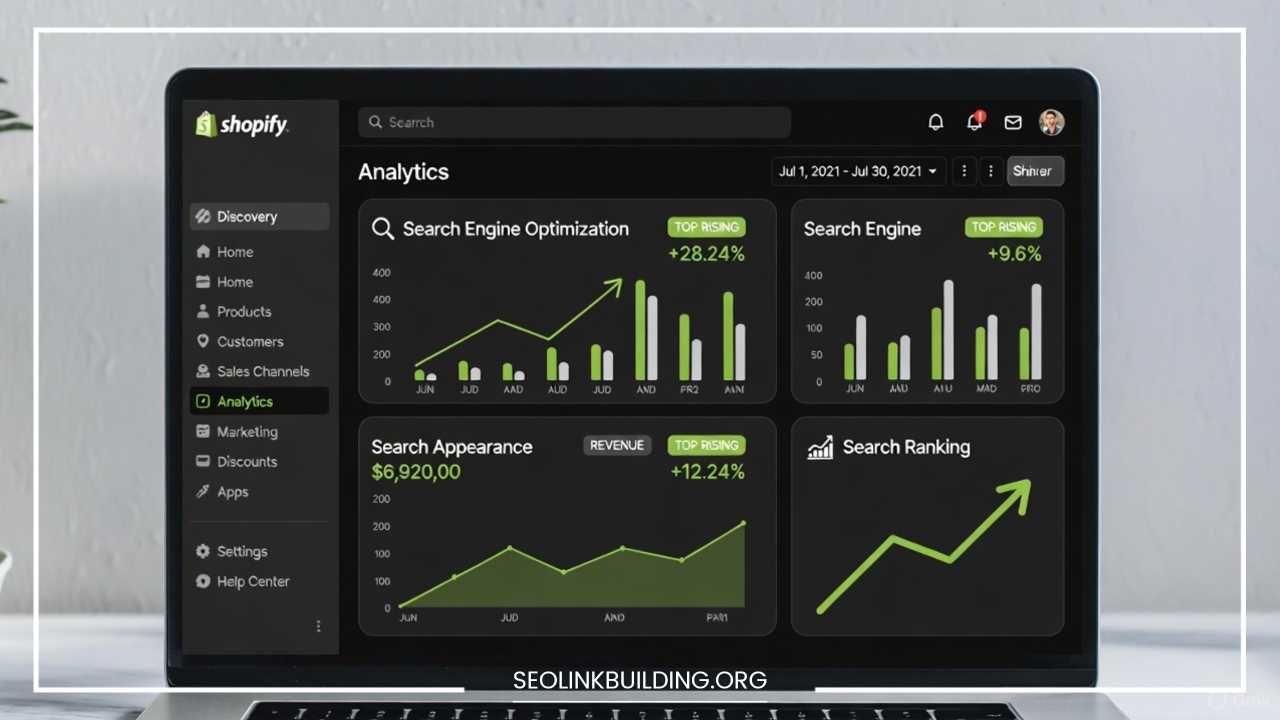
Tools: Google Analytics, Google Search Console, Shopify Analytics
-
Google Search Console (GSC): This is your direct line to Google. It reports on technical health, shows the exact search queries (keywords) you are ranking for, flags crawl errors (404s), and provides data on CTR. It is essential for technical SEO monitoring.
-
Google Analytics (GA4): Focuses on user behavior after they arrive at your site. You track which pages are driving the most organic traffic, what channels are converting best, and how users move through your funnel.
-
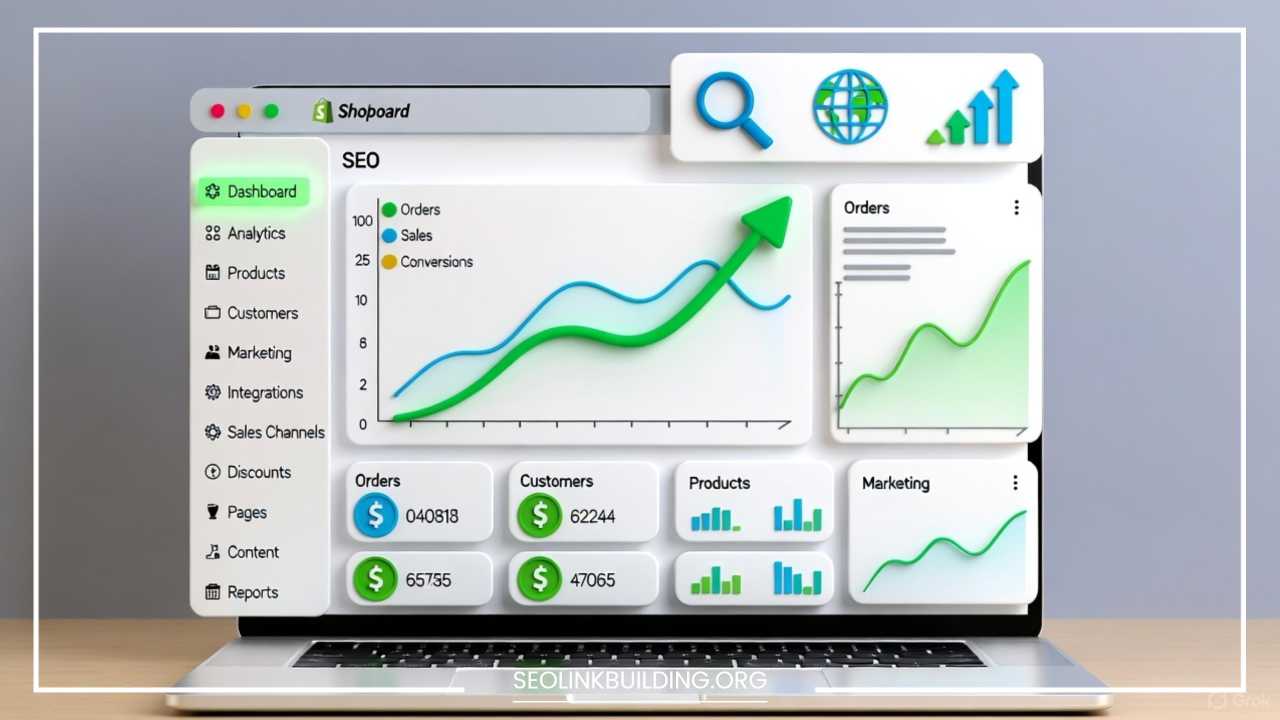
Shopify Analytics: Useful for immediate, high-level metrics on sales and revenue tied to different channels, offering quick financial insights.
How to Track Keyword Rankings, Traffic, and Conversions
-
Keyword Rankings: Use a paid rank tracking tool (Ahrefs, SEMrush) to monitor your position for high-value keywords over time.
-
Organic Traffic: In Google Analytics, segment your traffic by the “Organic Search” channel to see visitor numbers.
-
Conversion Rate: Track the “Organic Search” conversion rate—the percentage of organic visitors who complete a purchase. This is the ultimate metric for measuring the return on investment (ROI) of your Shopify SEO optimisation efforts.
Making SEO Data-Driven Decisions
Use GSC data to find “low-hanging fruit”—keywords you rank for on page two (positions 11-20). Optimizing the content for those pages, primarily by improving the title tag for a better CTR, can often move them to page one quickly.
Advanced Shopify SEO Tips
Moving beyond the basics allows you to capture more niche, high-value traffic segments.
Using Apps for SEO Optimisation
While speed is critical, some Shopify SEO apps provide functionality the platform lacks:
-
SEO Manager / Plug in SEO: These offer comprehensive audits, bulk editing of meta descriptions, and structured data generation, simplifying complex technical tasks.
-
Image Compression Apps: Crucial for maintaining site speed.
Optimizing for Voice Search and Local SEO
-
Voice Search: People use more conversational, long-tail phrases in voice search (e.g., “Where can I buy affordable blue cotton t-shirts online?”). Optimize content by answering questions directly and incorporating natural, conversational language.
-
Local SEO (for brick-and-mortar retailers): Claim and optimize your Google Business Profile (formerly GMB). Ensure your Name, Address, and Phone number (NAP) is consistent across your Shopify store and all online listings.
Leveraging User-Generated Content (Reviews, Q&A)
Product reviews and Q&A sections are SEO gold:
-
Fresh Content: They provide constantly refreshing, keyword-rich content on static product pages.
-
Rich Snippets: Reviews feed the Product Schema markup, enabling the display of star ratings in search results, dramatically increasing CTR.
Final Thoughts
The journey to high Google rankings is a marathon, not a sprint. Mastering Shopify SEO optimisation requires continuous effort, data analysis, and adaptation. We’ve covered the entire spectrum: from the foundational technical setup and high-intent keyword research to the execution of precise on-page optimizations, authority-building content marketing, and crucial off-page link building.
By implementing these strategies, you are not just ticking boxes; you are building a powerful, self-sustaining organic traffic machine. Every optimized title tag, compressed image, and hard-won backlink contributes to your store’s overall authority and visibility. Commit to this process, use the data to guide your decisions, and watch as your Shopify store climbs the Google ranks, translating high organic visibility directly into sustainable sales and a thriving eCommerce business.