
How to Calculate SEO ROI


How to Calculate SEO ROI: A Comprehensive Guide to Proving the Value of Organic Search
In the competitive landscape of digital marketing, Search Engine Optimization (SEO) is often viewed as a long-term, essential strategy. Yet, unlike instant-gratification channels like Pay-Per-Click (PPC) advertising, the financial returns of SEO can be complex and challenging to quantify. For businesses to sustain investment in organic search, marketing professionals must be able to move beyond simple traffic reports and demonstrate concrete, measurable results. This requires a robust framework for calculating Return on Investment (ROI).
An effective SEO strategy isn’t merely about climbing search engine rankings; it’s about translating that visibility into tangible business value—be it sales, leads, or brand equity. This comprehensive guide will dissect the process of calculating SEO ROI, from defining fundamental components to applying advanced attribution models, equipping marketers with the knowledge to prove SEO’s critical role as a profitable investment.
What is SEO ROI?
SEO ROI (Return on Investment) is a financial metric used to evaluate the efficiency and profitability of an investment made in organic search optimization. In simple terms, it measures the revenue or business value generated by SEO efforts compared to the total cost of those efforts over a specific period. It answers the fundamental question: For every dollar spent on SEO, how many dollars are we getting back?
Why It’s Important for Businesses and Marketers
Calculating SEO ROI is not just an accounting exercise; it’s a strategic necessity.
- Justification of Budget: It provides concrete evidence to stakeholders, proving that SEO is a valuable, revenue-generating channel, thereby securing future budget and resources.
- Strategic Focus: By pinpointing which SEO activities (e.g., content, technical fixes, link building) yield the highest returns, it allows marketers to prioritize resources and stop wasting effort on low-impact tasks.
- Benchmarking and Goal Setting: ROI figures serve as a benchmark for measuring success against competitors or previous periods, informing future business and marketing objectives.
- Competitive Advantage: Companies that accurately track and improve their SEO ROI can allocate capital more effectively, gaining a long-term edge over competitors who treat SEO as a vague or unmeasured expense.
Challenges in Measuring ROI from SEO
While critical, measuring SEO ROI presents unique challenges compared to other marketing channels:
- Time Lag: SEO results are rarely instantaneous. Investments can take months (often 6 to 12 months or more) to materialize into significant traffic and conversions, making short-term ROI calculations misleading.
- Attribution Complexity: Users often interact with a brand multiple times and through various channels (social, direct, email) before converting. Isolating the precise value of the initial organic search touchpoint can be difficult.
- Defining Non-Tangible Returns: The benefits of SEO extend beyond direct sales to include increased brand awareness, improved site authority, and reduced future PPC costs—values that are hard to put a number on.
Understanding the Basics of ROI in Marketing
ROI is a universal concept in business finance, and while the core formula remains the same, its application in marketing, particularly for a channel like SEO, requires nuanced understanding.
General ROI Formula
The foundational formula for calculating ROI is:

The result is typically multiplied by 100 to express it as a percentage:
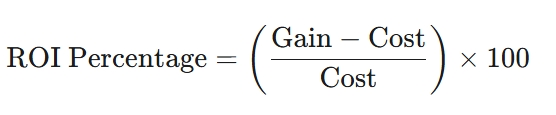
- A positive ROI (e.g., 200%) means the gain is greater than the cost. For every $1 invested, the business recouped the $1 and made an additional $2 profit.
- A negative ROI (e.g., -50%) means the cost exceeded the gain, resulting in a net loss.
Difference Between ROI for Paid Channels vs. Organic SEO
| Feature | Paid Channels (PPC, Social Ads) | Organic SEO |
| Cost Structure | Per-click or per-impression (direct variable cost) | Fixed investment (salaries, tools, time) |
| Time to Results | Immediate (hours/days) | Long-term (months/years) |
| Scalability | Linear (more money = more clicks/reach) | Non-linear (ranking impact depends on quality/competition) |
| Calculation Simplicity | Simpler; clear Last-Click attribution | Complex; requires sophisticated Attribution Modeling |
Time Lag Factor in SEO Results
The most crucial difference is the Time Lag. When a company invests $10,000 in PPC, they see the traffic and sales from that spend almost instantly. If they spend $10,000 on an SEO audit, content strategy, and link building, the organic ranking and traffic boost from that work might only begin 3-6 months later, and peak 12-18 months later. Therefore, an ROI calculation performed too early will invariably show a low or negative ROI, discouraging what could be a highly profitable long-term strategy. SEO ROI must be measured over an appropriate time horizon.
What Counts as “Return” in SEO?
The “Gain from Investment” (the numerator in the ROI equation) must be accurately defined and measured. It’s more than just raw traffic numbers; it’s the monetary value derived from that traffic.
Revenue from Organic Traffic (Direct Sales, Leads, Conversions)
The primary return is the revenue directly attributable to users who came from organic search (Google, Bing, etc.) and completed a valuable action.
- Ecommerce: Direct product purchases. The return is the total transaction revenue (or gross profit, which is a better metric).
- Lead Generation: Submitting a contact form, requesting a demo, or downloading gated content. The return is the calculated value of that lead.
Value of Assisted Conversions
This is where many businesses fail to capture the true return. An assisted conversion occurs when a user interacts with the brand via organic search at some point in their customer journey, even if another channel (like Direct or Email) was the final interaction (the Last Click). For example:
- User finds a blog post via Google (Organic Search – First Touch).
- User leaves and returns a week later via an email newsletter (Email – Middle Touch).
- User returns a day later by typing the URL directly (Direct – Last Touch) and makes a purchase.
Without considering the assisted value, the entire conversion would be credited to ‘Direct.’ Accurately calculating SEO ROI requires factoring in the value of these crucial early touchpoints.
Branding and Non-Tangible Returns (Brief Mention)
While not part of the standard ROI formula, these are significant long-term returns:
- Brand Authority: Ranking for high-volume, competitive terms builds trust and credibility.
- Reduced PPC Costs: High organic visibility means less reliance on expensive paid search ads. The budget saved can be considered a “return.”
- Media Value: The equivalent cost if the same traffic had been purchased via PPC (though using actual revenue is superior for ROI).
Tracking Goal Completions in Google Analytics or GA4
Accurate tracking is the foundation of ROI.
- Universal Analytics (UA): Goals are set up for specific actions (thank-you page views, events).
- Google Analytics 4 (GA4): Focuses on Events and Conversions. Key events to track include:
purchase,generate_lead,form_submit,begin_checkout, andsubscribe.
Ecommerce vs. Lead Generation Websites
| Website Type | Primary Conversion | How to Assign Monetary Value |
| Ecommerce | Purchase/Transaction | Direct Revenue: Use the actual recorded transaction value. |
| Lead Generation | Form Submission/Call | Lead Value: (Customer Lifetime Value (LTV) |
For example, if a company’s average customer LTV is $5,000, and 5% of all leads become customers, the value of a single lead is:

What Counts as “Investment” in SEO?
The “Cost of Investment” (the denominator in the ROI equation) must be comprehensive. Under-calculating the cost leads to an artificially inflated and unreliable ROI figure.
In-House Team Costs (Salary, Tools)
For businesses with an internal SEO team, the cost is primarily employee compensation.

If an employee (e.g., a Marketing Manager) only dedicates 50% of their time to SEO, only 50% of their total cost should be included in the SEO investment calculation.
Agency or Freelancer Fees
This is the most straightforward cost. Include the total monthly, quarterly, or project fees paid to external service providers for SEO strategy, execution, and reporting.
SEO Tools & Software
Include the annual or monthly subscription costs for essential tools:
- Analytics/Tracking: Google Analytics 360 (if used), other advanced analytics platforms.
- Keyword/Audit Tools: Ahrefs, SEMrush, Moz, Screaming Frog.
- Reporting Tools: Data visualization software like Tableau or Data Studio.
Content Creation and Link Building Costs
Content is the engine of SEO, and its cost is often overlooked or misattributed.
- Content: Costs for writers, editors, graphic designers, subject matter experts, and video production directly involved in creating or optimizing content for organic search.
- Link Building: Fees for outreach services, content promotion campaigns, or PR efforts specifically aimed at acquiring high-authority backlinks.
Opportunity Cost of Other Channels
While difficult to quantify precisely, sophisticated organizations consider the Opportunity Cost. This is the potential gain lost by choosing to invest resources in SEO rather than in another channel, like PPC or email marketing, that could have generated a different level of return. For most standard ROI calculations, this is excluded but is a factor in high-level financial planning.
Note: Always calculate the total cost within the exact same time frame as the total return being measured (e.g., all costs incurred between January 1st and December 31st for a one-year ROI).
Step-by-Step Guide to Calculating SEO ROI
Calculating SEO ROI involves a systematic, six-step process to ensure all variables—both costs and returns—are accurately accounted for.
Step 1: Define Conversion Goals
First, clearly articulate what success means for the business. This must be a trackable, measurable action in the analytics platform.
- Examples: Completed purchase, qualified lead form submission, demo request, or sign-up for a paid subscription.
Step 2: Set a Time Frame (e.g., 6 months, 1 year)
Select a measurement period long enough to allow for the inherent time lag of SEO.
- Initial ROI (6-12 months): Useful for an early health check. Often yields a lower ROI due to high initial setup costs and emerging results.
- Established ROI (12+ months): Provides a more accurate, stable picture of the channel’s profitability once rankings and authority have stabilized.
Step 3: Measure Organic Traffic Conversions
Using Google Analytics (or GA4), isolate the total number of conversions that were initiated, assisted, or completed by the Organic Search channel within the defined time frame.
- Data Source: Acquisition/Traffic Channels report in UA, or the “Conversions by default channel grouping” report in GA4.
Step 4: Assign Monetary Value to Conversions
Use the methods discussed earlier (actual transaction revenue for ecommerce, or calculated Lead Value for lead generation) to determine the total monetary return.

- Advanced Note: For the most accurate ROI, consider using Gross Profit (Revenue – Cost of Goods Sold) instead of raw Revenue to account for the true financial gain.
Step 5: Tally Total SEO Costs
Sum up all investments made during the defined time frame:

Step 6: Plug into ROI Formula
With the Total Return (Gain) and Total Cost (Investment), apply the core formula:

Example: Walkthrough of an ROI Calculation
Scenario: A B2B software company measures its SEO ROI over 12 months.
- Total Cost (12 months):
- In-House Salary (50% time): $40,000
- Agency Fees: $36,000 ($3,000/month)
- Tools & Content: $4,000
- Total SEO Investment: $80,000
- Total Return (12 months):
- Leads from Organic Search: 400
- Average Lead Value: $250 (calculated from LTV)
- Total Revenue Generated (Gain):
- Calculate ROI:
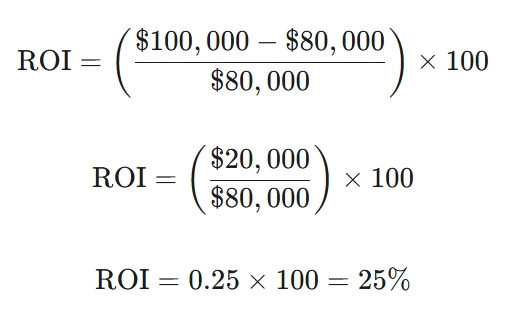
Conclusion: The SEO ROI for the year is 25%. For every $1 invested in SEO, the company gained $1.25 in return, resulting in a net profit of $0.25.
Tools to Help Measure SEO ROI
While the calculation is mathematical, the data collection relies on robust analytics and SEO platforms.
Google Analytics / GA4
The essential tool. It tracks organic traffic, conversion rates, and the entire user path. Crucially, it provides the data for assisted conversions and allows for setting up custom monetary values for goals/events. GA4’s focus on event-based data makes it powerful for tracking complex conversion funnels.
Google Search Console
Provides essential pre-click data, including impressions, clicks, and average ranking positions for keywords. This data helps attribute returns to specific keywords and content, which is useful for advanced segmentation of ROI.
Ahrefs / SEMrush / Moz
These are used primarily to track the performance metrics that drive ROI:
- Keyword ranking changes.
- Organic traffic estimation and value.
- Backlink acquisition and domain authority (DA/DR).
- They help justify investments by showing progress on key SEO deliverables.
CRM Systems (HubSpot, Salesforce)
CRM data is vital for accurate Lead Value and Customer Lifetime Value (LTV) calculations. By integrating the CRM with the analytics platform, businesses can track a lead from their first organic search click all the way to a closed-won sale and beyond, providing the most accurate return data.
Excel/Google Sheets for Manual ROI Calculations
Even with sophisticated tools, the final step often involves a spreadsheet to manually aggregate all costs (salaries, tools, content) and apply the ROI formula against the clean return data pulled from the analytics system. This provides a transparent, customizable record of the calculation.
Common Mistakes When Calculating SEO ROI
Even a seemingly perfect calculation can be flawed if fundamental missteps are made. Avoiding these common errors ensures a realistic and defensible ROI figure.
Not Accounting for All Costs
The most frequent error is neglecting internal staff costs. A company might track agency fees perfectly but forget to include the time the CTO spent reviewing the SEO roadmap or the salaried writer’s time dedicated to optimizing old pages. All resources consumed must be accounted for.
Ignoring Assisted Conversions or Attribution
Relying solely on a Last-Click attribution model is a critical mistake for SEO. If SEO is only credited for the final interaction, its role in initial awareness and mid-funnel education is completely undervalued. This often results in a vastly underestimated ROI, leading to underinvestment in the channel.
Measuring Too Early (SEO is Long-Term)
Evaluating the success of a new SEO campaign after only three or four months is premature and misleading. Due to the inherent delay in search engine indexing, ranking, and authority building, a short-term ROI will almost always be low or negative. Commit to a minimum 12-month evaluation window.
Not Aligning ROI with Business Goals
If the business goal is to increase Gross Profit, but the ROI calculation uses Total Revenue, the ROI figure is strategically meaningless. The chosen ‘Gain’ metric must directly correlate with the organization’s highest-level financial objectives.
Advanced Considerations
As an SEO strategy matures, so too should the sophistication of its ROI calculation. Moving beyond the simple formula provides a deeper, more actionable understanding of performance.
Attribution Modeling (First-Click vs. Last-Click vs. Data-Driven)
Attribution is the process of assigning credit to different marketing touchpoints that contributed to a conversion.
- Last-Click: Gives 100% of the credit to the final touchpoint (e.g., Direct traffic). Bad for SEO.
- First-Click: Gives 100% of the credit to the initial touchpoint (often Organic Search). Good for SEO awareness/blog content.
- Linear: Distributes credit equally across all touchpoints in the path.
- Time-Decay: Gives more credit to touchpoints closer in time to the conversion.
- Data-Driven Attribution (GA4 default): Uses machine learning to algorithmically assign credit based on how different touchpoints influence conversion probability. The best approach for an accurate SEO ROI.
Lifetime Value (LTV) of SEO Leads/Customers
The most powerful metric for proving SEO’s long-term value is Customer Lifetime Value (LTV). SEO customers often have a higher LTV than customers from paid channels, as organic search targets users with high purchase intent who are actively researching solutions.
To calculate LTV-based ROI, multiply the number of new SEO customers by their average LTV, then use this figure as the Total Return. This demonstrates the ROI of a customer over their entire lifespan with the business, not just their first transaction.
Segmenting ROI by Content Type or Keyword Group
A single, company-wide ROI figure is useful for budgeting, but segmentation is essential for optimization.
- Segment by Content: Calculate ROI separately for Blog Content (high-funnel, lower initial return) versus Product/Service Pages (high-intent, higher immediate return).
- Segment by Keyword: Determine the ROI of targeting Branded Keywords versus high-competition Non-Branded Keywords to justify resource allocation in each area.
Predictive SEO ROI Models
Advanced teams use current data to model future performance. By charting the expected correlation between increases in traffic (based on projected ranking gains) and conversion rates, they can forecast the ROI for the next 12-24 months. This is invaluable for securing future budget based on data-backed projections.
Real-World SEO ROI Example (Case Study)
Brief Background on a Business
Business: “HomeFit Pro,” an online retailer selling premium home gym equipment.
Challenge: High reliance on expensive Google Ads (PPC). Needed a sustainable, lower-cost channel for growth.
Their SEO Investment (Year 1: Jan 1 – Dec 31)
- Goal: Target high-intent, long-tail keywords (“best adjustable dumbbell set 2024”).
- Costs:
- SEO Consultant Fee: $1,500/month = $18,000
- Content Creation (40 articles): $10,000
- Tools (Ahrefs, etc.): $2,000
- Total SEO Investment (Cost): $30,000
Traffic/Conversion Growth Over Time
- Jan-Mar (Q1): Investment phase. Traffic flat.
- Apr-Jun (Q2): Rankings begin to climb. Organic Traffic
50%.
- Jul-Sep (Q3): High-intent keywords hit page one. Organic Traffic
150%.
- Oct-Dec (Q4): Peak sales season. Conversions scale rapidly.
| Metric | Year 1 Results (Organic Channel Only) |
| Total Organic Conversions (Purchases) | 600 |
| Average Order Value (AOV) | $500 |
| Total Transaction Revenue (Return) |
ROI Calculation
- Total Return (Gain): $300,000
- Total Investment (Cost): $30,000
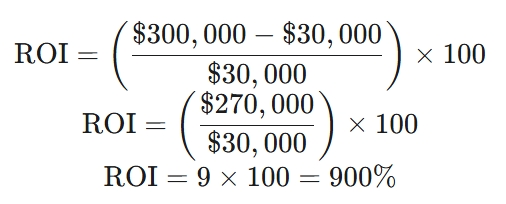
Conclusion: HomeFit Pro’s SEO generated a 900% ROI in its first year. For every $1 invested, they gained $10, resulting in $9 in net profit.
Takeaways
This case study demonstrates the power of SEO. Although the initial months showed a low ROI, the scaling effect once authority and rankings were achieved led to a significantly high return, especially when compared to the highly competitive and increasingly expensive PPC channel.
How to Improve Your SEO ROI
Once the ROI is accurately calculated, the focus shifts to optimization. The goal is simple: maximize the numerator (Return) and/or minimize the denominator (Cost) without compromising long-term quality.
Target High-Conversion Keywords
Shift effort away from high-volume, low-intent keywords and focus resources on long-tail, high-intent terms (e.g., “best project management software for small business”). These keywords have lower search volume but much higher commercial intent, resulting in fewer clicks that convert at a better rate, boosting the return component of the ROI formula.
Optimize Conversion Rate (CRO)
A high-ranking page that doesn’t convert is a massive drag on ROI. Conduct A/B testing and user experience (UX) audits to:
- Improve site speed.
- Ensure clear Calls-to-Action (CTAs).
- Simplify checkout/form completion processes.
Boosting the conversion rate by just 1% can instantly and significantly increase the total return without any additional investment cost.
Focus on Technical SEO and Site Speed
Technical SEO fixes (e.g., fixing crawl errors, improving core web vitals) are typically one-time or infrequent costs that yield long-term benefits in ranking stability and user experience. A faster, healthier website improves both organic traffic and conversion rates, attacking both parts of the ROI equation favorably.
Update Old Content for Performance Boosts
Instead of constantly writing new, expensive content, review existing high-ranking pages. Content auditing and refresh is a lower-cost activity than net-new creation. By updating an old article, you can gain a ranking boost, increase traffic, and improve conversion rate at a fraction of the cost, improving the ROI margin.
Build High-Authority Backlinks
Focus link building efforts on the most authoritative, relevant sites. A single link from a high-Domain Authority (DA) publication can often provide more ranking power and referral traffic than ten low-quality links. Prioritizing quality over quantity maximizes the impact of the investment in link building.
Final Thoughts
The ability to calculate and articulate SEO ROI is the bridge between the technical world of search optimization and the financial reality of business. It transforms SEO from an ambiguous marketing endeavor into a transparent, quantifiable investment—not an expense.
Understanding that SEO success is defined by a measurable return on capital is crucial for its long-term sustainability. While the process is more complex than for paid channels, the higher Lifetime Value and self-sustaining nature of organic traffic often result in an ROI that far surpasses nearly every other marketing avenue.
By diligently tracking all associated costs, accurately assigning monetary value to all conversions (especially assisted ones), and adopting an appropriate time horizon for measurement, marketers can confidently demonstrate SEO’s unparalleled role as a core driver of profitable business growth. Approach SEO with the rigor of an investor, and you will unlock its true financial power.