How to Rank Higher on Google

How to Rank Higher on Google: Proven SEO Strategies for 2026
The landscape of Search Engine Optimization has undergone a seismic shift. In 2026, the days of “tricking” an algorithm are long gone. We are living in an era defined by Generative AI, highly sophisticated user intent modeling, and a Google algorithm that prioritizes human experience over technical optimization.
Ranking higher on Google today isn’t just about keywords; it is about becoming the most trusted, authoritative, and helpful resource in your niche. Whether you are a small business owner, a seasoned digital marketer, or a passionate blogger, the fundamentals of visibility have changed. This guide provides a comprehensive, step-by-step framework to navigate the complexities of modern SEO and secure your spot at the top of the Search Engine Results Pages (SERPs).
The State of Search in 2026
Why does ranking on Google still matter in 2026? Despite the rise of social search on platforms like TikTok and the integration of AI chatbots, Google remains the primary gateway for high-intent discovery. When someone wants to solve a problem, buy a product, or learn a complex skill, they turn to search.
However, the “Search” we knew five years ago is dead. We have moved from a list of blue links to a multifaceted ecosystem of AI Overviews, Knowledge Panels, and Perspectives. In this environment, “ranking higher” doesn’t just mean being #1 in the organic list; it means being the cited source in an AI summary and appearing in the “Highly Rated” carousels.
This article is designed as a masterclass for those who want a sustainable, future-proof strategy. We will move from the core foundations of how Google’s 2026 brain works into the tactical “how-to” of content creation, technical health, and authority building.
How Google Rankings Work in 2026: Core Foundations
To rank higher, you must first understand the machinery behind the curtain. Google’s primary goal remains the same: to provide the most relevant, high-quality answer to a user’s query as quickly as possible. However, the way it identifies that “perfect” answer has evolved into a biological-like understanding of human language.
The Lifecycle of a Search Result
Google’s process involves three main stages, though they now happen in near real-time:
-
Crawling: Google Discovery bots (spiders) scour the internet for new or updated pages. In 2026, Google is more selective about what it crawls to save energy and “crawl budget,” prioritizing sites that show frequent, high-quality updates.
-
Indexing: Google analyzes the content, images, and videos on the page. It doesn’t just look for words; it looks for Entities—people, places, and things—and how they relate to one another.
-
Ranking: When a user types a query, Google sifts through its index. It uses “Personalization” signals, meaning the results I see might differ from yours based on our past behavior and location.
The Role of AI: RankBrain, BERT, and Beyond
In 2026, AI systems are the primary drivers of ranking.
-
RankBrain focuses on understanding the intent behind never-before-seen queries.
-
BERT helps Google understand the context of words in a sentence (e.g., “bank” as a financial institution vs. a “river bank”).
-
Helpful Content System: This is a sitewide signal. If Google determines that a large portion of your site is low-value or “unhelpful,” it can suppress the ranking of your high-quality pages too.
E-E-A-T: The Gold Standard
Google’s Search Quality Rater Guidelines emphasize E-E-A-T. In 2026, the first “E”—Experience—is the most crucial. In an age of AI-generated text, Google wants to see that a real person actually tested the product, visited the location, or performed the experiment.
The Golden Rule: Google ranks pages, not just websites. Every single page you publish must stand on its own merit as a high-quality asset.
Master Search Intent: The #1 Ranking Factor
You can have a technically perfect website, but if your content does not match Search Intent, you will never rank. Search intent is the “why” behind a query. If someone searches for “best espresso machines,” they want a comparison list (Commercial Intent), not a 5,000-word history of coffee beans (Informational Intent).
Identifying the Four Pillars of Intent
-
Informational: The user wants to learn. These queries often start with “How to,” “What is,” or “History of.”
-
Navigational: The user is looking for a specific site, such as “Canva login” or “NYT Crossword.”
-
Commercial: The user is researching products. Keywords include “best,” “review,” “top 10,” or “vs.”
-
Transactional: The user is ready to buy. Keywords include “price,” “discount,” “buy,” or “for sale.”
How to Analyze Top-Ranking Pages
Don’t guess what Google wants. The top 5 results are a cheat sheet.
-
Analyze the Format: If the top results are all videos, you must create a video. If they are all short-form FAQs, don’t write a long-form essay.
-
Analyze the Depth: Are the top results superficial or academic? Match the level of sophistication your audience expects.
-
Identify the “Angle”: If all top results for “lose weight” focus on “without exercise,” that is the angle the market is currently interested in.
Smart Keyword Research in 2026
Keywords are no longer about repetitive strings of text; they are about Topic Modeling. Google understands that if you are talking about “Climate Change,” you should naturally mention “Carbon Footprint,” “Renewable Energy,” and “Greenhouse Gases.”
Topic Clusters & Semantic SEO
Instead of targeting a single keyword like “Dog Training,” target a Topic Cluster.
-
Pillar Page: Everything you need to know about Dog Training.
-
Support Pages: “How to crate train a puppy,” “Stop your dog from barking at the mailman,” “Best treats for positive reinforcement.”
By linking these together, you tell Google: “I am not just writing about one keyword; I am an authority on the entire subject of dog training.”
Zero-Click Searches
In 2026, many searches result in “Zero Clicks”—the user gets the answer directly in the Google AI Overview or a Featured Snippet. To win here, provide concise, factual answers in the first paragraph of your articles. Even if they don’t click, being the “source” builds massive brand trust.
Modern Tools
While Ahrefs and SEMrush remain industry standards, Google Search Console (GSC) is your most honest tool. It shows you the keywords you are already starting to rank for on page 2 or 3. These are “low-hanging fruit.” Update those pages, and you can jump to page 1.
Create High-Quality, Helpful Content
In 2026, content quality is the ultimate differentiator. With the rise of AI-generated fluff, high-value “human-centric” content has become a premium asset. Google’s algorithms are now trained to detect “SEO-first” content (written for bots) vs. “People-first” content.
The Anatomy of High-Quality Content
-
Original Insights: Don’t just summarize what others said. Conduct a survey, run an experiment, or share a failure.
-
Clear Structure: Use a clear hierarchy.
-
H1: The main title (only one per page).
-
H2: Major sections.
-
H3: Sub-points under H2.
-
-
Visual Richness: Use original photos, infographics, and embedded videos. A page with only text is considered a poor user experience in 2026.
-
Readability: Use the “Snot Test”—if you can’t read a paragraph without taking a breath, it’s too long. Use bullet points and bold text to make your content scannable.
AI Content: Friend or Foe?
In 2026, the question isn’t “Should I use AI?” but “How should I use it?”
-
The Wrong Way: Prompting an AI to “write a 2,000-word article on SEO” and clicking publish. This creates “thin” content that lacks a soul and likely contains factual errors.
-
The Right Way: Using AI to generate an outline, brainstorm titles, or summarize your own research notes. The final output must be polished by a human to ensure it has Experience and Voice.
On-Page SEO Optimization Checklist
On-page SEO ensures that search engines can easily read and categorize your content. This is the “low-level” work that allows your “high-level” content to shine.
-
URL Structure: Keep it short.
site.com/rank-higher-googleis better thansite.com/2026/02/12/category/how-to-rank-higher. -
Keyword Placement: Include your primary keyword in the first 100 words, one H2, and the Meta Title. Do not “stuff” it. If it feels forced, delete it.
-
Internal Linking: This is the most underrated SEO tactic. Every new post should link to at least 3 older, relevant posts. This helps Google discover new content and passes “authority” throughout your site.
-
Anchor Text: Be descriptive. Instead of “Click here,” use “Check out our guide on technical SEO.”
-
Image Alt Text: This is for screen readers and search bots. Describe the image accurately (e.g., “A graph showing SEO growth over 12 months”).
-
Schema Markup: This is code that helps Google understand your content. Use “Review Schema” for products or “FAQ Schema” for guides to get extra space on the search page.
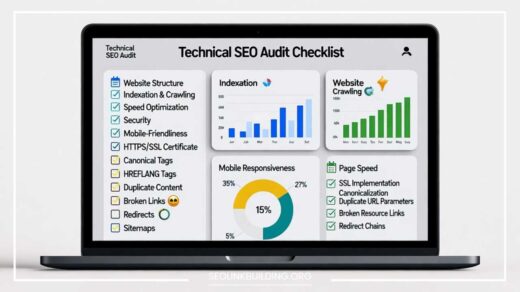
Technical SEO: Removing the Barriers
Technical SEO is the foundation of your house. If the foundation is cracked, it doesn’t matter how pretty the wallpaper (content) is.
Site Speed and Core Web Vitals
Google uses three main metrics to measure speed:
-
LCP (Largest Contentful Paint): How fast the main content loads.
-
FID (First Input Delay): How fast the site responds when a user clicks something.
-
CLS (Cumulative Layout Shift): Does the page jump around while loading?
In 2026, users expect instant loading. Use a fast hosting provider, compress your images using WebP format, and use a Content Delivery Network (CDN).
Mobile-First Indexing
Google does not care what your site looks like on a laptop. It ranks you based on the mobile version of your site. Ensure your buttons are easy to click with a thumb, your text is large enough to read on a phone, and your menus are simple.
Indexing and Crawlability
Check your Google Search Console for “Excluded” pages. If Google isn’t indexing your pages, they don’t exist in the eyes of the world. Ensure your robots.txt file isn’t accidentally blocking important folders and that your XML Sitemap is updated.
Build High-Quality Backlinks
Backlinks remain one of the top three ranking factors. Think of a backlink as a “digital referral.” If a high-authority site like The New York Times or TechCrunch links to you, Google assumes you are a trustworthy source.
The Death of Spammy Links
In 2026, low-quality links from “link farms” or irrelevant sites will actually hurt your rankings. Google’s SpamBrain AI identifies and ignores these links. Focus on:
-
Digital PR: Creating a story or data point that journalists want to cite.
-
Collaborations: Guesting on podcasts or writing for industry-leading blogs.
-
Earning Links: The best links are the ones you didn’t ask for. They happen because your content is the best resource on the web for a specific topic.
Improve User Experience (UX Signals)
In 2026, SEO and UX are the same thing. Google measures “User Signals” to determine if a result was helpful.
-
Dwell Time: If a user spends 5 minutes reading your page, Google sees that as a success.
-
Pogo-sticking: If a user clicks your result, hates it, and immediately clicks “back” to find another result, Google will drop your ranking.
-
Engagement: Are users clicking your internal links? Are they watching your embedded videos?
-
Accessibility: Ensure your site is usable for people with disabilities. High contrast, proper heading structures, and keyboard navigation are now ranking signals.
Building Topical Authority
Topical Authority is the process of becoming the “go-to” expert for a specific subject. Google prefers to rank a site that has 50 great articles on “Vegan Cooking” for a vegan recipe query than a general “Food Blog” that only has one.
The Strategy for Authority
-
Identify your Niche: Don’t try to be “The Tech Site.” Try to be “The site for Enterprise Cyber Security for Small Businesses.”
-
Cover the Breadth: Write about the beginner, intermediate, and advanced aspects of your topic.
-
Consistency: Publish on a regular schedule. A site that publishes once a week for a year is more authoritative than a site that publishes 50 articles in one week and then goes silent.
Track, Measure, and Improve
SEO is not a project; it is a process. You need to know which of your efforts are paying off.
Key Metrics to Watch
-
Organic Traffic: How many people are coming from search engines?
-
Keyword Rankings: Are your target keywords moving from page 3 to page 1?
-
Click-Through Rate (CTR): If you rank #1 but only 2% of people click, your title is boring. Aim for a high CTR.
-
Conversion Rate: Are your SEO visitors actually buying anything or signing up for your newsletter?
The Content Audit
Every six months, look at your underperforming content.
-
Delete: Remove pages that are old, irrelevant, and getting zero traffic.
-
Redirect: If you have two pages on the same topic, merge them into one “Mega-Guide” and redirect the old URL.
-
Refresh: Update old statistics, change the “2025” in the title to “2026,” and add new sections to keep the content fresh.
Common SEO Mistakes to Avoid in 2026
-
Chasing Search Volume: Many high-volume keywords are dominated by giants like Wikipedia or Amazon. Focus on “long-tail” keywords where you can actually win.
-
Ignoring Local SEO: If you have a physical business, your “Google Business Profile” is more important than your website for local searches.
-
Technical Neglect: Having great content on a slow, broken site is like putting a Ferrari engine in a lawnmower.
-
Fake Expertise: Don’t try to write about medical or financial advice (YMYL – Your Money Your Life) if you aren’t a qualified professional. Google is extremely strict with these topics.
Future-Proof Your SEO Strategy
As we look toward the horizon, the most successful SEOs will be those who focus on Brand Building.
The ultimate “SEO” hack is to have people search for your brand specifically. When people type “Nike running shoes” instead of just “running shoes,” Google recognizes that Nike is the authority.
Encourage newsletter sign-ups, build a community on social media, and provide such an incredible experience that people bookmark your site. In 2026, the best way to rank on Google is to build a site that users would love even if Google didn’t exist.
The Shift to Entity-Based Search
Start thinking about your business as an Entity. Ensure your “About” page is detailed, your social media profiles are linked, and you are mentioned on other authoritative sites. This helps Google build a “Knowledge Graph” around your brand.
Final Thoughts
Ranking higher on Google in 2026 is a marathon, not a sprint. The algorithm has become remarkably human in its ability to judge quality. By focusing on E-E-A-T, mastering Search Intent, and building Topical Authority, you aren’t just chasing an algorithm—you are building a digital asset that will provide value for years to share.
The steps are clear:
-
Fix your technical foundation.
-
Research the “why” behind the keywords.
-
Create the most helpful content on the internet.
-
Build relationships to earn links.
-
Analyze your data and repeat.
Success in search is achievable for anyone willing to put in the work to be truly helpful.