Google vs. Facebook Advertising

The Titans of Targeting: Google vs. Facebook Advertising in 2025
In the ever-evolving landscape of digital marketing, Google and Facebook (Meta) stand as the undisputed giants, commanding the lion’s share of advertising spend and advertiser attention. While both platforms offer unparalleled reach and sophisticated targeting capabilities, they operate on fundamentally different principles, catering to distinct stages of the customer journey and various business objectives. As we navigate 2025, understanding these nuances is more crucial than ever for businesses seeking to maximize their return on investment.
This comprehensive article will delve into the core differences between Google Ads and Facebook Ads, explore their unique strengths and weaknesses, analyze the impact of privacy regulations, highlight emerging trends, and ultimately, guide advertisers on how to strategically leverage both platforms for holistic and impactful campaigns.
The Foundational Divide: Intent vs. Discovery
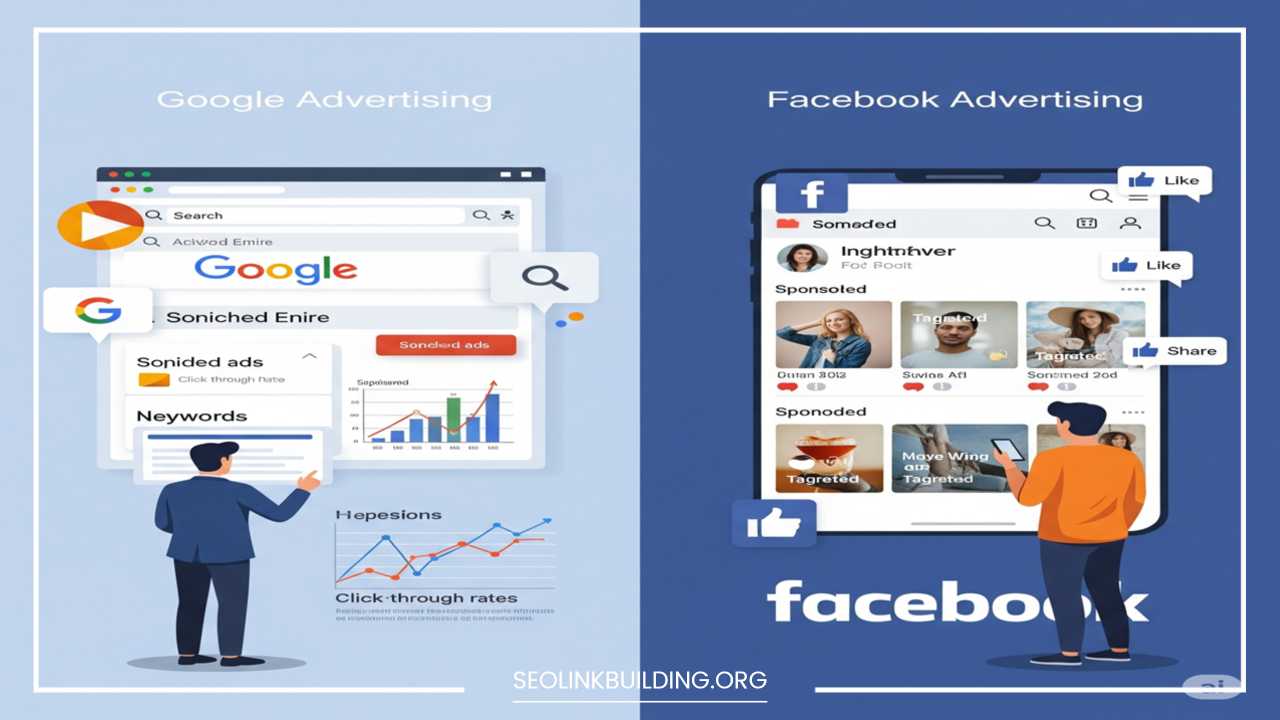
At the heart of the Google vs. Facebook advertising debate lies their fundamental approach to user engagement:
- Google Ads: Capturing Intent (The “I Want It Now” Audience)Google Ads, primarily through its Search Network, intercepts users at the moment of intent. When someone types “best web design company in Delhi” or “buy organic skincare” into Google, they are actively searching for a solution, a product, or information. This makes Google Ads a powerful tool for capturing existing demand. Advertisers bid on keywords, and their text-based ads appear directly in search results, often at the very top. This high-intent targeting translates to higher conversion rates for direct-response campaigns, as users are closer to a purchase decision.
Beyond Search, Google’s Display Network (G.D.N.) allows for more discovery-based advertising, showing visual ads across millions of websites, apps, and YouTube. While less intent-driven than search, the G.D.N. offers broad reach and visual storytelling capabilities. YouTube, as the world’s second-largest search engine, is a powerhouse for video advertising, catering to both discovery and intent depending on the video content and targeting.
- Facebook Ads (Meta Ads): Sparking Discovery (The “Didn’t Know I Needed It” Audience)Facebook Ads, encompassing Facebook, Instagram, Messenger, and Audience Network, excels at discovery-based advertising. Users are typically scrolling through their social feeds, engaging with friends and content, not actively searching for products. Facebook’s sophisticated algorithms leverage vast amounts of user data – including demographics, interests, behaviors, and connections – to place ads directly in front of people who are likely to be interested, even if they haven’t explicitly searched for it.
This platform is ideal for building brand awareness, generating interest, and fostering engagement. Its visually rich formats (images, videos, carousels, stories, reels) allow for compelling storytelling and emotional connection, making it particularly effective for visually-driven products or services and for creating demand where none previously existed.
Key Differentiating Factors: A Detailed Comparison
Let’s break down the core differences across several critical aspects:
1. Audience Targeting:
- Google Ads: Primarily relies on keyword intent, allowing advertisers to target users based on what they are actively searching for. Other targeting options include location, device type, time of day, and “in-market” audiences (users Google identifies as actively researching specific products or services). While powerful for capturing existing demand, it has less granular behavioral or demographic targeting compared to Facebook.
- Facebook Ads: Offers incredibly granular audience segmentation. Advertisers can target users based on:
- Demographics: Age, gender, location, education, relationship status, job title, income level, etc.
- Interests: Hobbies, favorite brands, entertainment preferences, pages liked, groups joined.
- Behaviors: Purchase history, device usage, travel patterns, online activities.
- Connections: People who like your page, friends of connections.
- Custom Audiences: Uploading your own customer lists (e.g., email addresses, phone numbers) to retarget existing customers or create lookalike audiences.
- Lookalike Audiences: Reaching new people who share similar characteristics with your existing best customers or website visitors. This allows for scalable growth by finding new, highly relevant audiences.
2. Ad Formats:
- Google Ads:
- Search Ads: Predominantly text-based ads appearing in search results.
- Display Ads: Image, rich media, and responsive display ads shown across the G.D.N.
- Video Ads (YouTube): Skippable and non-skippable in-stream ads, bumper ads, outstream ads, mastheads.
- Shopping Ads: Product listings with images, prices, and store names, appearing prominently in search results for e-commerce businesses.
- App Campaigns: Promoting mobile apps across Google’s properties.
- Performance Max: An automated campaign type leveraging AI to find converting customers across all Google channels.
- Facebook Ads:
- Image Ads: Single images with accompanying text.
- Video Ads: Single videos that can be short-form (reels) or longer.
- Carousel Ads: Multiple images or videos in a scrollable format.
- Collection Ads: A full-screen mobile experience with a primary video or image and several smaller product images.
- Instant Experience (formerly Canvas Ads): Immersive, full-screen mobile landing pages within Facebook.
- Lead Generation Ads: Forms embedded directly in the ad, allowing users to submit information without leaving the platform.
- Messenger Ads: Ads appearing in Facebook Messenger.
- Stories/Reels Ads: Full-screen vertical video ads appearing in Stories and Reels on Facebook and Instagram.
3. Cost and ROI (Return on Investment):
- Google Ads: Generally higher Cost-Per-Click (CPC) due to the high intent of users. Average CPC can range from $1-$4, but in highly competitive industries like legal or insurance, it can be significantly higher (e.g., $50+). However, the higher intent often translates to higher conversion rates and a quicker, more measurable ROI for direct sales or lead generation.
- Facebook Ads: Typically has a lower CPC (average $0.26-$0.30). While individual clicks may be cheaper, conversions might require more impressions or a longer customer journey, as users are not actively searching. The ROI is often seen in brand awareness, engagement, and nurturing leads over time. For visually driven products or those with a strong social appeal, Facebook can be very cost-effective for generating initial interest.
4. User Journey Stage:
- Google Ads: Best for capturing users in the lower funnel (consideration and decision stages) who are actively seeking solutions.
- Facebook Ads: Excellent for reaching users in the upper funnel (awareness and interest stages) to introduce products, build brand recognition, and generate initial curiosity. It’s also highly effective for retargeting.
5. Performance Metrics:
- Google Ads: Focuses on conversion-based metrics like Click-Through Rate (CTR), Cost Per Acquisition (CPA), and Conversion Rate (CR). Analytics are deeply integrated with Google Analytics 4 for comprehensive funnel tracking.
- Facebook Ads: Emphasizes engagement metrics such as reach, impressions, likes, shares, comments, video views, and cost per result (e.g., cost per lead, cost per message). It provides detailed audience insights for optimizing creative and targeting.
Evolution and Future Trends: AI at the Forefront
Both Google and Meta are aggressively investing in Artificial Intelligence (AI) and Machine Learning (ML) to enhance their advertising platforms. These advancements are shaping the future of digital advertising, driving greater automation, personalization, and efficiency.
Google Ads and AI:
- Performance Max Campaigns: This is Google’s most prominent AI-driven offering, designed to maximize conversions across all Google channels (Search, Display, YouTube, Gmail, Discover, Maps) from a single campaign. While offering less granular control, it leverages AI to optimize bids, creative combinations, and audience targeting. Advertisers are increasingly embracing PMax for its ability to drive results, despite concerns about transparency.
- AI-Powered Search Results: Google is experimenting with integrating ads into AI-generated summaries (AI Overviews) in search results. This presents new opportunities for advertisers to appear in these prominent, conversational AI responses.
- Ad Creation with AI: AI tools are increasingly being used to generate ad copy, headlines, and even images/videos, streamlining the creative process and enabling rapid A/B testing.
- Automation and Smart Bidding: AI algorithms are continually improving bidding strategies (e.g., Target ROAS, Maximize Conversions), allowing for real-time optimization based on predicted performance.
- Enhanced Audience Targeting: AI is refining audience segmentation, making it easier to reach the most relevant users across Google’s vast ecosystem.
Facebook Ads and AI:
- AI-Powered Personalization: Meta’s AI is hyper-personalizing ad delivery, ensuring users see ads most relevant to their interests and behaviors, even without explicit targeting parameters. This includes leveraging “Advantage+” ad systems for more automated campaign management.
- Video Content Dominance: AI is helping optimize video ad performance, especially for short-form, engaging formats like Reels and Stories. Algorithms are learning what visual elements and narratives resonate best with different audiences.
- Shoppable Posts and Social Commerce: AI is facilitating seamless shopping experiences directly within Facebook and Instagram, enabling users to purchase products without leaving the platform. This trend is set to revolutionize e-commerce.
- Interactive Ads: Expect more interactive ad formats that leverage AI to create engaging experiences, such as quizzes, polls, and augmented reality (AR) filters that allow users to virtually try on products.
- Audience Intelligence: Meta’s AI is becoming even more adept at understanding user behavior and preferences, allowing advertisers to rely more on the platform’s intelligence to find the right audiences, even with less explicit manual targeting.
The Elephant in the Room: Privacy Regulations
The digital advertising landscape has been significantly reshaped by increasing concerns about user privacy and stringent regulations like GDPR (General Data Protection Regulation) in Europe and CCPA (California Consumer Privacy Act) in the US. These regulations1 have had a profound impact on both Google and Facebook:
- Reduced Data Availability: The requirement for explicit user consent for data collection means that many users opt out, leading to gaps in conversion data and limiting the ability to track users across websites using third-party cookies. This poses challenges for conversion attribution and the effectiveness of automated bidding strategies that rely on robust data.
- Audience Targeting and Remarketing Limitations: The need for consent affects the ability to retarget website visitors or create highly granular custom audiences based on Browse history.
- Shift to First-Party Data: Advertisers are increasingly focusing on collecting and leveraging their own first-party data (data directly from their customers) rather than relying on third-party cookies.
- Contextual Targeting Resurgence: As personalized targeting becomes more complex, there’s a renewed interest in contextual advertising, where ads are placed based on the content of the webpage rather than user2 data.
- Transparency and Trust: Both platforms have been forced to become more transparent about data collection practices and provide users with greater control over their data. This fosters trust but also adds a layer of complexity for advertisers.
- Google’s Privacy Sandbox: Google is developing its Privacy Sandbox initiative to replace third-party cookies with privacy-preserving technologies that still allow for relevant advertising without individual tracking.
- Meta’s Data Practices: Facebook, having faced significant scrutiny over its data practices (e.g., Cambridge Analytica scandal), has implemented stricter policies and tools to enhance user privacy, including allowing users to opt out of having their Browse history collected when they visit sites running Meta plugins.
Advertisers must adapt by implementing clear consent mechanisms, diversifying measurement approaches, and prioritizing transparent data practices to ensure compliance and maintain consumer trust.
Strategic Synergy: The Power of Both Platforms
While Google and Facebook have distinct strengths, the most effective digital marketing strategies in 2025 will likely involve a synergistic approach, leveraging both platforms in tandem.
Here’s how they can complement each other across the marketing funnel:
-
Awareness (Upper Funnel):
- Facebook Ads: Excellent for introducing your brand or product to a broad, yet targeted, audience. Use visually appealing ads (video, image, carousel) to spark interest and generate initial brand recall. Campaigns focused on reach, brand awareness, or video views are ideal here.
- Google Display Network/YouTube Ads: Can also contribute to awareness through visual ads across relevant websites and engaging video content on YouTube.
-
Consideration (Mid-Funnel):
- Facebook Ads: Retargeting users who have interacted with your initial awareness campaigns (e.g., watched a video, visited your website). Use detailed interest and behavioral targeting to nurture leads and build deeper engagement. Lead generation ads and Instant Experiences can capture interest directly.
- Google Ads (Search & Display): Capture users who are starting to research solutions. Bidding on broader, informational keywords can bring them to your site. Display remarketing campaigns can re-engage users who visited your website but didn’t convert.
-
Conversion (Lower Funnel):
- Google Ads (Search & Shopping): This is where Google truly shines. Target high-intent keywords with specific product or service queries (e.g., “buy [product name]”, “[service] near me”). Google Shopping ads are crucial for e-commerce conversions.
- Facebook Ads (Retargeting): Re-engage users who have shown strong intent (e.g., added items to cart, viewed specific product pages) with conversion-focused ads, special offers, or urgency messaging. Social commerce features make direct purchases easier.
Practical Examples:
- E-commerce Business:
- Facebook: Run visually rich campaigns to showcase new collections and build brand lifestyle. Target lookalike audiences of existing customers.
- Google: Run Shopping ads for direct product sales. Bid on branded and non-branded search terms. Use remarketing lists for search ads (RLSA) to target past website visitors with specific offers when they search.
- Local Service Business (e.g., Plumber):
- Google: Essential for capturing “emergency plumber near me” or “plumber in [city]” searches. High intent, immediate need.
- Facebook: Run local awareness campaigns targeting homeowners in specific zip codes, showcasing reviews or offering seasonal promotions. Build a community around home maintenance tips.
- SaaS Company:
- Facebook: Generate leads by promoting free trials or webinars to audiences interested in business software, productivity, or specific industry challenges. Use LinkedIn targeting if available.
- Google: Capture demand from users searching for “best [software category]”, “CRM software reviews”, or comparing specific tools. Bid on competitor names.
Final Thoughts: A Dual-Powered Future
The battle between Google and Facebook for advertising dominance isn’t a zero-sum game. In 2025, smart advertisers recognize that each platform plays a vital, complementary role in a comprehensive digital marketing strategy. Google excels at capturing existing intent, connecting businesses with consumers at the moment of their need. Facebook, on the other hand, masterfully generates demand and fosters discovery, building brand awareness and nurturing relationships through engaging, visually-rich experiences.
The continued evolution of AI on both platforms promises even greater automation, personalization, and efficiency, albeit with the increasing complexities of data privacy regulations. Businesses that adapt by prioritizing first-party data, embracing AI-driven tools, and strategically integrating both Google Ads and Facebook Ads across the customer journey will be best positioned to unlock unparalleled reach, drive conversions, and achieve sustainable growth in the dynamic digital landscape of today and tomorrow. The future of advertising is not about choosing one titan over the other, but rather about harnessing the combined power of both to create a truly formidable and effective marketing engine.