How to Do SERP Analysis

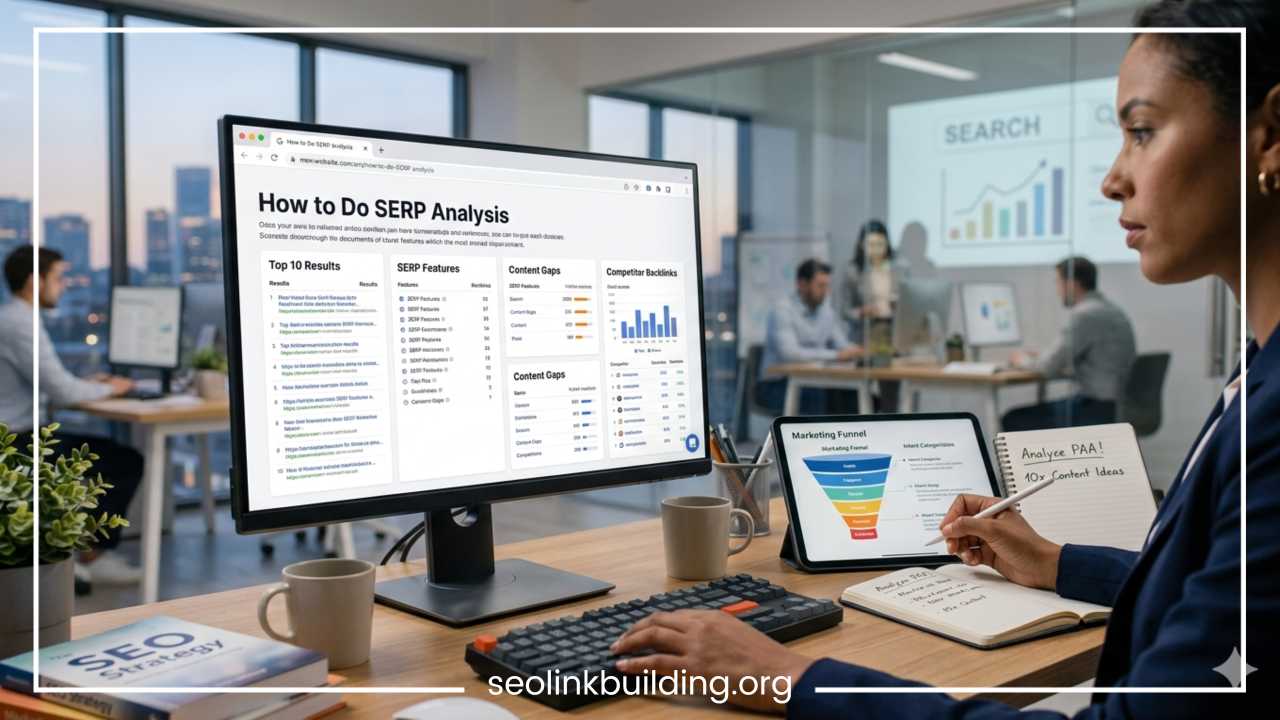
How to Do SERP Analysis: A Step-by-Step Guide
Why SERP Analysis Matters
In the early days of digital marketing, search engine optimization was largely a game of numbers. If you wanted to rank for a specific term, you simply ensured that term appeared frequently enough in your text and secured a handful of links containing that exact phrase. However, as search engines have evolved into sophisticated artificial intelligence systems, the “secret sauce” for ranking has shifted from simple keyword density to deep contextual relevance. This is where SERP analysis becomes the most critical weapon in an SEO professional’s arsenal.
SERP analysis is the process of examining the top-ranking pages on a Search Engine Results Page to understand why they are winning. It is a form of reverse-engineering Google’s secret algorithm by looking at the “answers” it provides. If Google has placed ten specific pages on the first page, it is telling you exactly what it believes the user wants to see. To ignore this data is to fly blind in your content strategy.
The modern search landscape is governed by intent rather than just keywords. Two keywords might have the same search volume, but if one is looking for a “how-to” guide and the other is looking for a “pricing page,” using the same content strategy for both will result in failure for at least one of them. SERP analysis allows you to identify this intent with surgical precision.
By performing a thorough analysis, you can outperform competitors who are still stuck in the “keyword-first” mindset. You can identify exactly what content formats are working, what subtopics are considered essential, and where the current leaders are falling short. This guide will provide an exhaustive, step-by-step framework to help you master the art of SERP analysis, from understanding the core foundations of intent to identifying content gaps that allow you to claim the top spot.
What Is SERP Analysis?
Search Engine Results Page (SERP) analysis is the practice of evaluating the top-ranking websites for a specific query to determine the difficulty of ranking, the intent of the searcher, and the specific requirements for content creation. It is not merely a glance at who is in the top three spots; it is a deep dive into the DNA of the results.
To understand SERP analysis, one must first distinguish it from traditional keyword research. Keyword research tells you what people are searching for—it provides metrics like monthly search volume, seasonal trends, and cost-per-click data. SERP analysis tells you how to serve those people. While keyword research identifies a potential opportunity, SERP analysis provides the blueprint for executing that opportunity.
In a modern SEO strategy, SERP analysis serves as the bridge between data and creativity. It prevents the common mistake of creating high-quality content that is fundamentally mismatched with what the search engine wants to display. For example, if you are targeting the keyword “best CRM software,” a traditional keyword research approach might suggest writing a 5,000-word history of CRM systems. However, a SERP analysis would quickly reveal that the entire first page consists of “top 10” listicles and comparison tables. A long-form history article, no matter how well-written, would likely never rank because it ignores the established user intent.
Consider a real-world example: searching for “apple.” Without context, this keyword is ambiguous. However, Google’s SERP for “apple” is dominated by the technology company, showing its official site, news about iPhones, and a knowledge panel. If you were an orchard owner trying to rank for “apple,” a SERP analysis would immediately signal that you are fighting an uphill battle against a global tech giant. You would then pivot your strategy to a more specific long-tail keyword like “organic honeycrisp apples for sale,” where the SERP analysis would show local maps and e-commerce listings instead of tech news.
Understanding Search Intent (Core Foundation)
Search intent, often called user intent, is the primary goal a user has when typing a query into a search engine. Understanding this is the “North Star” of SERP analysis. If your content does not satisfy the intent, no amount of backlinks or technical optimization will keep you on the first page. Intent is generally broken down into four distinct categories.
Informational Intent
These searchers are looking for knowledge. They want to learn something, solve a problem, or find an answer to a question. Keywords often include “how to,” “what is,” “history of,” or “guide.” The SERPs for these queries are usually dominated by blog posts, Wikipedia entries, and educational videos. The goal here is to provide value and build trust without a hard sell.
Navigational Intent
In this case, the user already knows where they want to go but finds it easier to search than to type the full URL. Examples include “Facebook login,” “Nike official site,” or “Gmail.” For these keywords, the brand itself will almost always occupy the top spot. Unless you are the brand in question, these keywords are generally not worth targeting in an organic strategy.
Transactional Intent
The searcher is in “buy mode.” They have finished their research and are ready to make a purchase or complete a specific action. Keywords like “buy running shoes,” “discount iPhone 15,” or “subscription for Netflix” signal this intent. The SERPs will be filled with product pages, category pages, and checkout screens.
Commercial Investigation
This is the middle ground between informational and transactional. The user knows they want to buy something, but they haven’t decided which product or service is right for them. They are looking for “best of” lists, comparisons, and reviews. For example, “best laptops for writers” or “Ahrefs vs Semrush.” SERP analysis for these terms usually shows third-party review sites and comparison guides.
Identifying Intent and Dealing with Intent Shifts
You can identify intent by looking at the “type” of pages ranking. If the top 10 results are all products, the intent is transactional. If they are all long articles, it is informational. Mismatched intent—such as trying to rank a product page for an informational query—is one of the most common causes of poor rankings.
Furthermore, intent can shift over time. During a global crisis, a keyword that used to be commercial might suddenly become informational as people search for news rather than products. Constant SERP analysis ensures your content remains relevant even as user behavior evolves.
Key Elements of a SERP You Must Analyze
When you look at a SERP, you are looking at a complex ecosystem. To analyze it effectively, you must break it down into two main categories: organic results and SERP features.
Organic Results
Organic results are the traditional listings that appear based on the search engine’s algorithm. When analyzing these, you must look at:
-
Types of Content: Are the winners individual blog posts, homepage listings, or category pages?
-
Content Formats: Is the SERP favoring listicles (“10 Best Ways”), comprehensive guides (“The Ultimate Guide to”), or interactive tools (calculators and templates)? Understanding the format allows you to mirror the structure that Google already prefers.
SERP Features
SERP features are non-traditional results that provide information directly on the page or enhance the standard listing.
-
Featured Snippets: These “position zero” results provide a direct answer to a query. If a snippet exists, it tells you exactly what the “perfect” answer looks like in the eyes of the search engine.
-
People Also Ask (PAA): This box provides a goldmine of related questions. Analyzing PAA allows you to identify the subtopics and concerns your content must address to be considered comprehensive.
-
Knowledge Panels: Found on the right side of the screen, these provide factual data about entities (people, places, things). If a knowledge panel appears, it suggests the query is tied to a specific, well-defined entity.
-
Image and Video Packs: If the SERP is crowded with images or YouTube videos, it’s a signal that users prefer visual or auditory learning for that topic. If you only provide text, you will likely lose out to visual content.
-
Local Packs: For queries with local intent (e.g., “pizza near me”), the local pack (Map) is the most prominent feature. If a local pack appears, your strategy must include local SEO and Google Business Profile optimization.
Analyzing these features tells you how much “real estate” is available. If a SERP is cluttered with ads, snippets, and video packs, the organic click-through rate (CTR) for the first position will be significantly lower than on a “clean” SERP.
Step-by-Step SERP Analysis Process
This section outlines the practical execution of a professional SERP analysis. Follow these steps for every major keyword in your strategy.
Step 1: Choose the Right Keyword
The process begins with selection. You shouldn’t analyze every keyword you find. Instead, focus on those where search volume, keyword difficulty, and business relevance intersect. Look for long-tail keywords (e.g., “how to do SERP analysis for SaaS”) as they often have clearer intent and lower competition than short-tail keywords (e.g., “SEO”).
Step 2: Analyze the Top 10 Results
Open a private or incognito browser window to avoid personalized results. Look at the top 10 sites. Note their Domain Authority (DA) or Rating (DR). If the first page is filled with massive sites like Amazon, Forbes, or New York Times, and you are a small blog, you may need a more specific “angle” to compete. Look at the “Content Angle”—are they targeting beginners, experts, or a specific industry?
Step 3: Identify Content Patterns
Success leaves clues. Examine the top three results and look for commonalities. Do they all use the same headings? Do they all include a specific chart or data point? Note the average word count. If every ranking page is over 2,000 words, a 500-word summary will not suffice. Look for the use of visuals; if the top pages all have original infographics, you should plan to create one as well.
Step 4: Evaluate Content Quality
Go beyond the surface level. Use the E-E-A-T framework (Experience, Expertise, Authoritativeness, Trustworthiness). Does the author have a bio that proves they are an expert? Is the content fresh, or was it last updated three years ago? Look at the readability—is the text broken up by subheadings and bullet points, or is it a wall of text?
Step 5: Analyze Backlinks and Authority
SEO is still heavily influenced by links. Use an SEO tool to check how many unique referring domains are linking to the top pages. If the average result has 500 backlinks and you have zero, you will need to incorporate a heavy link-building component into your strategy for that specific keyword.
Step 6: Spot Content Gaps
This is the most important step for outranking competitors. As you read the top results, ask:
-
What is missing?
-
Is there a question in the “People Also Ask” section that none of these articles answer well?
-
Is the design of these sites outdated or hard to use on mobile?
-
Can I provide a better free tool, template, or downloadable resource that they don’t offer?
Competitor Analysis Through SERPs
In SEO, your “real” competitors are not always the businesses you compete with in the physical world. Your SEO competitors are the websites currently occupying the space you want.
When you analyze these competitors, you are looking for their “Content Moat.” Why is Google keeping them there? Is it their brand name, their massive backlink profile, or the fact that they have the most comprehensive article on the web?
Reverse-engineering their strategy involves looking at their “Top Pages” report in SEO tools, but also manually checking their internal linking. Do they link to their SERP-winning page from their homepage? How do they structure their URL? By identifying their strengths, you can match them; by identifying their weaknesses (such as slow page speed, broken images, or thin content), you can surpass them.
Tools for SERP Analysis
While manual analysis is essential, tools can automate the data-gathering process.
-
Keyword Research Tools: Tools like Ahrefs, Semrush, or Moz provide data on keyword difficulty and SERP features. They allow you to see “SERP History” to see if the rankings have been stable or volatile.
-
SERP Simulators: These tools allow you to see how your meta title and description will look on the actual results page, helping you optimize for click-through rate.
-
Browser Extensions: Extensions like SEOQuake or Detailed SEO Extension allow you to see on-page SEO data (H1 tags, word count, meta tags) directly while browsing the SERP.
-
Content Optimization Platforms: Tools like Clearscope or Surfer SEO analyze the top-ranking pages and provide a list of terms and topics you must include to match the “topical authority” of the winners.
How to Turn SERP Insights into Content Strategy
Once you have the data, you must turn it into an actionable plan. This often involves the “10x Content” concept—creating something that is ten times better than what currently exists.
Matching Intent and Structure
Use your findings to create a detailed outline. If the SERP showed that users prefer listicles, your outline should be a listicle. If users want a guide, use a chronological structure. Ensure your H1 and H2 tags align with the primary and secondary keywords you identified during the pattern analysis phase.
On-Page SEO and Internal Linking
Incorporate the keywords naturally, focusing on the “entities” related to your topic. If you are writing about SERP analysis, you should naturally mention “search intent,” “organic traffic,” and “Google Search Console.” Furthermore, look at your own site and identify which existing pages can link to this new content. A strong internal linking structure signals to Google that this new page is an important part of your site’s architecture.
Common SERP Analysis Mistakes to Avoid
Even experienced marketers make mistakes during this process. The most common is ignoring search intent. You might find a keyword with low difficulty and high volume, but if you try to force an informational blog post into a transactional SERP, you will waste your resources.
Another mistake is copying competitors blindly. If you simply rewrite the top three articles, you aren’t giving Google a reason to rank you above them. You must add unique value—original data, a contrarian opinion, or better visual aids.
Overlooking SERP features is also a significant error. If a keyword is dominated by a Local Pack and you don’t have a physical presence or a local SEO strategy, you are effectively invisible, even if you rank #1 in the organic results below the map.
Finally, remember that SERP analysis is not a one-time task. Google updates its algorithm hundreds of times a year. A SERP that looks one way today may look completely different in six months. Regularly auditing your top-performing pages’ SERPs is vital for maintaining your rankings.
Advanced SERP Analysis Techniques
For those looking to take their strategy to the next level, consider these advanced methods.
Analyzing SERP Volatility
Some keywords are “stable,” meaning the top 10 results rarely change. Others are “volatile,” with positions shifting daily. Volatility often suggests that Google hasn’t quite figured out the perfect answer yet, or the topic is rapidly changing (like news or tech). High volatility can be an opportunity for a new player to break in.
Seasonal Trends and Localization
Search intent can be seasonal. A search for “decorations” in October means something very different than in December. Similarly, “personalization” means that a user in New York sees different results than a user in London. Using a VPN or localized search tools can help you see what your specific target audience is seeing.
Using Historical SERP Data
By looking at what the SERP looked like a year ago, you can see the “trajectory” of the niche. Is Google moving away from blog posts and toward video? Are more “big brands” entering the space? This helps you future-proof your content.
Example Walkthrough
Let’s perform a hypothetical analysis for the keyword: “how to grow organic tomatoes.”
-
Analyze Intent: A quick search shows the SERP is filled with blog posts, YouTube videos, and “how-to” cards. This is clearly informational intent with a strong visual component.
-
Top 10 Check: The results are a mix of major gardening sites and smaller niche bloggers. This tells us that a well-written article can compete even without massive authority.
-
Content Patterns: Every ranking article includes a list of “best varieties,” “soil requirements,” “watering tips,” and “pest control.” If we leave any of these out, our content will be seen as incomplete.
-
SERP Features: There is a large Featured Snippet at the top providing a numbered list of steps. There is also a “Video” carousel showing time-lapse growth and pruning techniques.
-
Finding the Gap: Most of the current articles use stock photos. To “10x” this, we could use original, high-resolution photos of each growth stage, or create a downloadable “Tomato Planting Calendar” PDF, which none of the current competitors offer.
-
The Strategy: We will write a 2,500-word guide, include an original video, optimize for the “how-to” schema to try and win the Featured Snippet, and offer a free companion PDF to capture email leads.
Final Thoughts
SERP analysis is the foundation upon which all successful SEO strategies are built. It is the process of listening to what the search engine and the users are telling you. By understanding intent, analyzing organic and feature-based results, and identifying the gaps left by your competitors, you can create content that doesn’t just “sit” on the web, but actively climbs to the top.
The key to success is consistency. Make SERP analysis a mandatory part of your content creation workflow. Don’t just guess what people want; look at the data Google has already provided. Focus on quality, stay aligned with intent, and always look for ways to provide more value than the current leaders. With this step-by-step approach, you are no longer just hoping to rank—you are planning to win.
Frequently Asked Questions About SERP Analysis
How do I perform a manual SERP analysis for long-tail keywords?
Performing a manual analysis for long-tail keywords involves entering your specific, three-to-five-word phrases into a search engine and observing the “type” of content that appears. Unlike broad terms, long-tail keywords often have very specific intent. Look at the “People Also Ask” boxes and the bottom “Related Searches” to see how Google connects your long-tail query to broader topics. If the results show forum posts or older articles, it is a sign that there is a content gap you can fill with updated, high-quality information.
What are the best free SERP analysis tools for SEO beginners?
For those just starting, several free tools provide immense value. Google Search Console is the most essential, as it shows you which queries are already driving impressions to your site. Additionally, browser extensions like the MozBar or the Detailed SEO Extension allow you to see on-page metrics and heading structures without leaving the search results page. For visualizing SERP features, many SEO platforms offer limited free daily lookups that show you featured snippets, image packs, and local results for specific regions.
Why is search intent more important than keyword density in SERP analysis?
Search intent is the “why” behind a query, whereas keyword density is a relic of older, less sophisticated algorithms. Modern search engines use natural language processing to understand if a user wants to buy, learn, or find a specific website. If your content has a high keyword density but fails to provide the answer or product the user is looking for, search engines will notice high bounce rates and low dwell times, leading to a drop in rankings. Aligning your content structure with the identified intent is the most effective way to ensure long-term visibility.
How does SERP volatility affect my keyword ranking strategy?
SERP volatility refers to how often the rankings for a specific keyword change. High volatility usually occurs in news-heavy niches or when Google is testing new ways to satisfy user intent. If you notice a keyword is highly volatile, your strategy should focus on “evergreen” value and building a diverse backlink profile to withstand fluctuations. Monitoring volatility helps you distinguish between a temporary dip in rankings and a fundamental shift in how the search engine views your content.
Can I do SERP analysis for local SEO without being in that location?
Yes, you can analyze local SERPs from a remote location by using search parameters or specialized tools. One simple method is to add the “near [City Name]” modifier to your search or use a “search from location” tool available in many SEO suites. This allows you to see the Local Pack and map results that users in that specific area see. Analyzing local SERPs is crucial for understanding the prominence of Google Business Profiles and local directories in your target market.
How often should I re-evaluate the search engine results pages for my top keywords?
You should perform a fresh SERP analysis for your most important keywords at least once every quarter, or immediately following a major core algorithm update. Search intent can shift, and new competitors can enter the space with better content formats. By regularly checking the SERP, you can see if Google has added new features—like a “Perspectives” or “Discussions” feed—that might require you to update your content strategy to maintain your click-through rate.