SEO and PPC Marketing: 5 Strategies to Dominate Search Results

SEO and PPC Marketing: 5 Strategies to Dominate Search Results
In the rapidly evolving landscape of digital marketing, the battle for visibility on search engine results pages (SERPs) has never been more intense. For businesses aiming to capture the attention of potential customers, two primary pillars stand at the forefront of search strategy: Search Engine Optimization (SEO) and Pay-Per-Click (PPC) marketing. While these two disciplines are often managed in silos by different teams or agencies, treating them as separate entities is a missed opportunity for exponential growth.
SEO is the art and science of earning traffic through unpaid or free listings, focusing on long-term authority and relevance. PPC, on the other hand, is a model of internet marketing where advertisers pay a fee each time one of their ads is clicked, providing an immediate doorway to the top of the search results. Individually, they are potent; combined, they form a comprehensive search engine marketing (SEM) powerhouse.
The importance of dominating search results cannot be overstated. With the majority of consumer journeys beginning with a search query, a brand that occupies both the paid and organic sections of a results page commands authority, builds immediate trust, and significantly increases the probability of a click. This article explores the synergy between these two channels, providing five actionable strategies to integrate SEO and PPC effectively. By the end of this guide, you will understand how to leverage data, optimize assets, and coordinate campaigns to achieve a dominant market position.
The goal is simple: total SERP real estate ownership. When a user searches for a solution your business provides, seeing your name in the sponsored section and the top organic results creates a “halo effect.” This dual presence signals to the user that you are a leader in your field, worth both the search engine’s algorithmic recommendation and your own investment in advertising.
Understanding SEO and PPC
Before diving into integration strategies, it is essential to establish a clear understanding of the mechanics behind both SEO and PPC.
SEO Overview
SEO is a multifaceted discipline aimed at increasing a website’s visibility in the organic search results. It is generally categorized into three core pillars:
-
On-page SEO: This involves optimizing individual web pages to rank higher. It includes strategic keyword placement in titles, headers, and body copy, as well as optimizing meta tags, image alt text, and internal linking structures. Content quality is the heartbeat of on-page SEO; search engines prioritize “E-E-A-T” (Experience, Expertise, Authoritativeness, and Trustworthiness).
-
Off-page SEO: This refers to actions taken outside of your own website to impact your rankings. The primary focus here is building high-quality backlinks from authoritative sites, which act as “votes of confidence” for search engines. It also encompasses social signals, brand mentions, and local citations.
-
Technical SEO: This is the foundation of your site. It ensures that search engine spiders can crawl and index your site without issues. Key elements include site speed, mobile-responsiveness, XML sitemaps, structured data (schema markup), and secure connections (HTTPS).
PPC Overview
PPC is a digital advertising model where businesses bid on keywords to display ads in search engine results. Platforms like Google Ads and Microsoft Advertising (Bing Ads) are the primary arenas for this.
-
Campaign Types: While search ads (text-based ads at the top of the SERP) are the most common, PPC also includes display ads (banners on partner sites), shopping ads (product listings with images), and video ads (YouTube).
-
The Auction Model: Ad placement is determined by an auction. However, it is not just about the highest bidder. Search engines use a “Quality Score”—measuring ad relevance, expected click-through rate, and landing page experience—combined with the “Max Bid” to determine the “Ad Rank.” This ensures that users see relevant ads, not just those from the biggest spenders.
-
Cost-per-click (CPC): This is the actual price you pay for each click. It is influenced by competitor bids and your own ad relevance.
Why Integrate SEO and PPC?
The primary reason to integrate these channels is that they compensate for each other’s weaknesses. SEO provides a long-term, sustainable flow of traffic without a direct cost-per-click, but it takes time to build momentum—often months or even years for highly competitive terms. PPC offers instant visibility and control, allowing you to “turn on” traffic for new products, seasonal promotions, or time-sensitive events immediately.
Furthermore, a combined approach provides double the data. When you analyze how users interact with your paid ads versus your organic listings, you gain a holistic view of the customer journey. Integrated strategies improve your overall Click-Through Rate (CTR) because having two listings on the same page reinforces brand familiarity. Research has consistently shown that even when a brand holds the #1 organic spot, having a supporting PPC ad can increase the total number of clicks the brand receives.
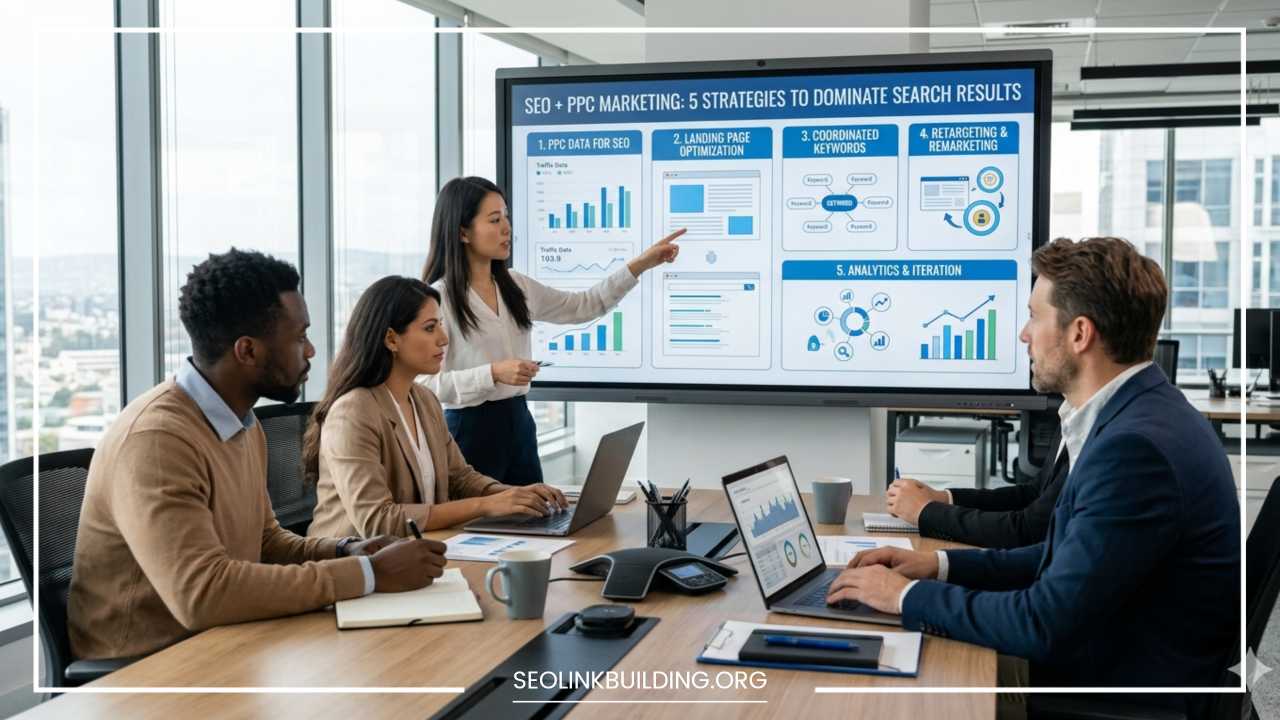
Strategy 1: Use PPC Data to Boost SEO
One of the most immediate benefits of running PPC campaigns is the wealth of real-time data they generate. SEO is often a waiting game; it can take months to see if a keyword strategy is working. PPC provides those answers in days, if not hours.
Identifying High-Converting Keywords
In SEO, we often target keywords based on “search volume,” but volume does not always equate to value. A keyword might bring thousands of visitors but zero sales. PPC allows you to test keywords by paying for traffic. By looking at your Google Ads “Search Terms” report, you can identify which specific queries result in actual conversions (sales, sign-ups, or leads).
If a particular long-tail keyword has a high conversion rate in your PPC campaign, it is a prime candidate for an intensive SEO content strategy. You can confidently invest resources in creating high-quality organic content for that term—such as a 2,000-word guide or a dedicated tool—knowing that once it ranks, it will drive revenue. This “PPC-to-SEO” pipeline ensures that your content team is never guessing what to write about.
Guiding Content Creation and On-Page SEO
PPC ad copy is essentially a laboratory for headlines. By running A/B tests on ad headlines and descriptions, you can discover which language, emotional triggers, or value propositions resonate best with your audience. For example, if an ad with the headline “Affordable Enterprise Software” outperforms an ad with “Best Software for Large Teams,” you should incorporate the “Affordable” phrasing into your SEO title tags, meta descriptions, and H1 headers.
This data-backed approach removes the guesswork from on-page optimization. Instead of wondering which benefit to highlight in your meta description, you simply look at the CTR data from your top-performing ads. If “Free Shipping” drives clicks in PPC, it belongs in your organic snippets too.
Understanding User Intent
PPC performance helps you decode the “why” behind a search. If users click on an ad but bounce immediately from a product page, the intent might be informational rather than transactional. This insight allows you to pivot your SEO strategy—perhaps moving away from a sales-heavy page toward a comprehensive guide that answers their underlying questions. Analyzing “Search Terms” also reveals the specific questions people are asking, which can be turned into an FAQ section on your website to capture “People Also Ask” (PAA) boxes in the organic results.
Case Studies and Examples
Consider a brand in the insurance space. They might find through PPC that keywords containing the word “instant” convert at triple the rate of keywords containing “cheap.” By shifting their SEO focus to “Instant Insurance Quotes,” they align their organic authority with the specific desire of the market. Another example involves a software company discovering through PPC that users are searching for comparisons (e.g., “Product A vs Product B”). This data justifies the creation of organic comparison pages that can rank highly and capture users in the consideration phase.
Tools for Execution
To execute this strategy, you should regularly export keyword data from Google Ads and cross-reference it with your SEO tools like SEMrush, Ahrefs, or Moz. Look for “low-competition, high-conversion” keywords in your PPC reports that you aren’t currently ranking for organically. These are your “low-hanging fruit.” Use Google Analytics to track the path from a paid click to a goal completion to build a roadmap for your organic content calendar that is strictly aligned with business outcomes.
Strategy 2: Optimize Landing Pages for Both Channels
A common mistake in digital marketing is creating “PPC-only” landing pages that are hidden from search engines or “SEO-only” pages that are too text-heavy to convert paid traffic. The most efficient strategy is to design high-performance pages that serve both masters.
Designing for Conversion and Authority
A successful landing page must satisfy the user’s need while also satisfying the search engine’s requirements. For SEO, this means having sufficient word count, structured data (schema), and keyword relevance. For PPC, it means having a clear, singular Call-to-Action (CTA), fast loading times, and a layout that matches the ad’s promise.
To optimize for both, follow these guidelines:
-
Clear Hierarchy: Use H1 and H2 tags that include your target keywords for SEO, but make sure they are compelling enough to keep a PPC visitor on the page. Use bullet points and short paragraphs to make the content “scannable.”
-
Visual Engagement: Use high-quality images, infographics, and videos to reduce bounce rates. High engagement signals to Google that the page is valuable (good for SEO) and increases the likelihood of a conversion (good for PPC).
-
Page Speed and Core Web Vitals: This is a direct ranking factor for SEO and a critical component of “Landing Page Experience” in PPC. A slow page kills your Quality Score—meaning you pay more for ads—and your organic rankings.
-
Mobile UX: Since most searches now happen on mobile devices, your landing page must be flawless on smaller screens. This includes thumb-friendly buttons and easy-to-read fonts.
Using PPC for A/B Testing
PPC is the ultimate testing ground for landing page elements. You can send 50% of your paid traffic to Version A and 50% to Version B to test different CTA buttons, form lengths, or testimonial placements. The winning elements should then be implemented across your high-traffic SEO pages. This allows you to improve the conversion rate of your organic traffic without having to wait for months of “natural” data to reach statistical significance.
Avoiding Duplicate Content
When creating specific landing pages for different ad groups, there is a risk of duplicate content which can confuse search engines and lead to ranking issues. To combat this, use “canonical tags.” If you have three slightly different landing pages for different PPC audiences (e.g., one for “Professional SEO Services” and one for “SEO Marketing Agency”), pick the most comprehensive one as the “master” and point the canonical tags of the others toward it. This tells search engines to rank only the master page, while still allowing you to run specific PPC variations for ad relevance.
Enhancing User Trust
Trust signals like “As Seen In” logos, SSL badges, and customer testimonials are vital for PPC conversion. Fortunately, these also contribute to the “Trust” element of SEO’s E-E-A-T. By integrating these elements naturally into your design, you boost the performance of both channels. A user who arrives via a paid ad is more likely to convert if they see evidence of your authority, while an organic visitor will find the page more credible.
Strategy 3: Coordinate Keyword Strategy Across SEO and PPC
The SERP is limited real estate. Coordination ensures you are not bidding against yourself or wasting money on keywords where you already have a dominant organic presence.
Segmenting Keywords for Targeting
Not every keyword requires both a paid ad and an organic listing. You should segment your keywords based on competition, cost, and strategic value:
-
High-Cost, High-Competition: If a keyword has a CPC of $50 and the competition is fierce, but it is highly relevant, focus your efforts on SEO. It may take longer to rank, but once you do, you save thousands in ad spend.
-
Low-Cost, High-Intent: If a keyword is cheap and leads to immediate sales, maximize your PPC spend. This allows you to “own” that term while you build up your SEO authority in the background.
-
Brand Protection: Always run PPC ads on your own brand name. Even if you rank #1 organically, competitors can bid on your brand name to steal your traffic. A PPC ad ensures you own the top of the page, provides a better link to specific promotions, and allows you to control the messaging.
Avoiding Cannibalization and Budget Waste
Keyword cannibalization occurs when your paid ads “eat” the clicks that would have gone to your organic listing anyway, essentially costing you money for “free” traffic. While having two listings often increases the overall click volume, for tight budgets, you might choose to pause PPC ads for keywords where you consistently hold the #1 organic spot and have a high CTR.
However, be cautious. Google’s algorithm is fluid. If you stop bidding on a keyword where you are #1 organically, a competitor might take that ad spot and push your organic listing further down the screen (especially on mobile). Use the “Paid & Organic” report in Google Ads to see if your total clicks increase or decrease when both ads and organic listings are present.
Long-Tail vs. Competitive Keywords
PPC is excellent for broad, competitive terms (“Search Marketing”) where SEO might take years to break through. SEO is often better suited for “long-tail” queries (“how to integrate seo and ppc for small business”)—specific, multi-word phrases that reflect a user’s deep research phase. By mapping these out, you can ensure your PPC budget is spent on high-intent “buy now” terms, while your SEO strategy captures the research-oriented traffic.
Keyword Mapping to Content
Create a master spreadsheet where every target keyword is assigned a primary channel. This prevents two different teams from working at cross-purposes. If the SEO team is building a pillar page for “Enterprise SEO Strategies,” the PPC team should know to focus their “Enterprise SEO” ads on that specific landing page rather than a generic homepage.
Strategy 4: Leverage Retargeting and Remarketing
Retargeting is the bridge that connects the awareness generated by SEO with the conversion power of PPC. Most users—up to 98%—do not buy on their first visit. They might find your site through an organic search for “how to choose a mountain bike,” read your guide, and then leave to do more research.
Retargeting Organic Visitors
Without PPC, that organic visitor might be lost forever to a competitor. With an integrated strategy, you can use a tracking pixel (like the Google Tag or Meta Pixel) to show PPC display ads to that specific user as they browse other sites or social media. This keeps your brand top-of-mind. Because they already visited your site through an organic search, they are a “warm” lead, making the PPC ad much more likely to convert than a “cold” ad shown to a stranger.
Segmented Remarketing Lists
Don’t just retarget everyone who visits your site. Use SEO data to segment your lists:
-
The “Researcher”: Someone who read an informational blog post. Show them a PPC ad for a free e-book or a “Getting Started” guide.
-
The “Comparison Shopper”: Someone who visited your “Services” or “Pricing” page. Show them a PPC ad with a testimonial or a discount code.
-
The “Cart Abandoner”: Someone who reached the checkout but didn’t buy. Show them a highly specific PPC ad with an “Incentive to Finish.”
High-Value Leads for SEO Content
You can also use PPC data to see which pages on your site are the best “hooks.” If your PPC data shows that people who visit your “Customer Success Stories” page are 5x more likely to convert, you should focus your SEO efforts on driving more organic traffic to pages that naturally link to those success stories. This turns your site into a conversion machine fueled by organic traffic.
Examples of Campaign Synergy
Imagine a travel agency. A user searches organically for “best time to visit Italy” and finds a blog post. The agency then uses PPC remarketing to show that user ads for “Exclusive Italy Tour Packages” over the next 14 days. This sequence mirrors the user’s natural progression from “interest” to “intent,” using the most cost-effective channel for each stage.
Strategy 5: Monitor, Analyze, and Iterate
The final strategy is the most critical: creating a unified reporting structure. If you measure SEO and PPC in isolation, you will never see the full picture of your search dominance.
Key Metrics to Track
For a holistic view, you should monitor “blended” metrics:
-
Total Search Share: The percentage of total clicks you get from both organic and paid for your top 50 keywords.
-
Blended CTR: The combined click-through rate. If your PPC ad has a 5% CTR and your organic listing has a 10% CTR, your blended CTR helps you understand the total value of that keyword.
-
Blended Cost Per Acquisition (CPA): When you factor in the “free” SEO leads alongside paid leads, your overall CPA usually drops. This is the true measure of your marketing efficiency.
-
Assisted Conversions: How many times a PPC ad led to an organic visit later, or vice versa. Google Analytics 4 (GA4) provides excellent “Path Exploration” reports for this.
Integrating Data for Better Insights
Use tools like Google Looker Studio to build dashboards that pull data from both Google Search Console (SEO) and Google Ads (PPC). This allows you to see side-by-side performance. For instance, if you notice organic rankings dropping for a core product due to a core algorithm update, you can immediately increase PPC spend to bridge the traffic gap while your SEO team diagnoses the issue. This “insurance policy” is one of the greatest benefits of a dual-channel strategy.
The Iterative Mindset
The digital marketplace is dynamic. Competitors enter the fray, search algorithms update, and consumer behavior shifts. An integrated approach requires a mindset of continuous testing. Use your PPC campaigns as a fast-paced laboratory to test new markets, new products, and new messaging. Then, take the winners and bake them into your long-term SEO strategy.
Automation can also play a role. Sophisticated marketers use scripts to adjust PPC bids based on organic ranking positions. For example, if your organic ranking for a high-value term falls below position #3, a script can automatically increase your PPC bid to ensure you still appear at the top of the page. Conversely, if you hit #1 organically, the script can lower the bid to save money.
Final Thoughts
Dominating the search results is not about choosing between SEO and PPC; it is about orchestrating them to work in harmony. As we have explored, the data gathered from your paid campaigns can provide a roadmap for your organic content, while your organic reach can provide a steady stream of leads for your retargeting efforts.
By implementing these five strategies—leveraging PPC data for SEO, optimizing landing pages for both channels, coordinating keyword targets, utilizing retargeting, and maintaining a rigorous analytical framework—you create a search presence that is greater than the sum of its parts. This unified front not only maximizes your visibility but also builds brand authority and improves your bottom line.
Digital marketing is increasingly competitive, and the “winner-takes-all” nature of the first page of search results means that there is no room for a fragmented strategy. The brands that dominate today are those that stop viewing SEO and PPC as rivals and start viewing them as partners. Start by breaking down the walls between your teams. Share the data, align the goals, and begin the process of total search engine dominance. The most successful businesses are those that realize search is a single, integrated ecosystem—and the only way to truly win is to occupy as much of that ecosystem as possible. Implementation of these strategies will not only drive more traffic but will ensure that the traffic you do get is of the highest possible quality, leading to sustainable, long-term growth.