What Is Topical Authority in SEO?

What Is Topical Authority in SEO? Complete Guide to Ranking Higher on Google
In the early days of search engine optimization, ranking on the first page of Google was often a numbers game. If you repeated a keyword enough times and pointed a handful of backlinks toward a page, you could practically guarantee a top spot. However, as Google’s algorithms have matured, the focus has shifted from “manipulating strings” to “understanding things.”
Today, search engines are no longer looking for the page with the most keywords; they are looking for the most authoritative source on a given subject. This shift has given rise to a critical concept: Topical Authority.
Topical authority is the perceived expertise a website has over a specific niche or subject matter. Instead of ranking individual pages for individual keywords, Google now looks at the collective depth and breadth of your entire website’s content. If you want to rank for competitive terms in 2026, you cannot simply write one great blog post. You must prove to Google that you are a master of the entire topic.
In this comprehensive guide, we will break down what topical authority is, why it has become the backbone of modern SEO, and how you can build a content strategy that establishes your site as the go-to resource in your industry.
What Is Topical Authority in SEO?
To understand topical authority, we must first define it. Topical authority is a measurement of a website’s credibility regarding a specific topic. It is earned when a website consistently publishes high-quality, comprehensive content that covers a subject from every possible angle.
Defining the Concept
When you demonstrate topical authority, search engines begin to trust your site as an “expert” in your field. If you run a website about “Organic Gardening” and you have 200 deeply researched articles covering everything from soil pH and heirloom seeds to natural pest control and seasonal planting, Google views you as an authority on organic gardening. Consequently, when you publish your 201st article, it is much more likely to rank quickly because Google already trusts your expertise in that niche.
Topical Authority vs. Domain Authority vs. Page Authority
It is easy to confuse these terms, but they represent different facets of the SEO ecosystem:
-
Domain Authority (DA): A metric (largely popularized by third-party tools like Moz) that predicts how well a website will rank based on its overall backlink profile. It is a site-wide “strength” score.
-
Page Authority (PA): This refers to the ranking power of a single, specific URL. A page might have high authority because it has many high-quality backlinks pointing directly to it.
-
Topical Authority: Unlike DA or PA, which are heavily weighted by links, topical authority is content-driven. It is about the “density of information” and the semantic relationship between your pages. You can have a lower Domain Authority than a competitor but still outrank them for a specific niche topic because your topical authority in that micro-niche is superior.
Why It’s Content-Driven
While backlinks still matter, topical authority is built through the exhaustive coverage of a subject. It signals to search engines that your site isn’t just “mentioning” a keyword; it is “explaining” a concept. By covering subtopics, answering frequently asked questions, and providing tutorials, you create a “map” of knowledge that search engines use to categorize your site.
Why Topical Authority Matters for Rankings
The importance of topical authority stems from Google’s primary goal: providing users with the best, most accurate, and most helpful information possible.
1. How Google Evaluates Expertise
Google uses a framework known as E-E-A-T (Experience, Expertise, Authoritativeness, and Trustworthiness) to evaluate the quality of content. Topical authority is the literal embodiment of the “Expertise” and “Authoritativeness” pillars.
When a user searches for a medical symptom, Google doesn’t want to show a random blog post from a general lifestyle site. It wants to show a page from a dedicated medical authority like the Mayo Clinic. Why? Because the Mayo Clinic has covered tens of thousands of related medical topics, proving their institutional expertise.
2. The Evolution of the Algorithm
Google’s journey toward understanding topics began years ago through several key updates:
-
Hummingbird (2013): This was the first major step toward semantic search. It allowed Google to understand the intent behind a query rather than just the individual words.
-
BERT (2019): Using neural networks, BERT helped Google understand the nuances of language and context in search queries.
-
Helpful Content Update (Ongoing): This update specifically rewards sites that provide a “satisfying” experience and punishes those that create content solely for search engines.
Understanding Context and Semantics
Google now uses “entities”—unique concepts or things—to understand the world. If you write about “Apple,” Google uses the surrounding content to determine if you mean the fruit, the tech company, or the record label. Building topical authority provides Google with the necessary context to categorize your site accurately. When you cover a topic deeply, you naturally use semantically related terms (LSI keywords) that confirm to Google you are a legitimate source of information.
How Google Measures Topical Authority
While Google does not provide a public “Topical Authority Score” in Search Console, we can infer how they measure it based on patent filings and ranking behavior.
Content Depth and Breadth
Google looks at how much of a topic you have covered. If you only have one page about “Digital Marketing,” you have low breadth. If that page is only 500 words, you have low depth. To build authority, you need “breadth” (covering all sub-topics like SEO, PPC, Email, and Social Media) and “depth” (writing 2,000-word guides for each of those sub-topics).
Internal Linking Structure
The way your pages connect tells Google which topics are related. A site with strong topical authority uses a logical internal linking structure to guide both users and crawlers through a subject. Every time you link from a sub-topic back to a main “pillar” page, you are passing “topical equity” and signaling that these pages belong to a single, authoritative cluster.
Semantic Keyword Coverage
Google’s Natural Language Processing (NLP) identifies whether you are using the terminology an expert would use. If you are writing about “Coffee Roasting” but never mention “Maillard reaction,” “first crack,” or “green beans,” Google may doubt your expertise. Topical authority ensures you hit all these “semantic nodes.”
User Engagement and Backlinks
If users spend a long time on your site clicking from one related article to another, it signals that your content is helpful. Furthermore, when other niche-relevant sites link to you, it acts as a “vote of confidence” for your authority. A backlink from a small gardening blog is often more valuable for topical authority than a backlink from a massive, unrelated news site.
Topical Authority vs. Keyword Targeting
For years, the standard SEO advice was: “One keyword, one page.” While that still has some merit, the strategy has fundamentally shifted.
| Traditional SEO | Topical Authority SEO |
| Focuses on high-volume, individual keywords. | Focuses on “Topic Clusters” and subject mastery. |
| Pages are often isolated or “orphaned.” | Pages are part of an interlinked ecosystem. |
| Success is measured by specific keyword ranks. | Success is measured by total organic traffic across a niche. |
| Leads to “thin” content that barely covers a topic. | Leads to comprehensive “hubs” of information. |
The Shift from Keyword-First to Topic-First
In the old model, you might try to rank for “best running shoes.” In the topical authority model, you realize that to rank for “best running shoes,” you also need to have content about “how to measure foot width,” “trail vs. road running,” “marathon training for beginners,” and “shoe cushioning technology.”
By shifting to a topic-first strategy, you stop chasing individual vanity metrics and start building a sustainable “moat” around your niche.
What Is a Topic Cluster?
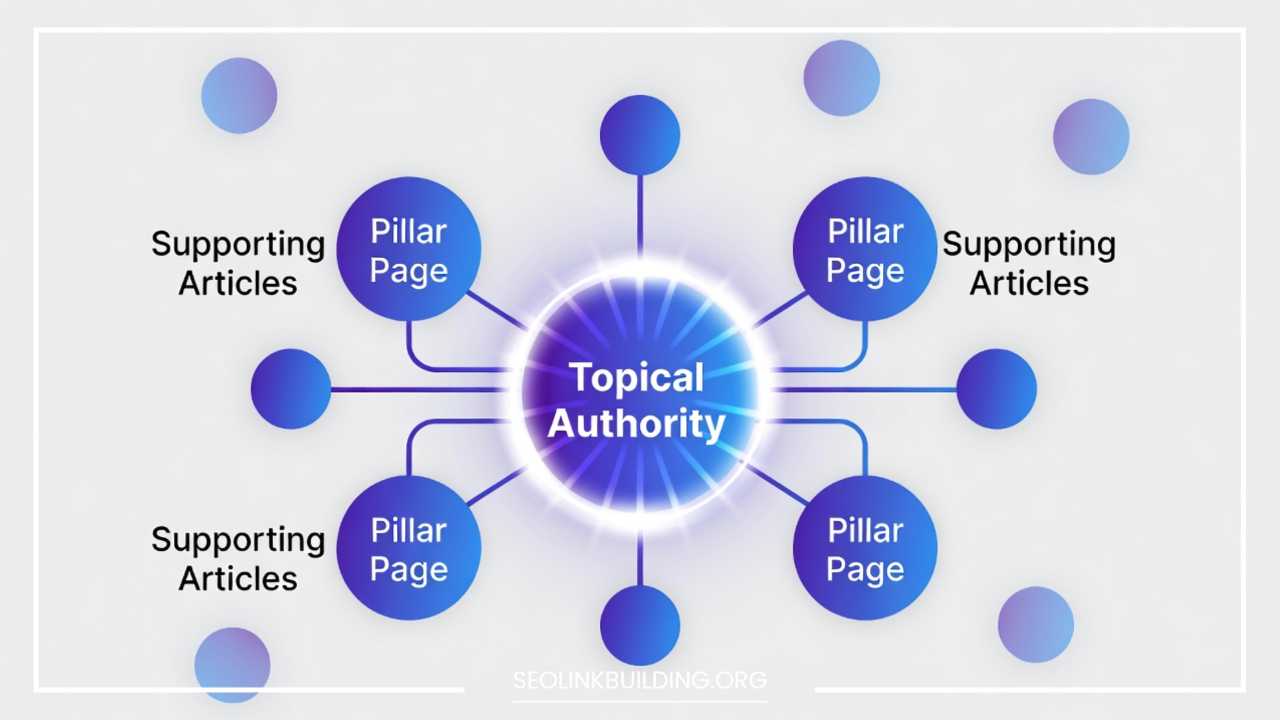
The “Topic Cluster” model is the practical framework used to build topical authority. Popularized by HubSpot, this model organizes your site architecture in a way that search engines love.
The Three Pillars of a Cluster
-
Pillar Content: This is a comprehensive, high-level guide on a broad topic (e.g., “The Ultimate Guide to Content Marketing”). It touches on all aspects of the topic but leaves the granular details for other pages.
-
Cluster Content (Supporting Pages): These are articles that dive deep into specific sub-topics (e.g., “How to Write a Blog Post,” “Video Marketing Strategy,” “Podcast SEO”).
-
Internal Linking: This is the glue. All cluster pages must link back to the pillar page, and the pillar page should link out to the cluster pages.
Example Cluster: “Search Engine Optimization”
If you wanted to be an authority on SEO, your cluster might look like this:
-
Pillar Page: Everything You Need to Know About SEO.
-
Cluster Page 1: A Deep Dive into On-Page Optimization.
-
Cluster Page 2: Technical SEO Audit Checklist.
-
Cluster Page 3: How to Build High-Quality Backlinks.
-
Cluster Page 4: Understanding Keyword Intent.
-
Cluster Page 5: The Best SEO Tools for 2026.
By interlinking these, you create a “web” of relevance. Google sees this structure and recognizes that your site isn’t just a collection of random posts; it is a structured library of SEO knowledge.
Step-by-Step: How to Build Topical Authority
Building authority doesn’t happen by accident. It requires a methodical, step-by-step approach to content creation.
Step 1: Choose a Clear Niche
The biggest mistake beginners make is trying to be “everything to everyone.” It is nearly impossible for a new site to build authority in “Technology.” However, you can build authority in “Mechanical Keyboards for Software Developers.” Start narrow. Once you dominate a micro-niche, you can expand to adjacent topics.
Step 2: Map the Entire Topic Universe
Before you write a single word, you need to know what your audience is asking.
-
Keyword Tools: Use tools like Ahrefs, Semrush, or AnswerThePublic to find every related query.
-
Analyze Competitors: See what categories your top competitors have in their navigation menus.
-
People Also Ask (PAA): Look at the questions Google displays in the search results. These are literally the “sub-topics” Google thinks are relevant.
Step 3: Create a Pillar Page
Your pillar page should be the “home base” for the topic. It should be long-form (usually 2,000+ words) and serve as a table of contents for the entire subject. It should provide enough value to stand alone but also pique the reader’s interest to click through to your deeper cluster articles.
Step 4: Build Supporting Content
Now, start filling in the gaps. For every sub-heading on your pillar page, you should eventually have a dedicated, 1,000-word supporting article. The goal is to ensure that a user never has to leave your site to find an answer related to that specific niche.
Step 5: Interlink Strategically
The power of a topic cluster lies in the links.
-
Use descriptive anchor text (e.g., instead of “click here,” use “on-page SEO techniques”).
-
Ensure every cluster page links back to the pillar.
-
Link between cluster pages where it makes sense for the user journey.
Step 6: Update Content Regularly
Topical authority is not a “set it and forget it” strategy. Information changes. To maintain your status as an expert, you must revisit your pillar and cluster pages at least once a year to update facts, statistics, and best practices.
Step 7: Earn Relevant Backlinks
While topical authority is built via content, it is validated via links. Reach out to other experts in your niche. Guest post on relevant sites. If your content is truly the most comprehensive resource on a topic, people will naturally start linking to it as a reference.
Real Example of Topical Authority in Action
To see topical authority in the real world, look no further than NerdWallet.
NerdWallet doesn’t just rank for “best credit cards” because they have a high Domain Authority. They rank because they have built massive clusters around every conceivable financial topic. If you search for “how to balance a checkbook,” “what is a mortgage,” or “how to invest $1,000,” NerdWallet is there.
By providing thousands of free, deeply researched articles on small, “low-volume” financial questions, they have proven to Google that they are a master of the “Personal Finance” entity. When they eventually publish a page about a high-competition keyword like “Best Savings Accounts,” Google gives them a massive “head start” because their topical authority is so high.
Another example is Ahrefs. Their blog is a masterclass in topical authority for SEO. They don’t write about cooking or lifestyle; they write exclusively about SEO and marketing. Because their coverage is so dense, they can rank for new, high-competition terms almost instantly.
Common Mistakes to Avoid
Even with a plan, it is easy to veer off track. Avoid these common pitfalls:
-
Publishing “Random” Content: Don’t write about a trending news story just because it’s popular if it has nothing to do with your core niche. This dilutes your topical relevance.
-
Ignoring Internal Links: If you write 50 great articles but they aren’t linked together, Google will see them as 50 isolated pages rather than one authoritative body of work.
-
Writing “Thin” Articles: Don’t create pages just to hit a word count. If a page doesn’t provide real value or answer a specific user intent, it’s “noise,” not authority.
-
Chasing High Volume Only: Many SEOs ignore low-volume keywords. However, low-volume “long-tail” keywords are often the foundation of topical authority. They prove you care about the details, not just the traffic.
-
Relying Only on Backlinks: A site with 1,000 links but only 5 pages of content will never have the topical authority of a site with 100 links and 500 pages of deeply interlinked content.
How Long Does It Take to Build Topical Authority?
Topical authority is a marathon, not a sprint. Because you are building a reputation with an algorithm, it takes time for Google to crawl, index, and understand the relationships between your pages.
Generally, you can expect to see significant results within 6 to 12 months of consistent content production. The timeline depends on:
-
Content Velocity: How many high-quality articles are you publishing per month?
-
Niche Competition: Are you competing against established giants or a wide-open niche?
-
Historical Data: It is easier to build authority on an aged domain than on a brand-new one.
However, once you reach the “tipping point,” the results are exponential. You will find that new content begins to rank on page one within days rather than months.
FAQs Section
Is topical authority an official Google ranking factor?
Google does not have a single “Topical Authority Score,” but they have confirmed that they use various signals to determine a site’s expertise and relevance for specific topics. It is a conceptual framework that aligns with their documented ranking systems.
Does topical authority replace the need for backlinks?
No. Think of topical authority as the “foundation” and backlinks as the “votes.” You need a solid foundation to be taken seriously, but you still need votes to win the election for the number one spot.
Can a brand-new site build topical authority?
Absolutely. In fact, focusing on a tight “micro-niche” is the best way for a new site to compete with larger, more established domains. By being more specific and more thorough than the “big guys,” you can win.
How many articles do I need to build authority?
There is no magic number. For some narrow niches, 20-30 articles might suffice. For broader niches like “Fitness,” you may need hundreds. The goal is “complete coverage”—if a user has a question about your topic, you should have the answer.
Final Thoughts
In the modern SEO landscape, the “secret sauce” is no longer a secret. It is Topical Authority.
By moving away from the “one-off keyword” mentality and toward a “subject mastery” mindset, you align your goals with Google’s. You stop trying to trick the algorithm and start providing the depth, structure, and consistency that users—and search engines—crave.
Building topical authority requires a significant investment of time and resources. You must research deeper, write better, and organize your site more logically than your competitors. But the reward is a sustainable, long-term ranking position that is incredibly difficult for competitors to steal.
Start by choosing your niche, mapping your cluster, and writing your first pillar page. Once you prove you are the expert, the rankings will follow.