Search Engine Rank Tracking for SEO Performance

Search Engine Rank Tracking for SEO Performance
In the ever-evolving landscape of digital marketing, the ability to measure progress is what separates successful campaigns from shots in the dark. Search engine rank tracking remains one of the most fundamental pillars of a robust Search Engine Optimization (SEO) strategy. While modern SEO has shifted toward holistic metrics like user engagement, brand sentiment, and conversion rates, the position of your website on a Search Engine Results Page (SERP) remains the primary gateway to visibility and organic traffic. Without a clear understanding of where your pages stand in the digital hierarchy, any attempt at optimization is essentially an exercise in guesswork.
Introduction to Search Engine Rank Tracking
Search engine rank tracking is the systematic process of monitoring the positions of your website’s URLs for specific keywords over a period of time. It is a diagnostic tool that tells you exactly where you stand in the vast, hyper-competitive library of the internet. In the early, simpler days of the web, this was a straightforward task: you typed a word into Google and counted how many links down you were. However, as search engines have become more sophisticated, rank tracking has evolved into a complex data science.
Today’s search results are highly personalized. Two users searching for the same term at the same time might see different results based on their search history, their physical location, and the device they are using. This makes manual tracking not only tedious but fundamentally inaccurate. Modern rank tracking requires specialized tools that can simulate searches from various locations and devices to provide a clean, unbiased view of a site’s performance.
Despite the rise of social media and paid advertising, rankings still matter immensely because the vast majority of user clicks go to the top three organic results. If you aren’t tracking your positions, you are essentially flying blind. Rank tracking provides the feedback loop necessary to understand if your on-page optimizations, backlink building, and technical fixes are actually moving the needle. By correlating ranking shifts with broader SEO performance metrics, businesses can justify their marketing spend, report accurately to stakeholders, and pivot their strategies based on real-world data rather than intuition.
Throughout this guide, we will explore the mechanics of how rankings work, why they fluctuate, and how you can harness this data to drive meaningful growth for your digital presence.
Understanding How Search Engine Rankings Work
To track rankings effectively, one must first understand the complex machinery that determines them. At its core, a search engine like Google uses automated programs called “crawlers” or “spiders” to map the web. These crawlers follow links from one page to another, indexing content and storing it in massive, globally distributed databases. When a user enters a query, the search engine doesn’t search the live web; it searches its index.
The “magic” happens in the ranking algorithm. This algorithm applies hundreds, if not thousands, of ranking signals to find the most relevant, authoritative, and high-quality pages to display for a specific query. While Google keeps the exact weights of these factors a closely guarded secret, the SEO community generally categorizes them into three main buckets:
-
Relevance: How well does the content on the page match the intent behind the user’s search query?
-
Authority: Does the page have high-quality backlinks from other reputable sites, signaling that the information is trustworthy?
-
Experience: Is the site fast, mobile-friendly, and easy for a human to navigate?
The Modern SERP Landscape
The Search Engine Results Page is no longer just a “ten blue links” list. Modern search pages are filled with dynamic elements known as SERP features. These features have fundamentally changed the way we track rankings because a “number one” organic position might actually be pushed far down the page by other elements. Key features include:
-
Featured Snippets: Often called “Position Zero,” these provide a direct answer to a query in a box at the top of the page.
-
Local Packs: The map and business listings that appear for location-specific queries (e.g., “coffee shop near me”).
-
People Also Ask (PAA): Accordion-style boxes containing questions related to the initial search.
-
Knowledge Panels: Information boxes that appear on the right side of the screen (on desktop) regarding entities like celebrities, brands, or historical events.
Why Rankings Fluctuate
Rankings are rarely static. On any given day, a page might move up or down several spots. This volatility is often caused by the “Google Dance,” a period where Google’s index is updating and testing new data. Other causes include competitor activity—if a rival publishes a better guide or gains a significant backlink, they may leapfrog you. Major core algorithm updates, which Google releases several times a year, can cause massive shifts across entire industries. Understanding that a rank is a dynamic data point in a shifting ecosystem is crucial for anyone responsible for SEO performance.
Why Search Engine Rank Tracking Is Critical for SEO Performance
The primary reason to track rankings is to measure the Return on Investment (ROI) of your SEO efforts. Unlike Paid Search (PPC), where you can see immediate results for your spend, SEO is a long-term game. It often takes months for a new content strategy or technical overhaul to yield a significant increase in traffic. Rank tracking acts as a leading indicator; seeing a keyword move from page five to page two is a clear sign of progress long before that keyword starts generating revenue.
Identifying Winners and Losers
Rank tracking allows you to identify “winning” keywords—those that have high search volume and intent and are steadily climbing. Conversely, it helps you spot “underperforming” keywords that may have once been high-earners but are now slipping. This data is actionable. If you see a high-value keyword dropping, you can investigate immediately: Is the content outdated? Has the page slowed down? Is a competitor targeting that specific term?
Strategic Alignment
Aligning ranking data with business goals is where the real value lies. If a company’s quarterly goal is to increase sign-ups for a specific software tool, the SEO team should prioritize tracking and improving rankings for “transactional” keywords related to that tool. Tracking generic informational terms is fine for brand awareness, but rank tracking allows you to focus your limited resources on the terms that directly affect the bottom line. It provides a roadmap for where to allocate budget, whether that means hiring writers for new content or investing in a technical audit to fix indexing issues.
Key Metrics to Track in Search Engine Rank Tracking
To get a full, 360-degree picture of SEO performance, you must look beyond the simple “rank number.” While being #1 is the goal, other metrics provide context that is often more useful for strategy.
Keyword Position Tracking
This is the baseline: the specific numerical rank of your URL for a chosen keyword. However, it is important to track this over time rather than looking at a single snapshot. A “trend line” is much more informative than a single data point.
Visibility Score and Share of Voice
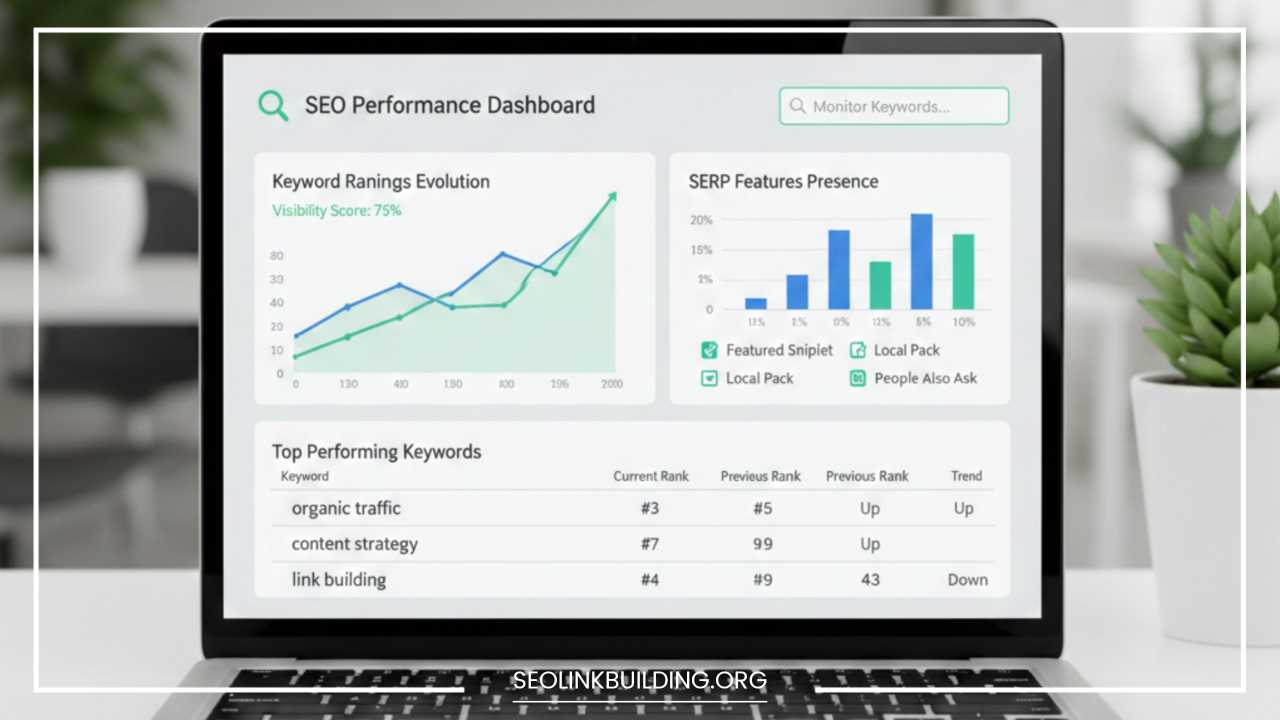
This is a sophisticated, weighted metric. It calculates your overall presence in search by considering how many keywords you rank for and how high those ranks are. A visibility score of 20% means you are capturing about one-fifth of the total potential clicks for your tracked keyword list. This is an excellent way to report progress to executives who may not care about individual keywords but want to see the brand’s overall market share growing.
SERP Feature Presence
In a world of “zero-click searches,” owning the Featured Snippet or appearing in the Local Pack can be more valuable than the top organic link. Tracking these features allows you to see how much “real estate” you occupy. If you rank #1 but a Featured Snippet and a Video Carousel are above you, your actual click-through rate (CTR) will be much lower than expected.
Mobile vs. Desktop Rankings
Since Google switched to mobile-first indexing, the mobile version of your site is the one that counts for ranking. However, users still behave differently on different devices. Tracking the discrepancy between mobile and desktop ranks can reveal technical issues. For instance, if you rank #3 on desktop but #15 on mobile, your site likely has mobile usability or speed issues that need urgent attention.
Local vs. Global Rankings
For a business with physical locations, such as a retail chain or a medical practice, global rankings are almost irrelevant. They need to know how they rank in specific cities, neighborhoods, or even within a few blocks of their front door. Local rank tracking uses GPS coordinates or IP filtering to show what a “local” sees, which is essential for managing a Google Business Profile.
Types of Search Engine Rank Tracking
Not all rank tracking is created equal. Depending on your business model and the competitiveness of your niche, you will need to employ different strategies.
Frequency of Tracking
-
Daily Tracking: Necessary for highly volatile industries like news, finance, or e-commerce, where a single day’s drop can mean thousands of dollars in lost revenue.
-
Weekly/Monthly Tracking: Sufficient for B2B companies or niche blogs where the search landscape is more stable and changes happen more slowly.
Geographical Scope
-
Global Tracking: Used by international brands or digital-only services (like SaaS) that want to see their standing across an entire language-speaking population (e.g., all of the US or the UK).
-
Hyper-Local Tracking: Essential for “near me” searches. This tracks rankings at the city or zip code level, providing a granular view of local competition.
Device-Specific Tracking
With mobile devices accounting for more than half of all web traffic, tracking your mobile performance is no longer optional. A comprehensive tracking strategy monitors both mobile and desktop to ensure a consistent user experience and visibility across all platforms.
Competitor Rank Tracking
You do not exist in a vacuum. If your rankings go down, it’s often because a competitor’s rankings went up. By tracking your competitors alongside your own site, you can identify their strategy. Are they attacking your “money keywords”? Have they found a gap in your content that they are exploiting? Competitor data turns rank tracking from a defensive measure into an offensive weapon.
Tools for Search Engine Rank Tracking
The SEO industry has developed a wide array of tools to automate and refine the tracking process. Manual searching is not just inefficient; it is misleading. Google’s algorithms are designed to give you what you want, so if you frequently visit your own site, Google will likely show it higher in your search results than it does for a stranger.
Features to Look For in Rank Tracking Software
When evaluating tools, look for the following:
-
Data Accuracy: Does the tool update frequently?
-
Localization: Can it track at the city or zip code level?
-
SERP Feature Tracking: Does it show you who owns the snippets and map packs?
-
Historical Data: Can you look back a year or more to see long-term trends?
-
Integration: Does it connect with Google Search Console and Google Analytics to provide a unified view?
Common Tool Categories
-
All-in-One SEO Suites: Tools like Semrush, Ahrefs, and Moz offer rank tracking as part of a larger package that includes backlink analysis and site auditing. These are great for generalists.
-
Dedicated Rank Trackers: Tools like AccuRanker or Advanced Web Ranking focus specifically on one thing: rank tracking. They often offer faster updates and more granular local data.
-
Free Tools: Google Search Console is the most powerful free tool. While it doesn’t give you “live” rankings in the same way paid tools do, it provides “average position” data based on real user searches.
Limitations of Rank Tracking Tools
It is important to remember that tools are providing a “simulated” rank. They use proxy servers to mimic users. While they are highly accurate, they may occasionally miss hyper-personalized results or experimental SERP layouts that Google is testing on a small percentage of users. Treat tool data as a highly reliable trend indicator rather than the absolute truth.
How to Set Up Search Engine Rank Tracking Correctly
A common mistake made by beginners is “data dumping”—uploading every keyword they can think of into a tracker and then becoming overwhelmed by the noise. A strategic setup is required for the data to be useful.
1. Choosing the Right Keywords
Focus on a “representative sample” of keywords. This should include:
-
Head Terms: High-volume, broad terms (e.g., “shoes”).
-
Mid-Tail: More specific terms (e.g., “running shoes for men”).
-
Long-Tail: Highly specific, high-conversion terms (e.g., “waterproof trail running shoes for wide feet”).
2. Grouping Keywords by Intent
Group your keywords into categories:
-
Informational: Users looking for answers (e.g., “how to clean running shoes”).
-
Navigational: Users looking for a specific brand (e.g., “Nike official site”).
- Transactional: Users ready to buy (e.g., “buy Nike Pegasus 40”).By grouping them, you can see if your “top of funnel” content is working compared to your product pages.
3. Selecting Locations and Devices
If your business is based in London but has a branch in Manchester, you must set up separate tracking for both cities. Similarly, if your audience is primarily Gen Z, you should prioritize mobile tracking, as that demographic rarely uses desktop computers for casual search.
4. Establishing Benchmarks
Before you launch a new SEO campaign, a site migration, or a major content update, record your current rankings. This “Day Zero” data is essential. Without a benchmark, you cannot prove that your work led to the subsequent growth.
Analyzing Rank Tracking Data for SEO Performance
Collecting data is only half the battle; the real skill lies in interpretation. A drop in rankings isn’t always a disaster, and a rise isn’t always a victory.
Interpreting Ranking Changes
Minor fluctuations (moving from #4 to #6) are often just “noise.” However, a “precipitous drop”—where a page falls from the first page to the fifth—usually signals a problem. This could be a technical error (like accidentally “noindexing” a page), a loss of a major backlink, or an algorithm update that has re-evaluated the quality of your content.
Connecting Rankings with Traffic and Conversions
Rankings are a “vanity metric” if they don’t lead to traffic and sales. Always cross-reference your rank tracking data with Google Analytics. If your rank for a specific keyword goes up, but your traffic doesn’t, it might mean the keyword is “dead”—perhaps people aren’t searching for that term anymore, or a new Google feature is answering the question so well that no one needs to click on a website.
Identifying Algorithm Updates
When you see a site-wide shift in rankings, compare the date of the shift with official Google announcements. If your rankings dropped exactly when a “Product Reviews Update” was released, you know that you need to improve the quality and depth of your reviews to regain your positions.
Using Rank Tracking to Improve SEO Strategy
Rank tracking should be a proactive tool that informs your daily SEO tasks. It is the compass that tells you which way to walk.
Optimizing “Striking Distance” Keywords
One of the most effective SEO tactics is to find keywords for which you rank at the top of page two (#11 through #15). These are “striking distance” keywords. Because they are already on the cusp of page one, a small effort—adding an image, improving the internal linking, or updating a few paragraphs—can push them onto page one, where the traffic is significantly higher.
Finding New Keyword Opportunities
If your rank tracker shows that you are suddenly ranking for a keyword you didn’t explicitly target, this is a “gift” from the search engine. It means Google thinks your site is an authority on that topic. You can capitalize on this by creating a new, dedicated page for that specific keyword to capture even more traffic.
Competitive Gap Analysis
By tracking your competitors, you can see which keywords they rank for that you don’t. This “gap” represents a ready-made list of content ideas. If three of your competitors rank for “best eco-friendly running shoes” and you don’t, it’s a clear sign that you need to create a page on that topic.
Common Rank Tracking Mistakes to Avoid
To ensure your data leads to good decisions, avoid these common pitfalls:
-
Obsessing Over Single Keywords: Don’t let your boss or client fixate on one specific term. SEO is about the “aggregate.” It is better to rank #5 for ten high-volume keywords than #1 for a single keyword that no one uses.
-
Ignoring Search Intent: Google frequently changes the “intent” of a SERP. If a keyword used to show blog posts but now shows e-commerce listings, your blog post will drop. This isn’t a failure of SEO; it’s a change in user behavior that requires a change in your content type.
-
Tracking Too Many Irrelevant Keywords: If you track 10,000 keywords but only 500 of them are relevant to your products, your “average position” and “visibility score” will be skewed. Focus on the keywords that actually matter to your business.
-
Not Correlating with Performance Metrics: Always ask: “So what?” If a rank goes up, did revenue go up? If not, you may be targeting the wrong keywords.
Future of Search Engine Rank Tracking
The future of rank tracking is moving away from a simple “list” mentality toward “Visual Visibility.” With the introduction of AI-driven results (like Google’s SGE or AI Overviews), the organic search results are being pushed further down the page. In the future, we may track “Pixel Height”—how many pixels from the top of the screen your result appears.
We are also seeing a shift toward “Sentiment Tracking” in search. It’s not just about where you rank, but what the snippet says about you. If you rank #1 but the snippet is a negative review from a third-party site, that’s an SEO problem that traditional rank tracking wouldn’t catch.
Furthermore, as voice search and “Zero-Click” searches grow, tracking “visibility” (the percentage of times your brand is the source of an answer) will become more important than tracking a specific URL’s position. The tools of tomorrow will likely use AI to predict ranking drops before they happen, allowing SEOs to be purely proactive.
Final Thoughts
Search engine rank tracking is more than just a weekly report; it is the heartbeat of your digital marketing strategy. It provides the empirical evidence needed to understand the complex relationship between your website and the search engine algorithms. By tracking the right metrics—from keyword positions to share of voice and SERP feature ownership—you gain the insights necessary to outmaneuver competitors and capture your target audience’s attention.
The most important takeaway is that rank tracking is a means to an end, not the end itself. The goal is not just to see a “1” in your tracking tool; the goal is to drive traffic, build brand authority, and ultimately grow your business. Consistency is key. By monitoring your progress daily or weekly, you can identify patterns, learn from your mistakes, and stay ahead of the curve in an increasingly crowded digital world.