
B2B Digital Marketing Strategies

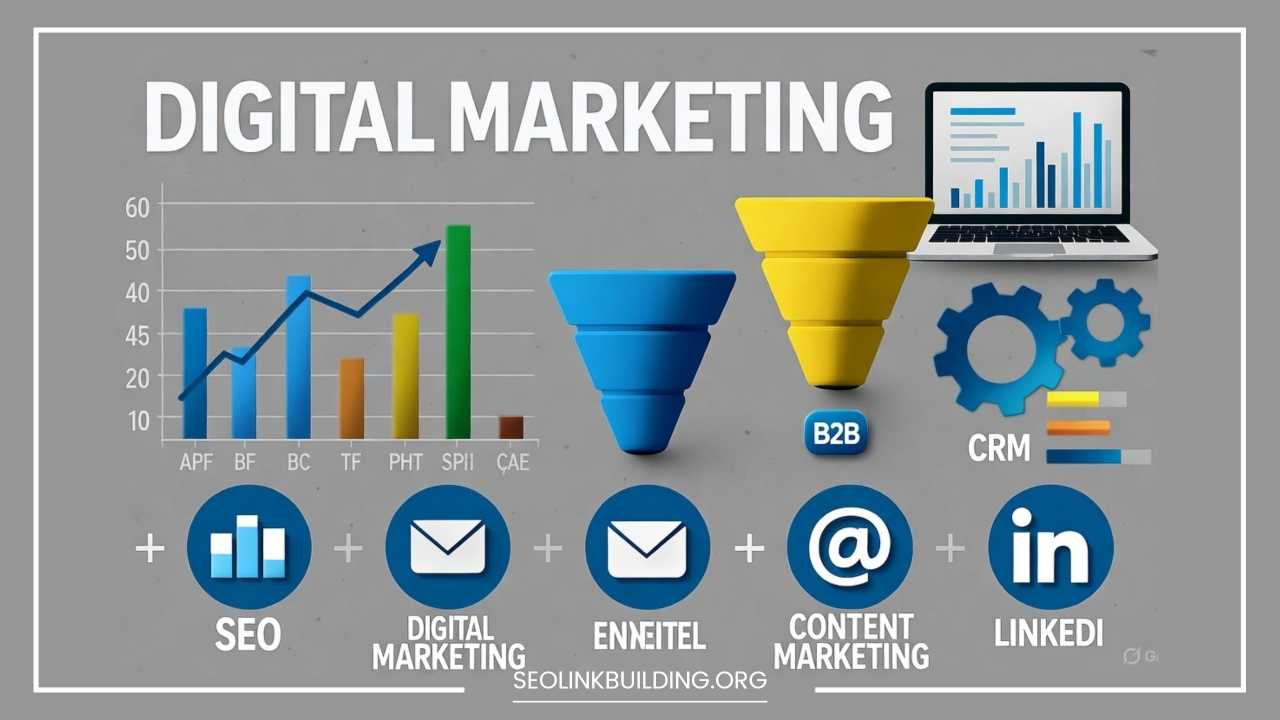
B2B Digital Marketing Strategies | Proven Tactics to Drive Leads & ROI
The business-to-business (B2B) landscape has fundamentally shifted. Gone are the days when networking, cold calling, and print ads were sufficient to fill the sales pipeline. Today, the initial discovery, research, and vetting of vendors happen almost entirely online. This makes B2B digital marketing not just a luxury, but the absolute engine for modern business growth. It encompasses all digital efforts—from content creation and SEO to social media and paid advertising—used to connect businesses with the right decision-makers at potential client companies.
The ultimate goal of these strategies is twofold: to drive qualified leads and to ensure a measurable, significant Return on Investment (ROI). Unlike B2C marketing, which often targets immediate purchases, B2B digital marketing focuses on building long-term trust, demonstrating expertise, and nurturing relationships over extended sales cycles.
This comprehensive guide breaks down the proven tactics and cutting-edge strategies that top-performing B2B organizations use to outperform the competition, secure high-value contracts, and build sustainable, long-term growth. Readers will gain a strategic blueprint for maximizing their digital presence, aligning sales and marketing efforts, and generating a predictable stream of revenue-generating leads.
Understanding the B2B Buyer Journey
Successfully marketing to other businesses requires a deep, empathetic understanding of how their internal decision-making process works. This journey is typically broken down into three core stages, which are fundamentally different from the often impulsive, shorter B2C cycle:
- Awareness: The prospect recognizes they have a problem or opportunity. They are looking for educational content that validates their pain point and provides preliminary high-level solutions. They are not yet ready to hear a sales pitch.
- Consideration: The prospect has defined their problem and is now actively researching various solutions. They are comparing different approaches, methodologies, and product categories. Content here must be comparative, data-rich, and focused on methodology (e.g., “5 Ways to Automate X,” “Guide to Choosing a Y Platform”).
- Decision: The prospect has created a shortlist and is ready to evaluate specific vendors. They need content that proves value, minimizes risk, and outlines clear ROI. This is the stage for product demos, pricing information, and contract negotiations.
B2B vs. B2C: The Key Difference
The B2B journey is characterized by multiple stakeholders (the “buying center”), higher contract values, and significantly longer sales cycles (often 6-18 months). The purchase is a logical, risk-averse decision, meaning trust, authority, and proven ROI are paramount. Digital marketing must focus on providing value at every stage to build the necessary credibility for a complex, committee-based sale.
Core B2B Digital Marketing Channels
A successful B2B strategy integrates multiple digital channels into a cohesive ecosystem. Each channel plays a distinct, crucial role in moving a prospect from initial awareness to final conversion.
Content Marketing
Content is the fuel for the entire B2B engine. It serves to educate, build authority, and organically attract high-intent prospects.
- Blog Posts & Articles: Used for the Awareness stage, addressing common pain points and industry trends (e.g., “The Future of Cloud Security”).
- Whitepapers & eBooks: High-value, gated content for the Consideration stage, offering in-depth solutions in exchange for lead data.
- Case Studies: Essential for the Decision stage, providing irrefutable proof of ROI and successful outcomes with real client examples.
Email Marketing
Email is the single most effective channel for lead nurturing and maintaining long-term engagement.
- Lead Nurturing/Drip Campaigns: Automated sequences that deliver contextually relevant content based on a prospect’s behavior (e.g., sending a case study to a prospect who downloaded a whitepaper).
- Newsletters: Regular communication to keep the brand top-of-mind and share thought leadership content, reinforcing authority.
SEO & SEM
This combination ensures your business is discoverable when a prospect is actively searching for a solution.
- Search Engine Optimization (SEO): The process of optimizing website and content to rank organically in search results. B2B SEO focuses heavily on long-tail keywords that indicate high purchase intent (e.g., “best supply chain management software for SMBs”).
- Search Engine Marketing (SEM) / Paid Search: Using platforms like Google Ads to secure top-of-page visibility for crucial, high-intent keywords. This is often an effective strategy for capturing leads who are already in the Decision stage.
LinkedIn & Social Media
For B2B, LinkedIn is the uncontested primary platform, though Twitter/X and niche industry forums are also valuable.
- Thought Leadership: Positioning executives and subject matter experts as authorities in their field, driving organic awareness and credibility.
- Targeted Lead Generation: Utilizing LinkedIn’s precise audience targeting features (based on job title, industry, and company size) for highly specific ad campaigns.
Webinars & Virtual Events
These are powerful tools for trust-building and education-based selling.
- Education-Based Selling: Webinars allow prospects to dedicate an hour to understanding a complex problem and the solution, providing significant value without a hard sales pitch.
- Live Interaction: The Q&A component offers direct engagement with potential clients, allowing the sales team to gather key intelligence and qualify leads in real time. They represent a high-intent conversion point at the start of the Consideration stage.
Account-Based Marketing (ABM)
As B2B sales cycles focus increasingly on quality over quantity, Account-Based Marketing (ABM) has emerged as a critical strategy. Instead of casting a wide net for individual leads, ABM flips the funnel: it identifies a specific set of high-value target companies (the “accounts”) and then deploys personalized, coordinated marketing and sales efforts to penetrate and engage those accounts.
Personalization at Scale
The core of ABM is treating an entire target company as a “market of one.” This involves:
- Hyper-Personalized Content: Creating dedicated landing pages, email copy, and even ad creative that directly references the target company, its stated goals, or recent news.
- Multi-Channel Engagement: Ensuring every key stakeholder within the target account sees a consistent, tailored message across LinkedIn, paid display ads, and email.
Tools and Platforms
Executing ABM requires technology to orchestrate this level of personalization. Platforms like Demandbase and Terminus provide the infrastructure to identify anonymous website visitors from target accounts, deploy dynamic advertising, and measure engagement across the buying center.
ABM Success Metrics
Traditional metrics like Clicks and Impressions are secondary. ABM success is measured by:
- Account Engagement: How many target contacts at the account are engaging with content?
- Pipeline Velocity: How quickly are target accounts moving through the sales funnel?
- Account-Specific Revenue: The ultimate measure of ABM ROI.
Leveraging Marketing Automation & CRM Integration
The sheer volume of data, content, and prospect interactions in B2B marketing makes manual management impossible. This is where Marketing Automation and Customer Relationship Management (CRM) Integration become essential infrastructure.
The Technology Backbone
Platforms like HubSpot, Marketo, and Pardot (often integrated with the Salesforce CRM) automate repetitive tasks, allowing marketers to focus on strategy rather than execution. Key automation functions include:
- Lead Scoring: Assigning numerical scores to leads based on explicit (form data) and implicit (website behavior, email opens) actions. This ensures sales focuses on the most qualified, highest-intent prospects.
- Segmentation: Grouping prospects based on industry, company size, behavior, or pain point to deliver highly relevant, personalized content.
- Nurturing Workflows: Setting up automated email sequences that trigger based on specific actions (e.g., a lead who views the pricing page gets a specific follow-up email).
CRM + Marketing = Alignment with Sales
The seamless integration between the marketing automation platform and the CRM is the key to aligning the entire revenue team. When a lead reaches a defined Marketing Qualified Lead (MQL) score, the automation system automatically pushes it to the CRM and alerts the sales rep. This ensures the hand-off is clean, the sales team has a complete history of the prospect’s digital journey, and the marketing team receives crucial feedback on which MQLs convert to Sales Qualified Leads (SQLs) and, ultimately, customers. This closed-loop feedback system is vital for accurate ROI calculation and strategy refinement.
Data-Driven Marketing & Analytics
In B2B, the focus must shift from simply generating activity to generating measurable, profitable results. Data-Driven Marketing replaces gut-feeling decisions with insights derived from robust analytics.
Key Performance Indicators (KPIs) to Track
The B2B metrics suite focuses on quality, efficiency, and revenue attribution:
- MQLs & SQLs: The number of leads marketing delivers (MQLs) and the number sales accepts (SQLs). A high MQL-to-SQL conversion rate indicates strong lead quality.
- Customer Acquisition Cost (CAC): The total cost of sales and marketing efforts divided by the number of new customers acquired over a specific period.
- Marketing ROI: The revenue attributed to marketing efforts minus the marketing spend, divided by the marketing spend.
- Pipeline Velocity: How long it takes a lead to move from one stage of the sales pipeline to the next—a key indicator of efficiency.
Tools and Actionable Insights
Platforms like Google Analytics, the built-in reporting of HubSpot/Marketo, and specialized dashboards are essential for visualization. Marketers must move beyond vanity metrics (page views) and focus on Conversion Rate Optimization (CRO). This involves continuous A/B testing of landing page headlines, call-to-action (CTA) button copy, and form fields to incrementally improve conversion rates from visitors to leads and leads to opportunities. Data provides the why behind performance, guiding resource allocation to the most profitable channels and content formats.
B2B SEO & Content Strategy
B2B search engine optimization (SEO) is fundamentally about positioning your expertise to be found precisely when a buyer is expressing intent via a search query. It requires a structured, strategic approach centered on topic authority.
Topic Clusters and Pillar Pages
Instead of haphazardly creating content, modern B2B SEO relies on a topic cluster model:
- Pillar Page: A comprehensive, broad piece of content (typically 3,000+ words) that covers a high-level topic (e.g., “The Complete Guide to Enterprise Cloud Migration”). This page is optimized for a head term.
- Cluster Content: Several narrower, deeper articles (e.g., “5 Cloud Migration Risk Assessment Tools,” “Choosing Between Multi-Cloud and Hybrid Cloud”) that link back to the Pillar Page.
This structure tells search engines that your site is the definitive authority on the core topic, boosting the ranking of all related pages.
Targeting Long-Tail Keywords
B2B buyers are highly specific in their search queries. Targeting long-tail keywords (usually 4+ words) is crucial because they reveal clear intent. For instance, instead of targeting “CRM,” a B2B marketer should target “CRM features for healthcare compliance” or “best CRM for sales team of 50.” These keywords have lower search volume but significantly higher conversion rates.
Content Formats that Convert
While blog posts drive traffic (Awareness), other formats are designed for deeper engagement and conversion (Consideration/Decision):
- Interactive Tools & Calculators: (e.g., ROI calculators) provide immediate value in exchange for data.
- EBooks & Comprehensive Guides: Function as the best MQL magnets, offering deep-dive education.
- Infographics & Data Visualizations: Excellent for condensing complex B2B information into shareable, digestible assets for social channels.
Example of High-Performing B2B Content Strategy
A cyber-security firm could have a Pillar Page on “Zero Trust Security Frameworks.” Cluster content would then cover “Implementing Micro-Segmentation,” “Zero Trust Policy Management,” and “Zero Trust Vendor Comparison.” These assets address every stage of the buyer’s journey, using SEO to ensure the firm appears as the primary resource from the moment the buyer realizes they need a solution.
Video Marketing for B2B
Video is no longer a “nice-to-have”; it’s a non-negotiable component of a modern B2B strategy. It significantly cuts through complexity and builds trust faster than text alone.
High-Impact Video Formats
- Product Demos & Feature Overviews: Crucial for the Consideration and Decision stages, allowing buyers to visualize the solution in action. A well-produced demo can dramatically shorten the sales cycle.
- Customer Testimonials/Success Stories: These act as digital references, providing social proof and addressing buyer skepticism with authentic, face-to-face feedback.
- Explainer & Animated Videos: Perfect for the Awareness stage, simplifying complex B2B concepts (e.g., software integrations, regulatory frameworks) in a 60-90 second format.
Distribution and Impact
B2B video should be strategically deployed:
- Website & Landing Pages: Embedding videos on high-conversion pages can boost conversion rates by over 80%.
- LinkedIn: Video content sees significantly higher engagement rates than static posts, driving brand awareness and thought leadership.
- YouTube: Functions as a second search engine for B2B queries. Optimizing videos for YouTube SEO (transcripts, tags, description) captures a vast audience actively researching solutions.
Video increases prospect time-on-site, improves SEO, and injects much-needed personality into the traditionally dry B2B sales process.
Retargeting & Paid Ads
The reality of B2B is that most first-time visitors will not convert. Retargeting and Paid Ads provide the necessary mechanism to bring back highly qualified traffic and accelerate them toward a conversion point.
Strategic Retargeting
Retargeting, also known as remarketing, targets users who have already visited your website but left without converting.
- Segmentation is Key: Don’t show the same ad to everyone. Target prospects who viewed a pricing page with a limited-time demo offer, while those who read a blog post should see an ad for a relevant whitepaper.
- Platform Focus: LinkedIn Ads are superior for B2B as they target specific professional demographics (job title, company size). Google Display Ads (GDN) and YouTube Ads are effective for broad brand awareness and visual retargeting.
Matching Ads to Funnel Stages
- Awareness: Broad, educational ads to cold audiences (e.g., “Industry Trend X is Changing”).
- Consideration: Targeted ads promoting gated content like eBooks or webinars.
- Decision: Highly specific ads promoting product demos, free trials, or case studies.
Budgeting Tips for B2B Campaigns
B2B Cost Per Click (CPC) is typically higher than B2C. Therefore, focus on precise targeting and high-quality ad creative to ensure a high Quality Score (in Google Ads) or high Relevance Score (in LinkedIn), which ultimately lowers your effective cost and boosts ROI.
Common Mistakes to Avoid in B2B Marketing
Even well-funded B2B operations often stumble due to fundamental, avoidable errors that destroy trust and waste budget.
1. Ignoring Data or Buyer Intent
The most expensive mistake is generating high-volume, low-quality traffic. If your content is attracting individual students or irrelevant job seekers, you are ignoring the true buyer intent keywords and demographics that signal a high-value purchase. Always prioritize MQL-to-SQL conversion rate over simple traffic volume.
2. Too Much Focus on Features, Not Value
B2B buyers are risk-averse; they don’t buy features, they buy outcomes. A common error is creating content that simply lists product specs. Successful marketing focuses on the transformational value (e.g., “Achieve 40% compliance audit time reduction” vs. “Our software has Module 7.2”). Value-based selling resonates with the executive level.
3. Misalignment Between Sales and Marketing Teams
Often called “Smarketing,” a lack of a unified definition for an MQL or an SQL, and a failure to pass timely lead intelligence, is disastrous. Marketing generates a lead, but sales fails to follow up with the proper context, resulting in a lost opportunity. Service Level Agreements (SLAs) defining lead quality, follow-up speed, and feedback loops are mandatory.
4. Over-Gating Content
If everything requires a form fill, you inhibit the ability of prospects to self-educate and for search engines to fully crawl your content. Gate only the most valuable, bottom-of-funnel content (eBooks, demos, case studies). Leave blog posts and general information open to build trust and authority first.
Future Trends in B2B Digital Marketing
The B2B marketing landscape is constantly evolving, driven primarily by advancements in artificial intelligence and a greater focus on buyer needs.
AI in Personalization and Content Creation
Artificial Intelligence (AI) is rapidly moving from a novelty to a necessity. Tools are now available that can:
- Hyper-Personalize: Dynamically adjust website content, email copy, and ad creative based on a visitor’s industry, company size, and previous site behavior.
- Scale Content Generation: Assist human writers in generating outlines, first drafts, and variations of content at a speed previously impossible, freeing up marketers for strategic oversight.
Intent-Based Marketing
This is a shift from reactive to proactive marketing. Intent Data Providers (like G2, ZoomInfo) track external online behavior—which topics a prospect is researching, which competitors they are looking up—before they ever visit your site. This allows marketers to launch targeted campaigns against companies that are already showing buying signals, drastically improving lead quality.
Voice Search and Interactive Content
As executives rely more on smart speakers and virtual assistants, optimizing for natural language queries (Voice Search SEO) will become important. Furthermore, Interactive Content (e.g., personality quizzes, advanced calculators, virtual tours) will see increased use as a way to gather deeper prospect data while providing a more engaging experience.
Final Thoughts
B2B digital marketing is not a simple checklist; it is an ongoing, integrated ecosystem that demands strategic planning, technological infrastructure, and constant refinement. The proven tactics—from the foundational authority of Content Marketing and SEO to the precision of ABM and Retargeting—are all designed to serve the core mission: building trust and demonstrating irrefutable value to complex buying committees.
To succeed in this landscape, organizations must prioritize:
- Alignment: A non-negotiable handshake between sales and marketing.
- Data: A closed-loop feedback system to measure ROI and CAC accurately.
- Agility: A willingness to experiment with new channels (like Video and AI) and quickly pivot based on performance data.
By committing to a robust, data-backed B2B digital strategy, businesses can transform their marketing efforts from a cost center into a predictable, high-performing revenue engine that drives long-term success and a powerful ROI.