Marketing Mix Elements: The 4Ps, 7Ps, and Digital Evolution

The Pillars of Strategy: A Deep Dive into the Marketing Mix
1. Introduction
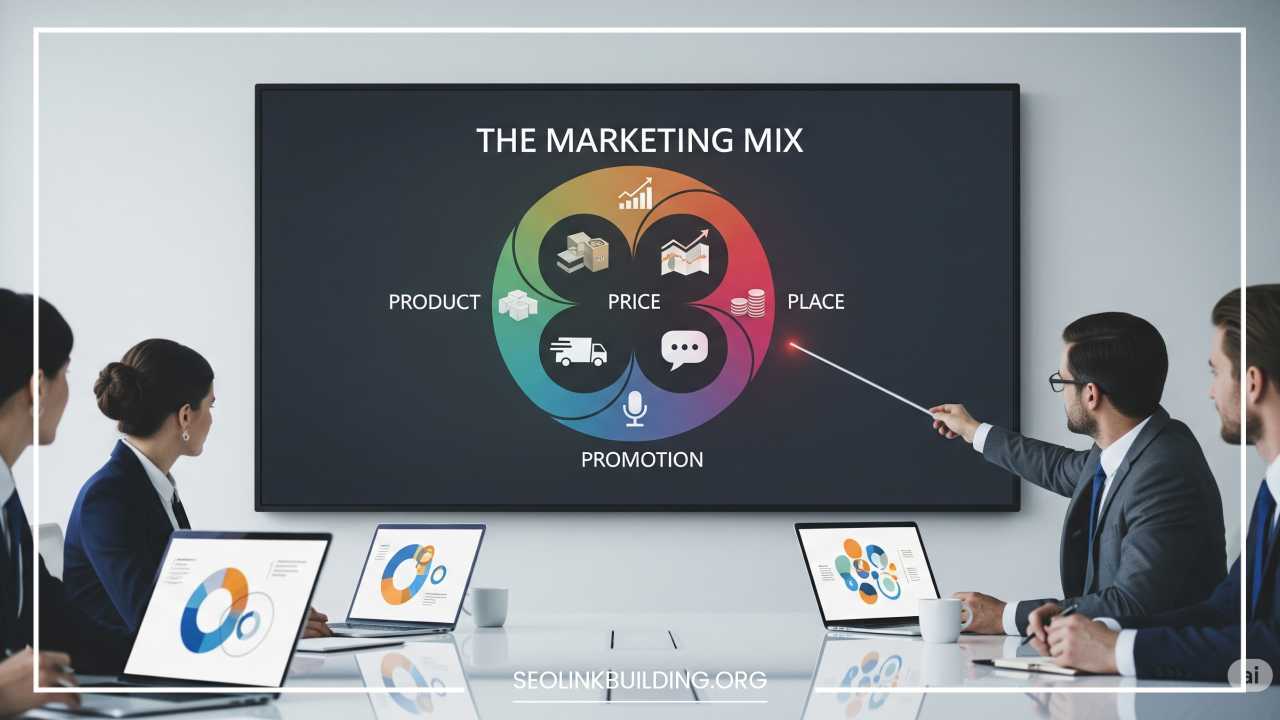
The marketing mix is a cornerstone of modern business strategy, a fundamental concept that provides a framework for how companies interact with their markets. At its core, it’s a set of controllable, tactical marketing tools that a firm uses to produce the response it wants in the target market. Think of it as a recipe for business success, where each ingredient must be carefully chosen and blended to create a desirable outcome. Without a well-defined marketing mix, a business is essentially navigating without a compass, unable to effectively position its offerings, reach its customers, or compete in a crowded marketplace. It’s the blueprint that guides decisions on what to sell, for how much, where to sell it, and how to tell people about it.
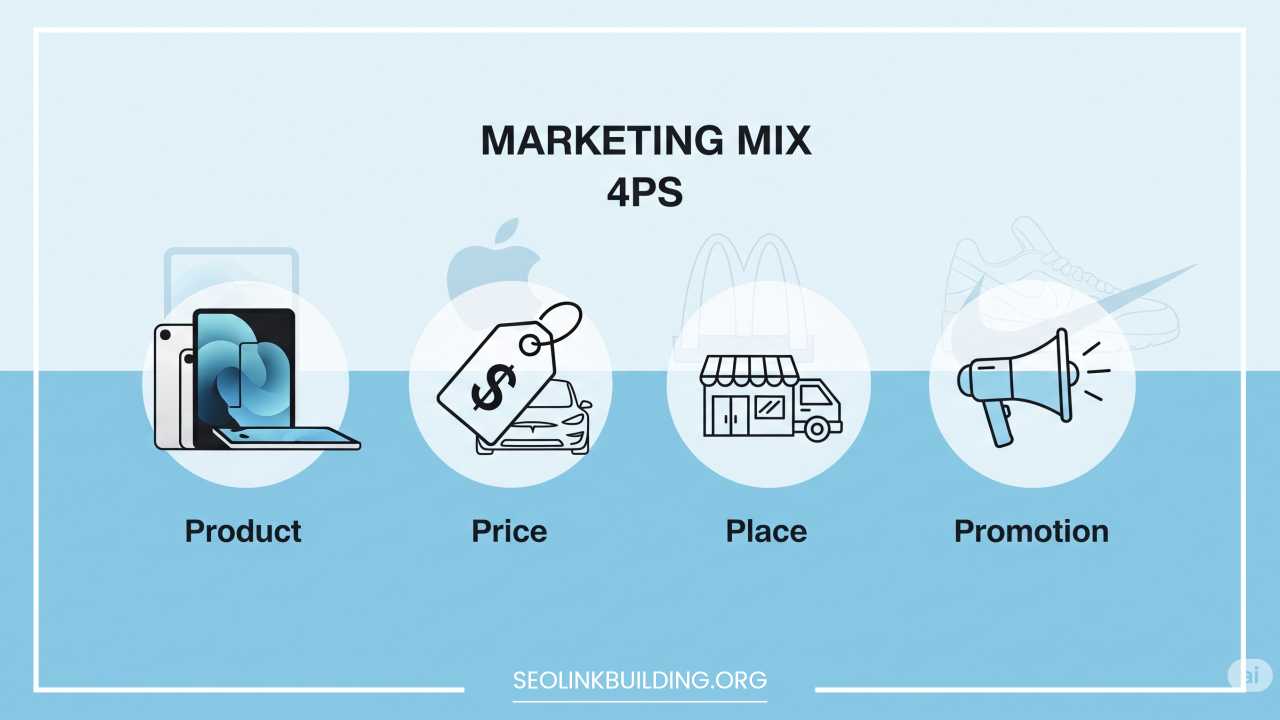
The concept was first popularized by Neil Borden in the 1950s, who described the “marketing mix” as the various activities a marketing manager undertakes to influence the market. However, it was E. Jerome McCarthy who simplified and codified this framework into the now-famous 4Ps: Product, Price, Place, and Promotion. This elegant model became a cornerstone of marketing education and practice, offering a simple yet powerful way to structure a marketing plan. The 4Ps provide a clear, easy-to-understand structure for analyzing a company’s strategic position and making decisions that directly impact its market performance.
The purpose of this article is to provide a comprehensive exploration of the marketing mix, starting with the foundational 4Ps and expanding to more modern iterations like the 7Ps. We will examine how these elements are defined, how they interact, and how they’ve been transformed by the digital age. Through detailed discussions and real-world case studies, we aim to demonstrate why mastering the marketing mix is not just a theoretical exercise but a critical, practical necessity for any business seeking to thrive in today’s dynamic and competitive environment.
2. The 4Ps of Marketing
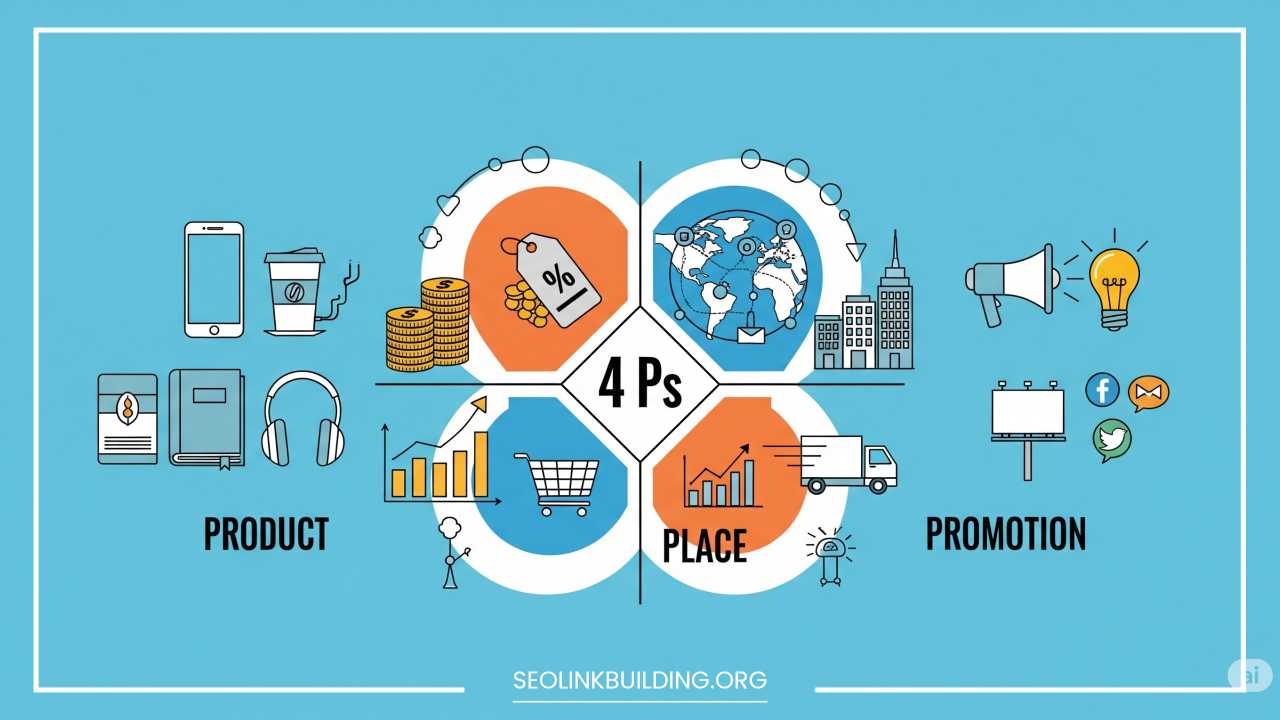
The 4Ps of marketing—Product, Price, Place, and Promotion—represent a classic, foundational model for building a marketing strategy. Each element is interconnected, with decisions in one area often influencing the others. A cohesive and successful strategy requires careful alignment of all four Ps to effectively meet the needs of the target audience.
2.1 Product
The product is the heart of the marketing mix. It refers to the tangible goods, intangible services, or ideas that a company offers to satisfy a customer’s needs or wants. The product is not just the physical item itself but encompasses its features, quality, design, branding, packaging, and a range of accompanying services like warranties and customer support. The core of a product strategy is to understand what problem a product solves for the customer and to ensure the offering is well-differentiated from competitors. A company’s product portfolio must be carefully managed throughout its lifecycle, which typically consists of four stages:
- Introduction: This is the launch phase, characterized by high costs, low sales, and a focus on building awareness. The product is new and requires significant marketing investment.
- Growth: If the product is successful, sales and profits increase rapidly as it gains market acceptance. The focus shifts to building brand loyalty and expanding distribution.
- Maturity: Sales growth slows down as the product becomes widely adopted. Competition intensifies, and the focus shifts to maintaining market share through product improvements, competitive pricing, and aggressive promotion.
- Decline: Sales and profits begin to fall due to new technologies, changing consumer tastes, or increased competition. At this stage, a company must decide whether to discontinue the product, harvest it for a final profit, or find new uses for it.
Product design and development are crucial for creating a product that resonates with consumers. Quality, features, and variety are all levers that can be pulled to meet specific customer demands. For example, a car manufacturer might offer a range of models with varying features and price points to appeal to different segments of the market, from budget-conscious buyers to luxury seekers.
Branding is another vital aspect of the product element. A brand is more than just a name or a logo; it’s the sum of a customer’s experiences and perceptions of a company or its products. A strong brand identity creates trust, fosters loyalty, and can command a price premium. Companies like Apple and Nike have built immensely powerful brands that symbolize innovation and performance, respectively, making their products highly desirable even at a premium price.
2.2 Price
Price is the amount of money a customer has to pay to obtain the product. It’s the only element of the marketing mix that generates revenue; all other elements represent costs. Pricing decisions are arguably the most critical and complex, as they directly impact a company’s profitability, market share, and brand image. A price that is too high may deter potential customers, while a price that is too low may signal poor quality and erode profit margins. The sweet spot is a price that reflects the product’s value to the customer while also being competitive and profitable for the company.
Understanding price elasticity is fundamental to effective pricing. This concept measures how sensitive consumer demand is to changes in price. If demand for a product changes significantly with a small price change, it’s considered elastic (e.g., consumer electronics). If demand remains relatively stable, it’s considered inelastic (e.g., essential medicines or gasoline).
Marketers employ various pricing strategies to achieve their business objectives:
- Competitive Pricing: Setting prices based on what competitors are charging. This is common in highly competitive markets where products are similar, such as the airline or telecommunications industries.
- Cost-Plus Pricing: A simple strategy where a company adds a standard markup to the cost of the product. This ensures a profit but may not be competitive.
- Penetration Pricing: Setting a low initial price to attract a large number of customers quickly and gain market share. This is often used by startups or new entrants to a market.
- Price Skimming: Setting a high initial price for a new, innovative product to “skim” maximum revenue layer by layer from the segments willing to pay the high price. Over time, the price is lowered to attract more price-sensitive customers. This strategy is common for new technology products like smartphones and gaming consoles.
Finally, psychological pricing leverages the fact that consumers don’t always make purely rational purchasing decisions. Tactics like using prices that end in “.99” (e.g., $9.99 instead of $10) are based on the perception that consumers perceive these prices as being significantly lower.
2.3 Place (Distribution)
Place, or distribution, refers to the activities involved in making a product available to the target market. It’s about getting the right product to the right customer at the right time and place. An effective distribution strategy ensures that products are accessible and convenient for consumers, which is a major driver of sales and customer satisfaction.
The choice of distribution channels is a critical decision. There are several types:
- Direct Channel: The company sells directly to the consumer without intermediaries. This can include a company’s own retail stores, its website, or a direct sales force. This model gives the company greater control over the customer experience and profit margins.
- Indirect Channel: The company uses intermediaries, such as wholesalers, distributors, or retailers, to get the product to the consumer. This is a common strategy for products sold in grocery stores or department stores.
- Hybrid Channel: A mix of both direct and indirect channels. For example, a company might sell products through its own website (direct) while also selling through large retail chains (indirect).
Logistics and supply chain management are the backbone of the place element. This involves all the processes required to move a product from the point of origin to the point of consumption, including inventory management, transportation, warehousing, and order processing. An efficient supply chain minimizes costs and ensures products are consistently in stock, which is essential for customer satisfaction.
The rise of e-commerce has dramatically changed the role of place. A company’s retail and online presence are now equally important. While physical stores offer a tangible experience, e-commerce platforms provide global reach and 24/7 accessibility. The modern consumer often expects a seamless omnichannel experience, where they can browse products online, purchase them in a store, or order online and pick up in-store.
2.4 Promotion
Promotion encompasses all the activities a company undertakes to communicate with its target audience and persuade them to buy its products. It’s the voice of the company, and its goal is to inform, persuade, and remind customers about the product. An effective promotional strategy creates a strong brand image and drives sales by making the product top-of-mind for consumers.
The promotion mix includes a variety of tools:
- Advertising: Any paid form of non-personal presentation and promotion of ideas, goods, or services by an identified sponsor (e.g., TV commercials, print ads, online banner ads).
- Sales Promotions: Short-term incentives to encourage the purchase or sale of a product (e.g., coupons, discounts, free samples, contests).
- Personal Selling: A face-to-face presentation by the firm’s sales force for the purpose of making sales and building customer relationships.
- Public Relations (PR): Building good relations with the company’s various publics by obtaining favorable publicity, building a good corporate image, and handling or heading off unfavorable rumors, stories, and events.
- Digital Marketing: A broad category that includes a range of online activities, from search engine optimization (SEO) and email marketing to social media and influencer collaborations.
The concept of Integrated Marketing Communications (IMC) is crucial for effective promotion. IMC ensures that all promotional tools—from advertising to social media—are coordinated to deliver a clear, consistent, and compelling message about the organization and its products.
The digital promotion landscape has exploded in recent years. Social media marketing allows companies to engage directly with consumers, build communities, and gather real-time feedback. Content marketing, through blogs, videos, and podcasts, provides value to consumers and establishes the company as a thought leader in its industry, fostering trust and loyalty. The rise of influencers has also created a powerful new channel for promoting products by leveraging the trust and reach of social media personalities.
3. Evolving the 4Ps: The 7Ps
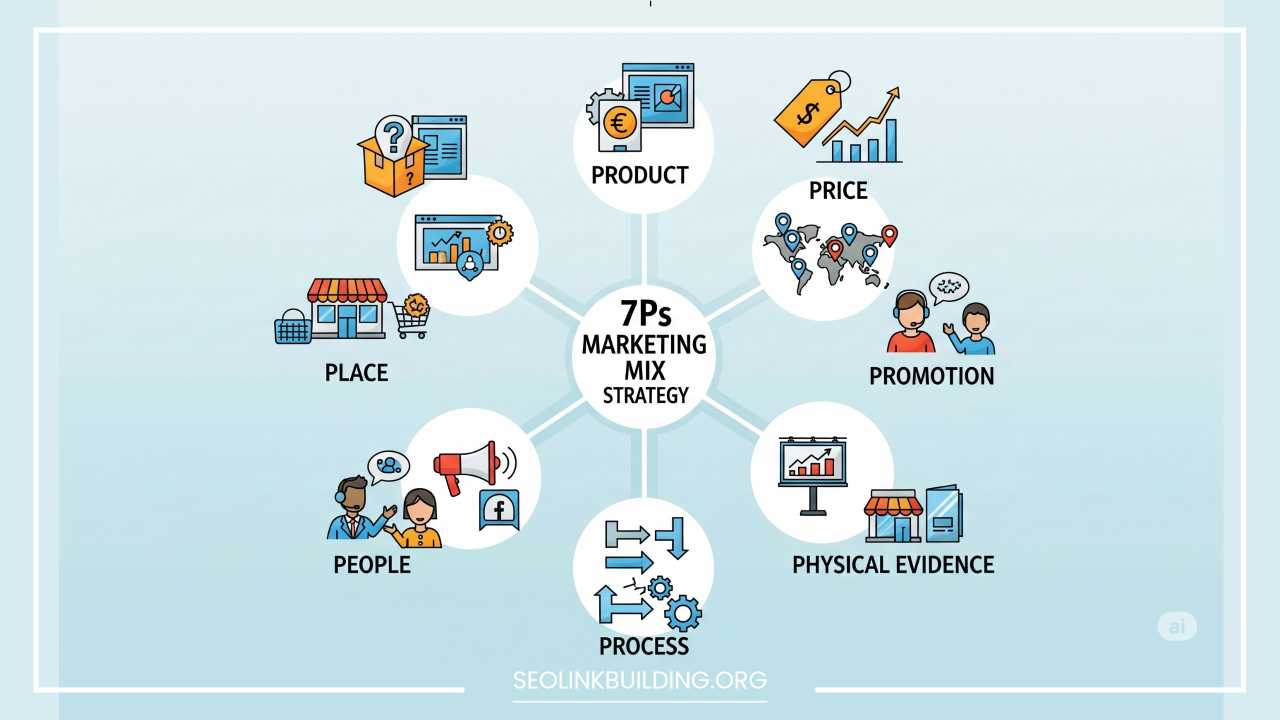
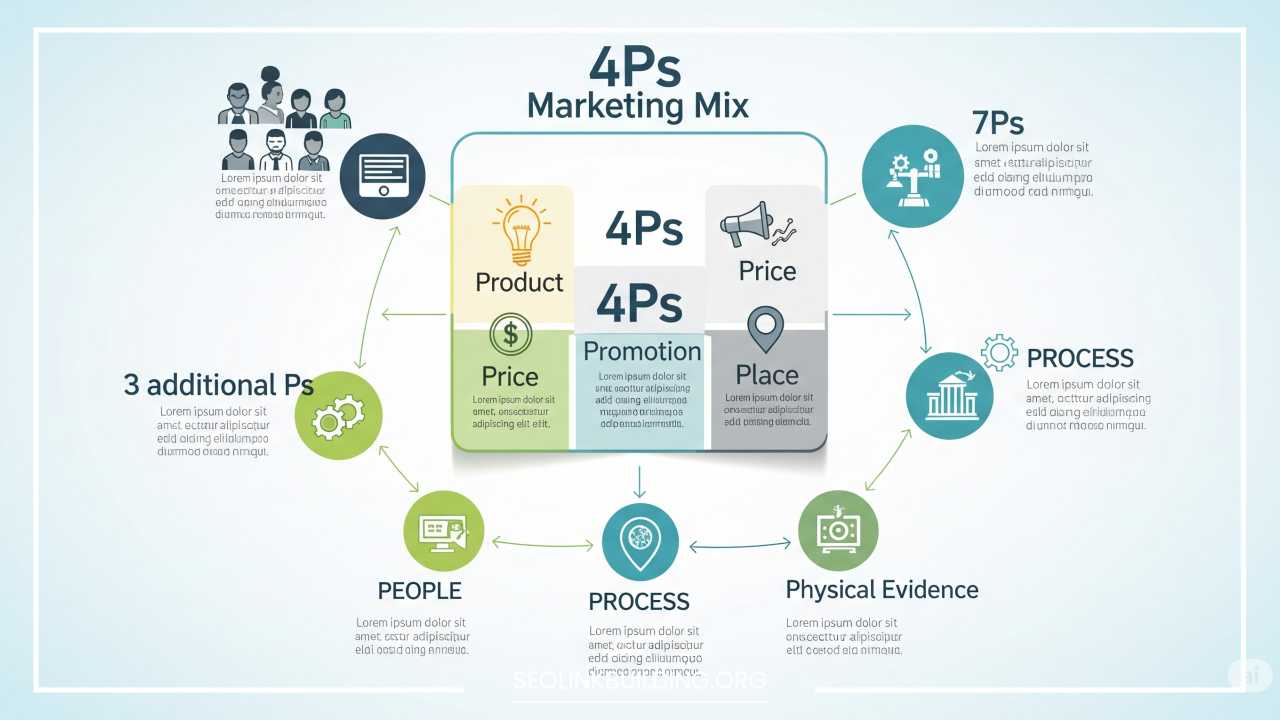
As the global economy shifted from a focus on tangible goods to a service-based model, the traditional 4Ps proved to be an insufficient framework. In the late 1970s, Bernard Booms and Mary Bitner proposed an extension to the marketing mix, introducing three additional elements to better account for the unique characteristics of services. The 7Ps—Product, Price, Place, Promotion, People, Process, and Physical Evidence—provide a more comprehensive framework, especially for service industries like banking, hospitality, and healthcare.
- People: In service industries, the employees who deliver the service are an integral part of the product itself. This includes everyone from the customer service representative to the delivery driver. The attitude, skill, and appearance of these individuals directly impact the customer’s experience. A company’s investment in employee training, motivation, and empowerment is therefore a critical part of its marketing strategy. For example, a high-end restaurant relies not just on its food but on the expertise and demeanor of its waitstaff to create a memorable experience.
- Process: This refers to the systems and procedures by which a service is delivered. A streamlined, efficient process leads to a positive customer experience, while a clunky, time-consuming one can lead to frustration and churn. This includes everything from the ordering process on a website to the handling of customer complaints. Companies that excel in their processes, such as Amazon with its one-click ordering and fast delivery, gain a significant competitive advantage.
- Physical Evidence: Services are intangible, which makes it challenging for customers to evaluate them before purchasing. Physical evidence refers to the tangible cues that give customers an impression of the service’s quality. This includes the physical environment where the service is delivered (e.g., the décor of a hotel lobby or the cleanliness of a hospital), the company’s branding and signage, and any tangible items the customer receives, such as a well-designed airline ticket or a neatly presented receipt. These cues help to build trust and reinforce the brand’s promise.
4. The Digital Era: Adapting the Marketing Mix
The advent of the internet and digital technology has fundamentally reshaped the marketing mix, forcing companies to adapt their strategies and embrace new tools and channels. The digital transformation of the marketing mix is not just about adding new channels; it’s about re-evaluating the core tenets of the 4Ps and 7Ps in a digital context.
- Product: The digital age has blurred the lines between goods and services, leading to the rise of “digital products” like software, apps, and streaming services. The product itself can now be endlessly customized and personalized. Data analytics allows companies to gather real-time feedback on product usage and user experience, enabling them to make rapid, data-driven improvements.
- Price: Online platforms have made it easier for consumers to compare prices, leading to increased price transparency. This has intensified price competition and made dynamic pricing a more viable strategy. Companies can now use algorithms to adjust prices in real-time based on factors like demand, time of day, and even the customer’s Browse history.
- Place: E-commerce has revolutionized distribution. The internet acts as a global marketplace, eliminating geographical barriers and allowing even small businesses to reach a worldwide audience. The focus has shifted from physical logistics to the efficiency of the digital supply chain, including website performance, payment processing, and digital fulfillment.
- Promotion: Digital marketing has introduced a wealth of new promotional tools. From search engine marketing (SEM) and social media ads to email marketing and affiliate programs, companies can now target specific demographics with unprecedented precision. The rise of content marketing has created a new paradigm where promotion is less about interrupting consumers and more about providing them with valuable, engaging content that builds trust and authority.
The role of data analytics and AI cannot be overstated in the modern marketing mix. Businesses can now collect vast amounts of data on customer behavior, preferences, and purchase history. AI-powered algorithms can use this data to deliver personalized marketing messages, product recommendations, and offers, creating a one-to-one marketing experience at scale. This personalization touches all elements of the marketing mix, from tailoring product features to individual needs to delivering dynamic pricing and personalized promotions.
5. Case Studies and Real-World Applications
Understanding the marketing mix in theory is one thing; seeing it in action is another. Let’s examine how a few different companies apply these principles.
Example 1: Apple
Apple is a master of the marketing mix. Its strategy is a cohesive blend of all the Ps.
- Product: Apple’s products are renowned for their sleek design, intuitive user experience, and premium quality. The company manages a highly curated product portfolio that includes hardware (Mac, iPhone, iPad), software (iOS, macOS), and services (Apple Music, iCloud). The brand promise is innovation, simplicity, and elegance.
- Price: Apple employs a price skimming strategy, launching new products at a premium price point to capture early adopters who are willing to pay for the latest technology. Over time, older models are sold at a lower price to attract a broader market. This strategy reinforces the brand’s premium image.
- Place: Apple’s distribution strategy is a hybrid model. It sells directly to consumers through its globally recognized Apple Stores, which serve as both a retail outlet and a brand-building experience. It also sells through a network of authorized resellers and mobile carriers, ensuring wide availability.
- Promotion: Apple’s promotions are iconic. Their minimalist, visually-driven advertisements focus on the emotional benefits and the “cool factor” of their products. They leverage public relations by creating a massive amount of media buzz around their product launch events.
Example 2: A Local Coffee Shop
A small, local coffee shop can also apply the marketing mix to great effect.
- Product: The product is not just coffee; it’s the experience. This includes the quality of the beans, the variety of drinks, and the comfortable, inviting atmosphere. They might offer a loyalty program to encourage repeat business.
- Price: The pricing is likely a mix of competitive pricing (to stay in line with other local cafes) and premium pricing for specialty drinks that use high-quality, ethically sourced beans.
- Place: The most crucial element is the physical location. A coffee shop thrives on being in a high-traffic area, with a welcoming storefront and accessible seating. They might also offer online ordering for pickup to cater to busy customers.
- Promotion: Promotion can be very localized. This might involve social media campaigns featuring latte art, local print advertisements, and a strong presence on Google Maps. They might also run sales promotions like “buy one, get one” on certain days to attract new customers.
Example 3: E-commerce vs. Brick-and-Mortar Retail
The marketing mix for an e-commerce company looks significantly different from a traditional brick-and-mortar retailer.
- Product: An e-commerce business can offer a virtually limitless product catalog without the constraints of physical shelf space. They can also use customer data to personalize product recommendations.
- Price: E-commerce companies can use dynamic pricing and A/B testing to optimize prices in real-time. Price transparency is a major factor, with customers easily able to compare prices across different sites.
- Place: The “place” is the company’s website and app. The focus is on user experience (UX), site performance, and a seamless checkout process. The supply chain is centered on efficient warehousing and logistics to ensure fast, reliable delivery.
- Promotion: E-commerce promotion is heavily data-driven, relying on SEO, PPC (pay-per-click) ads, social media marketing, and email campaigns to drive traffic and sales. Content marketing and influencer collaborations are also key to building brand awareness and trust.
6. Final Thoughts
The marketing mix, whether in its classic 4Ps form or its more comprehensive 7Ps extension, remains the indispensable blueprint for creating a successful marketing strategy. The four foundational elements of Product, Price, Place, and Promotion provide a robust framework for understanding and influencing the market. By carefully aligning these components, businesses can craft a cohesive strategy that effectively positions their offerings, reaches their target customers, and achieves their commercial objectives.
However, the marketing world is in a state of constant evolution. The rise of the digital era, with its emphasis on e-commerce, social media, and data analytics, has not rendered the marketing mix obsolete but rather has transformed and enriched it. The traditional Ps have been re-imagined for a digital context, with personalization, data-driven decisions, and content marketing becoming central to the modern marketer’s toolkit. The additional 3Ps—People, Process, and Physical Evidence—remain vital for service industries, ensuring a holistic approach to customer experience.
Looking ahead, the future of the marketing mix will be shaped by a number of emerging trends. Artificial Intelligence (AI) will continue to drive personalization and automation, allowing for a more nuanced and responsive approach to each element of the mix. Sustainability is becoming a critical factor, influencing product development (e.g., eco-friendly materials), pricing (e.g., fair trade), and promotion (e.g., transparent supply chains). Finally, a shift towards customer-centric marketing will continue to put the consumer at the heart of every decision, with feedback and engagement shaping strategies in real-time.
Ultimately, mastering the marketing mix is not about following a rigid formula but about creatively and strategically blending its elements to meet the ever-changing needs of the market. It is the art and science of shaping a brand’s destiny, and for any business hoping to thrive in today’s fiercely competitive landscape, understanding and executing it flawlessly is non-negotiable.