On-Page vs Off-Page SEO

On-Page vs Off-Page SEO: Key Differences & Optimization Strategies
In the vast, ever-evolving landscape of the internet, where billions of web pages compete for attention, visibility is the ultimate currency. Search Engine Optimization (SEO) is the discipline that determines this visibility, acting as the bridge between a website and its target audience. It is not a singular strategy but a holistic practice built upon foundational principles that help search engines like Google understand, evaluate, and rank content.
At its core, SEO is separated into two interdependent pillars: On-Page SEO and Off-Page SEO.
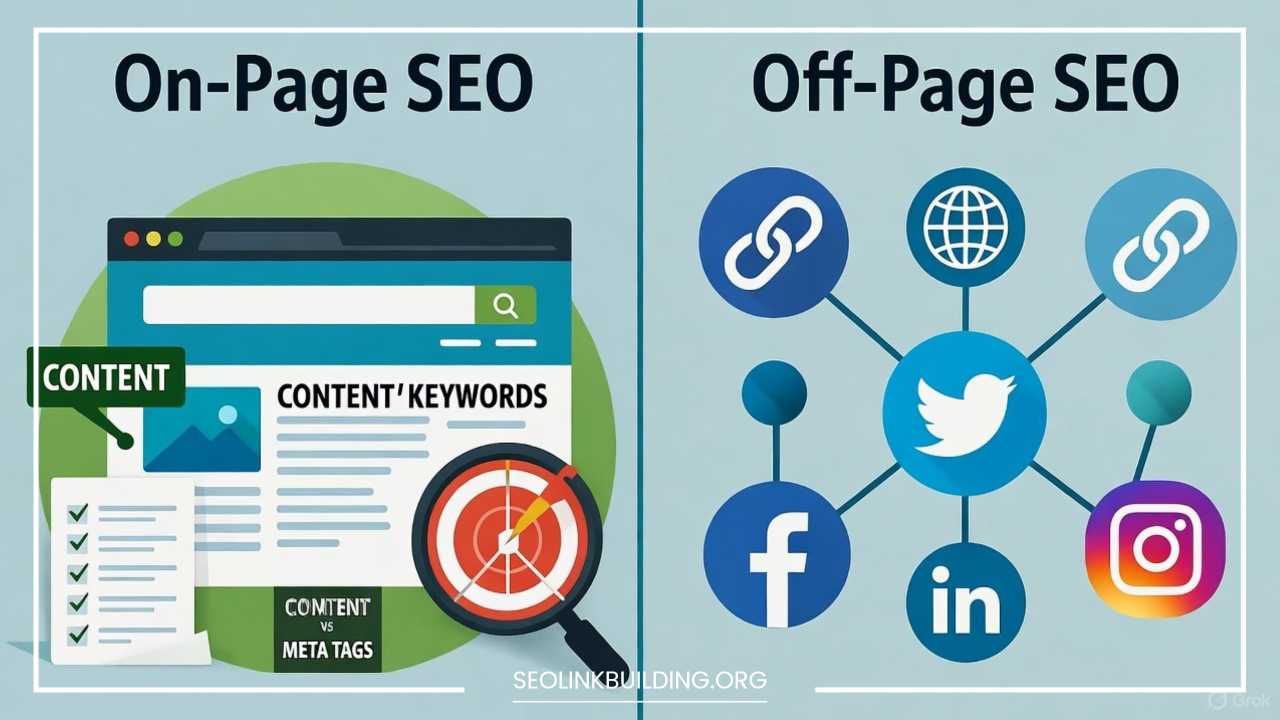
On-Page SEO deals with optimizing the elements within your direct control—the content, structure, and user experience of your website. Off-Page SEO, conversely, focuses on activities outside your website, primarily building credibility, trust, and authority in the eyes of search engines through external validation. Both are not only essential but are entirely interdependent; one cannot truly succeed without the other.
This article will serve as your definitive guide, dissecting the key differences between these two foundational SEO disciplines, exploring their individual components, and providing actionable optimization strategies for each, demonstrating how their synergy is the true catalyst for sustained ranking success.
Understanding SEO Fundamentals
What is Search Engine Optimization (SEO)?
Search Engine Optimization (SEO) is the practice of increasing the quantity and quality of traffic to your website through organic search engine results. It’s not about cheating the system; it’s about aligning your website with what search engines are designed to do: deliver the most relevant, high-quality, and authoritative results to a user’s query.
How Search Engines Rank Web Pages
Search engines use complex algorithms to crawl the web, index content, and rank pages based on hundreds of factors. When a user enters a search query, the search engine rapidly processes its index, looking for pages that demonstrate:
- Relevance (On-Page): How well the content matches the user’s search intent, keywords, and topical needs.
- Authority (Off-Page): The site’s perceived trustworthiness and reputation, primarily determined by the quality and quantity of external links pointing to it.
- User Experience (Technical/On-Page): How quickly, smoothly, and effectively the page delivers the information to the user across all devices.
Google’s ranking factors are often summarized by principles like E-E-A-T (Experience, Expertise, Authoritativeness, and Trustworthiness). A balanced SEO strategy ensures that technical foundations are solid, On-Page elements prove relevance and quality (E-E-A-T), and Off-Page efforts build authority and trust. Ignoring any one of these three elements—Technical, On-Page, or Off-Page—results in a capped potential for growth.
What is On-Page SEO?
Defining the Discipline
On-Page SEO refers to the practice of optimizing individual web pages to rank higher and earn more relevant traffic in search engines. This includes optimizing both the visible content and the underlying HTML source code of a page.
Its purpose is twofold: first, to clearly signal to search engines what your content is about and which search queries it should rank for; and second, to ensure that the content is engaging, readable, and satisfies the user’s intent, thereby improving the overall user experience.
Key Elements of On-Page SEO:
- Keyword Optimization and Intent Matching: This is the bedrock. Identifying the primary and secondary keywords for a page and ensuring the content satisfies the user’s intent (e.g., informational, transactional, navigational).
- Title Tags, Meta Descriptions, and Header Tags (H1, H2, etc.):
- Title Tag: The single most important On-Page element, signaling the page’s topic to search engines and acting as the clickable headline in the SERPs.
- Meta Description: A brief summary that encourages clicks from the search result page. While not a direct ranking factor, it impacts Click-Through Rate (CTR).
- Header Tags: Structuring content logically with H1 for the main topic and H2-H6 for subtopics, improving readability and topic segmentation.
- Content Quality, Readability, and Relevance: The content must be comprehensive, original, well-researched, and directly address the user’s query. Google rewards content that demonstrates high levels of E-E-A-T.
- Internal Linking Structure: Links that point from one page on your domain to another. A robust internal link structure strengthens topical authority, helps search engines crawl and index more pages, and passes link equity (value) between related pages.
- Image Optimization (Alt Text, File Size): Compressing images for faster load times is crucial. Alt text provides a textual description of the image for visually impaired users and helps search engines understand the image’s context.
- URL Structure and Keyword Usage: URLs should be clean, short, and contain the primary keyword. They act as another strong relevance signal.
- User Experience (UX) Factors: Core Web Vitals (site speed, interactivity, visual stability), mobile-friendliness, and intuitive navigation. These are increasingly vital ranking signals.
- Schema Markup and Structured Data: Code added to the website to help search engines understand the context of the page content (e.g., product, review, recipe, or FAQ). This often leads to rich snippets in the SERPs.
What is Off-Page SEO?
Defining the Discipline
Off-Page SEO refers to actions taken outside of your own website to impact your search engine rankings. It’s about building the credibility, trustworthiness, and domain authority of your site in the eyes of search engines. If On-Page SEO is the quality of your house, Off-Page SEO is your neighborhood’s reputation.
The primary mechanism for Off-Page SEO is backlinks, which act as “votes of confidence” from other websites. The more high-quality, relevant websites link to you, the more authoritative your site is perceived to be. This credibility is critical for achieving high rankings, even with perfectly optimized On-Page content.
Key Elements of Off-Page SEO:
- Backlinks: Quality vs. Quantity: Not all links are created equal. A single link from a globally recognized industry leader (high quality) is far more valuable than dozens of links from low-quality, spammy sites (low quality/high quantity).
- Link-Building Strategies: The active process of acquiring external links. This includes ethical strategies such as:
- Guest Posts: Writing content for another reputable site that includes a link back to yours.
- Digital PR: Creating newsworthy content (e.g., unique research, data studies) that journalists and publications naturally link to.
- Broken Link Building: Finding broken links on authoritative sites and suggesting your content as a replacement.
- Social Signals and Brand Mentions: While social media links are often nofollow (meaning they don’t pass direct link equity), high engagement, shares, and mentions across platforms signal that your brand is active, relevant, and authoritative. Unlinked brand mentions can also be interpreted by search engines as a sign of trust.
- Local SEO and Citations: For local businesses, Off-Page SEO includes ensuring consistency of NAP (Name, Address, Phone Number) across various directories and managing your Google Business Profile (GBP). These ‘citations’ act as local trust signals.
- Influencer Outreach and Collaborations: Partnering with key figures in your industry to promote content, resulting in valuable links and amplified reach.
- Online Reputation Management: Monitoring and responding to reviews and mentions on third-party sites. A strong, positive reputation is a vital Off-Page trust signal.
- Content Marketing for Link Acquisition: Creating “linkable assets” like free tools, comprehensive guides, infographics, or proprietary research. These types of content naturally attract backlinks because they provide unique value to other publishers.
On-Page vs Off-Page SEO: Key Differences
The distinction between the two is clear, primarily revolving around control, location, and objective.
Comparison Table
| Aspect | On-Page SEO | Off-Page SEO |
| Focus | Website content, structure, and user experience. | External authority and credibility building. |
| Location | Elements on your website (HTML, content). | Activities off your website (external links, social media). |
| Control | Fully within your control. Changes are immediate. | Relies on third parties. Changes are earned and slower. |
| Key Elements | Content quality, Title tags, Page speed, Internal links. | Backlinks, Brand mentions, Local citations, Social signals. |
| Objective | Improve relevance and user experience. | Improve credibility and Domain Authority. |
| Tools | Yoast, Rank Math, Screaming Frog, Google Search Console, Lighthouse. | Ahrefs, SEMrush, Moz, Majestic, BuzzSumo, HARO. |
The Core Distinction: Relevance vs. Authority
The fundamental difference lies in the objective:
- On-Page SEO establishes a page’s RELEVANCE. It tells Google: “This page is about X, Y, Z, and it fully addresses the user’s intent.”
- Off-Page SEO establishes a site’s AUTHORITY. It tells Google: “Other reputable websites trust this site as a source of information, therefore it is credible.”
A page can be perfectly relevant (great On-Page SEO) but struggle to rank if the domain lacks authority (weak Off-Page SEO). Conversely, a highly authoritative domain can rank a moderately optimized page, but the best long-term success comes from combining both.
How On-Page and Off-Page SEO Work Together
The relationship between On-Page and Off-Page SEO is symbiotic. They are the two hands clapping that create the sound of ranking success.
The Synergy Effect
- On-Page Feeds Off-Page: The primary way to acquire high-quality backlinks (Off-Page) is by creating high-quality, valuable, unique content (On-Page). Nobody links to thin, poorly written, or unoriginal content. Great content is a “link magnet.”
- Off-Page Amplifies On-Page: When an authoritative site links to your page, it boosts that page’s authority score (often called PageRank or Link Equity). This external authority allows your perfectly relevant On-Page optimized content to finally rise to the top of the search results.
- Balanced Strategy: A robust internal linking structure (On-Page) ensures that the link equity acquired from external links (Off-Page) is efficiently distributed throughout the rest of your site, strengthening related topics and supporting pages.
If your On-Page SEO is weak, the powerful boost from a strong backlink profile will be wasted. The user arriving from the SERP will have a poor experience (slow speed, bad content) and immediately bounce, signaling dissatisfaction to Google. A successful SEO strategy ensures the authority is earned (Off-Page) and the experience is worth it (On-Page).
On-Page SEO Optimization Strategies
Achieving On-Page mastery requires a commitment to quality and user satisfaction.
- Conduct Intent-Based Keyword Research: Go beyond simple keywords. Use tools to analyze the SERP and determine the user intent (Are they looking for a definition, a product, or a guide?). Your content must match this intent.
- Optimize Meta Tags and Headings: Ensure the primary keyword is in the Title Tag (preferably near the beginning) and in the H1 tag, but always write for the human reader first. Use secondary and semantic keywords naturally throughout the H2 and H3 subheadings.
- Implement Internal Linking Strategy: Use text that contains relevant keywords (anchor text) to link from high-authority pages to new or low-authority pages on the same topic. Focus on creating topical clusters—a pillar page linked to several supporting sub-pages.
- Enhance Page Speed and Core Web Vitals: Use tools like Google PageSpeed Insights to identify issues. Strategies include compressing images, leveraging browser caching, and minimizing CSS and JavaScript. Speed is crucial for retaining users.
- Optimize for Mobile-First Indexing: Since Google primarily uses the mobile version of a website for indexing and ranking, ensure your layout is responsive, fast, and easy to navigate on a smartphone.
- Create E-E-A-T Content: Demonstrate:
- Experience: Show practical use (e.g., “I used this product…”).
- Expertise: Be factually accurate and cite sources.
- Authority: Have the right credentials or history on the topic.
- Trust: Ensure the site is secure (HTTPS) and privacy policies are clear.
- Use Schema Markup: Implement structured data for content types like reviews, recipes, or FAQs to help search engines present your information more effectively in the SERPs, often leading to coveted rich snippets that boost visibility.
Off-Page SEO Optimization Strategies
Off-Page SEO is an ongoing process focused on building genuine, high-quality relationships and reputation.
- Focus on High-Quality Backlinks: Prioritize relevance and domain authority (DA) over quantity. A link from a site with a DA of 70 in your niche is worth more than 100 links from irrelevant, low-DA sites.
- Digital PR and Linkable Assets: Create newsworthy, unique assets—like a comprehensive industry study, an interactive tool, or original data visualizations—that journalists and bloggers will want to reference and link to. This is the most scalable form of link building.
- Guest Blogging and Strategic Partnerships: Pitch content ideas to highly relevant, authoritative websites in your industry. This is not just about the link; it’s about brand visibility and establishing a reputation among peers.
- Leverage Social Media for Brand Awareness: While social shares may not directly boost rankings, they increase the likelihood of your content being seen by bloggers, journalists, and webmasters who can link to you. Use social media to amplify your content’s reach.
- Local SEO Optimization (For Local Businesses):
- Optimize your Google Business Profile (GBP) with accurate information, photos, and services.
- Acquire and manage positive customer reviews on GBP and other major platforms (Yelp, TripAdvisor).
- Ensure absolute consistency of NAP across all local directories and citation sites.
- Monitor and Disavow Toxic Links: Regularly audit your backlink profile (using tools like Ahrefs or SEMrush). If you find links from clear-cut spam sites, use Google’s Disavow Tool to tell the search engine to ignore them, protecting your site from penalties.
- Influencer Outreach: Identify industry influencers and offer to collaborate. This might involve them reviewing your product, co-authoring a guide, or participating in a podcast, all of which naturally lead to authoritative links and mentions.
Tools to Improve On-Page and Off-Page SEO
A successful SEO campaign relies on accurate data and efficient processes.
| Category | Tool Examples | Primary Use Case |
| On-Page Tools | Yoast SEO/Rank Math | WordPress plugins for title/meta optimization, internal linking, and content analysis. |
| Screaming Frog | Technical SEO audit (crawling site for broken links, duplicate content, title tags). | |
| SurferSEO/Frase | Content optimization based on competitor analysis and keyword density/topic modeling. | |
| Google Search Console | Monitoring indexing, Core Web Vitals, and identifying on-page errors. | |
| Off-Page Tools | Ahrefs / SEMrush / Moz | Backlink profile analysis, competitor link research, domain authority monitoring. |
| Majestic | Link analysis, focusing on Trust Flow and Citation Flow metrics. | |
| BuzzSumo | Identifying highly shared and linkable content ideas and influencer outreach targets. | |
| HARO (Help a Reporter Out) | Connecting with journalists looking for sources, a powerful digital PR tool for link acquisition. |
Common Mistakes to Avoid
SEO success is as much about what you do as what you don’t do. Avoid these pitfalls:
- Ignoring Technical SEO: Technical issues (slow speed, crawl errors, poor mobile UX) create a hard ceiling on both On-Page and Off-Page efforts.
- Keyword Stuffing or Over-Optimization: An outdated On-Page practice. Excessive keyword repetition leads to penalties and damages E-E-A-T. Content must read naturally first.
- Buying Backlinks or Using Black-Hat Schemes: Any attempt to manipulate the system by purchasing links, participating in link farms, or using automated link programs is a violation of Google’s guidelines and guarantees a devastating penalty.
- Neglecting Old Content: Regularly update and refresh old, high-performing content to maintain its relevance and authority. This is a crucial On-Page strategy.
- Focusing Only on One Side: Thinking you can achieve success with perfect On-Page SEO and zero authority, or vice-versa, is a guaranteed path to mediocrity.
- Not Monitoring Backlink Profile: Failing to audit your links allows toxic or spammy links to build up, potentially harming your site’s reputation and inviting manual or algorithmic penalties.
Future Trends in SEO
The core principles of relevance and authority remain constant, but the methods evolve:
- AI-Driven Search: Generative AI is changing the SERP landscape. Content will need to be written to satisfy complex, conversational queries and demonstrate unique E-E-A-T that AI models cannot replicate.
- Focus on Topical Authority and Clustering: Google is shifting from ranking individual keywords to ranking sites that demonstrate deep authority on an entire topic. A structured content cluster is the future of On-Page SEO.
- User Engagement Metrics (The Ultimate On-Page Signal): Metrics like CTR, dwell time, and pogo-sticking (returning to SERP) are increasingly critical. High engagement tells Google your page is the best result.
- Ethical Link-Building and Brand-Driven SEO: The emphasis is moving from “link building” to Digital PR and Brand Building. Links should be a byproduct of being an industry leader, not the sole goal of a campaign.
Final Thoughts
The journey to sustained SEO success is not a quick sprint but a persistent marathon built on duality. On-Page SEO is the process of putting your house in order, ensuring your content is relevant, user-friendly, and structurally sound. Off-Page SEO is the effort to build your reputation in the wider world, earning the trust and authority required to stand out.
Ignoring one pillar in favor of the other creates a significant imbalance, capping your potential. The most successful websites operate from a holistic strategy, ensuring that high-quality, relevant content (On-Page) is backed by high-authority external validation (Off-Page).
Embrace both disciplines, commit to user value, and you will build a robust, sustainable foundation for organic traffic growth.