Benefits of Search Engine Marketing

Top 10 Benefits of Search Engine Marketing for Business Growth
In the modern digital landscape, finding a reliable, scalable way to grow your business can feel like chasing a moving target. Algorithms shift, consumer behaviors evolve, and organic reach often shrinks just when you need it most. If you are trying to capture the attention of customers at the exact moment they are looking to buy, few methodologies carry the raw, predictable power of paid search.
This comprehensive guide breaks down the benefits of search engine marketing for business growth and explores why a well-executed search engine marketing strategy is often the fastest engine behind modern enterprise expansion.
Whether you are launching a brand-new e-commerce platform or attempting to scale an established service business, understanding the foundational advantages of SEM can help you transform your marketing from an unpredictable expense into a highly measurable revenue driver. Let’s dive into how it works, why it remains indispensable, and the distinct ways it elevates your brand above the noise.
What Is Search Engine Marketing?
Before exploring the core benefits of search engine marketing, we must establish a clear foundation. Historically, the term “Search Engine Marketing” (SEM) was used as an umbrella phrase to encompass both organic search optimization (SEO) and paid search tactics. Today, the industry uses SEM almost exclusively to denote paid search marketing—the practice of paying for advertisements to appear at the very top of search engine results pages (SERPs).
The Mechanics of Paid Search
At its core, SEM operates on a model known as PPC advertising (Pay-Per-Click). Unlike traditional advertising—where you pay a flat fee upfront to buy a billboard space or a television slot regardless of who looks at it—with PPC, you only pay when an interested user actively clicks on your ad.
The entire ecosystem is fueled by keywords. These are the specific terms, phrases, and questions that users type into search bars when looking for information, products, or services.
When a user executes a search, a lightning-fast process called the ad auction occurs behind the scenes. Search platforms like Google Ads and Microsoft Ads (formerly Bing Ads) evaluate every eligible advertiser bidding on that keyword. The search engine determines which ads to display, and in what specific order, based on two primary pillars:
-
The Maximum Bid: The highest amount of money the advertiser is willing to pay for a single click.
-
The Quality Score: A dynamic metric that grades the relevance, quality, and user experience of your ad copy and your destination landing pages (the specific web page a user hits after clicking your link).
By balancing financial bids with user relevance, search platforms ensure that searchers receive helpful, high-quality answers while businesses get their messages in front of the right buyers.
Why Search Engine Marketing Matters in Today’s Digital Landscape
The modern consumer path to purchase is no longer linear. It rarely starts with a television commercial and ends at a local brick-and-mortar storefront. Instead, today’s buyers are fiercely independent researchers. Before making a purchasing decision—whether they are hiring an estate planning attorney, purchasing a software subscription, or choosing a local lunch spot—consumers instinctively turn to their smartphones and laptops.
This shift has created an environment dominated by search intent. When someone searches for a phrase like “best cloud accounting software for small business” or “emergency furnace repair near me,” they are demonstrating an incredibly high level of readiness to act. They aren’t casually browsing a social media feed or watching an entertaining video; they are actively seeking a solution to an immediate problem.
As online competition intensifies, relying purely on organic traffic is a long, uphill battle. Algorithms can change overnight, and building up authority organically can take months or even years. If your business isn’t visible at the absolute top of the search engine results page, your competitors will inevitably capture those ready-to-buy consumers. This reality is exactly why paid search advertising has become an essential pillar for sustainable business scaling.
Top 10 Benefits of Search Engine Marketing
Now that we understand the underlying framework, let’s break down the tangible search engine marketing benefits that directly contribute to long-term business growth.
Instant Visibility on Search Engines
One of the biggest hurdles when building an organic presence is time. Search engine optimization is an invaluable practice, but it requires patience. It can take six to twelve months for a new piece of content to rank competitively on organic search results.
SEM provides an immediate solution to this lag time. The moment your campaign is approved and your bids are set, your business can leapfrog directly to the top of the first page of search results.
This instant execution makes search engine advertising an absolute necessity for scenarios that require rapid turnaround times:
-
New Product Launches: Introducing a novel item to the market where you need immediate eyes on the product page.
-
Seasonal Promotions: Capitalizing on short-term buying windows like Black Friday, Mother’s Day, or summer clearances where waiting for organic rankings is impossible.
-
Time-Sensitive Campaigns: Testing a brand-new service offering or a limited-time flash sale.
Real-World Example: Imagine you are launching a brand-new online boutique selling sustainable, zero-waste activewear. Your website is brand new and has zero search engine authority. By utilizing highly targeted search ads, your brand can appear at the top of Google for queries like “buy recycled yoga leggings” on day one, generating immediate sales while your organic SEO strategy builds slowly in the background.
Highly Targeted Audience Reach
Traditional media functions like a massive net thrown into a vast ocean; you capture some target fish, but you also bring in a massive amount of unhelpful debris. SEM functions more like a laser-guided system. It allows you to filter out the noise and only spend money on prospects who match your ideal customer profile.
Modern search advertising platforms allow you to target your audience using an array of sophisticated parameters:
-
Keywords: Aligning your ads strictly with specific phrases that indicate clear commercial intent.
-
Geographic Location (Geo-targeting): Restricting your ads to specific countries, states, cities, ZIP codes, or even a tight radius around a physical storefront.
-
Device Type: Tailoring different experiences for users searching on mobile devices, tablets, or desktop computers.
-
Language: Ensuring your message lands perfectly with specific linguistic demographics.
-
Scheduling (Ad Dayparting): Running your campaigns only during peak business hours when your sales team is available to take calls, or during evenings when consumers do most of their online shopping.
-
Demographics & Interests: Tuning your reach based on age, gender, household income levels, or long-term behavioral patterns.
For example, a local emergency plumber can use precise geo-targeting and scheduling to run ads exclusively within a 15-mile radius of their workshop, specifically between the hours of 6:00 PM and 6:00 AM, targeting phrases like “burst pipe emergency.” This ensures they aren’t wasting money showing ads to someone three states away or someone looking for general plumbing DIY tips during the afternoon.
Increased Website Traffic
While it may sound simple, driving a steady stream of traffic to your website is the foundation of digital commerce. However, not all website traffic is created equal. Raw traffic numbers mean very little if those visitors have no true interest in what you sell.
SEM excels because it generates highly qualified traffic. Because these users are self-selecting by actively typing relevant terms into a search engine, they arrive at your website pre-qualified and interested in the subject matter.
When you align a high-intent keyword with highly relevant ad copy and a streamlined landing page, you dramatically lower your bounce rates (the percentage of visitors who leave after viewing only one page) and boost deep-site engagement. You aren’t forcing your way into their worldview; you are simply answering a digital call for help they initiated themselves.
Higher Conversion Rates
Because SEM traffic consists of high-intent visitors, it naturally translates into superior conversion rates. A conversion occurs when a visitor completes a desired action on your website—whether that’s filling out a lead generation form, completing a product purchase, calling your office directly, or booking an introductory appointment.
Search engine marketing captures users at the bottom of the purchasing funnel. These are individuals who have already identified their problem, researched their options, and are now looking for the right place to spend their money.
By combining this natural user intent with conversion rate optimization (CRO) best practices—such as clear headlines, compelling calls-to-action (CTAs), and frictionless forms—your search ads turn simple clicks into tangible revenue far more efficiently than passive display or social media ads. High-intent search queries lead directly to relevant ads, which route users to optimized landing pages built for immediate conversions.
Cost-Effective Marketing with Budget Control
A common misconception among business owners is that paid search advertising is too expensive for small-scale operations. In reality, SEM is one of the most cost-effective, financially controllable marketing channels available.
Because you function strictly within a pay-per-click framework, you are never paying for passive views; you only pay for actual engagement. Furthermore, platforms like Google Ads give you absolute, granular control over your financial allocations:
-
Daily and Monthly Caps: You can set a strict daily spending limit (e.g., $20 per day) that the search engine will not exceed.
-
Bid Management: You decide the maximum amount you are willing to spend for a single click on a keyword-by-keyword basis.
-
Instant Pause Capability: If a product goes out of stock, your team goes on holiday, or a campaign isn’t performing well, you can pause your ads instantly with a single click. There are no long-term contractual commitments or cancellation fees.
| Marketing Channel | Upfront Cost | Pricing Model | Audience Intent | Flexibility |
| Search Engine Marketing | None | Pay-per-click (PPC) | Exceptionally High | Instant updates & pauses |
| Television/Radio Ads | Very High | Fixed production & airtime fees | Low/Passive | Rigid, long-term contracts |
| Billboards/Print Media | High | Fixed monthly rental rates | Low/Passive | Non-editable once printed |
Measurable Results and Detailed Analytics
With traditional marketing, calculating your exact return on investment (ROI) is notoriously difficult. As the old business adage goes, “Half the money I spend on advertising is wasted; the trouble is I don’t know which half.”
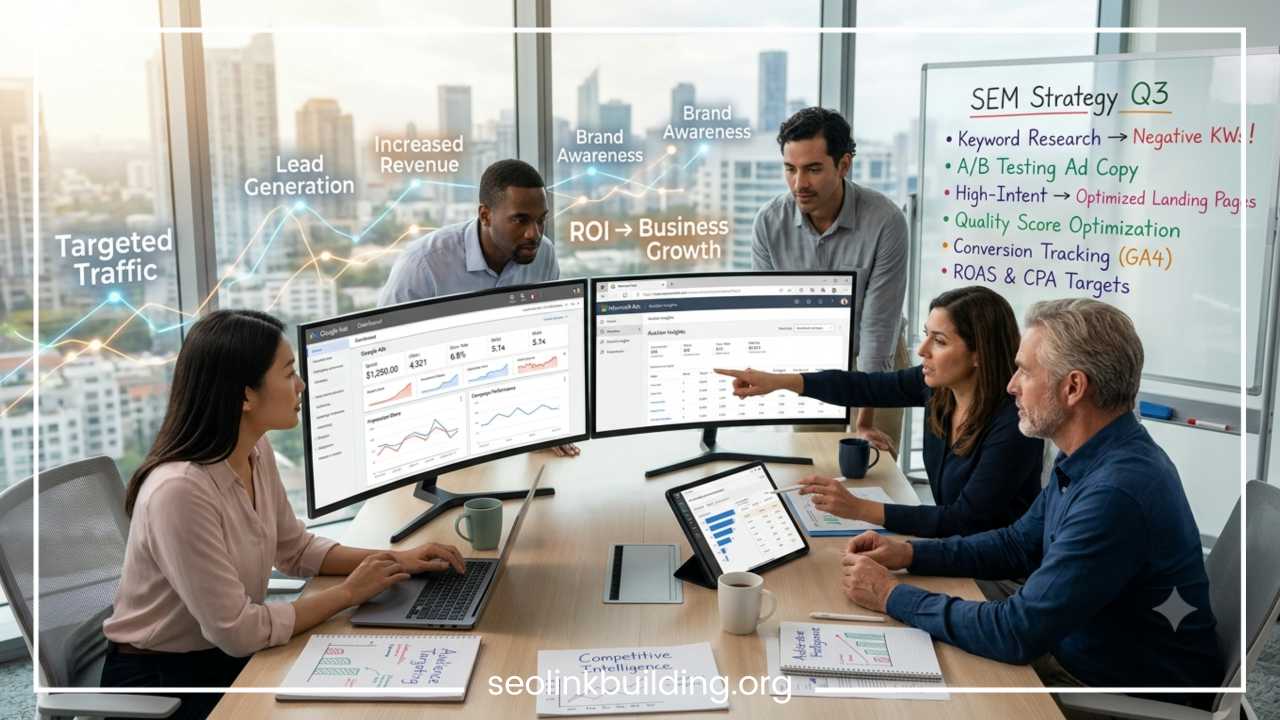
SEM completely eliminates this ambiguity. Every single element of a search campaign leaves a digital paper trail. By linking platforms like Google Ads with analytics suites such as Google Analytics 4 (GA4), you can track your performance metrics with surgical precision:
-
Impressions: Exactly how many times your ad was displayed to a user.
-
Clicks & Click-Through Rate (CTR): How many people interacted with your ad relative to how many saw it.
-
Cost Per Click (CPC): The exact average cost you paid for each visitor.
-
Cost Per Acquisition (CPA): How much ad spend was required to generate a single closed lead or sale.
-
Return on Ad Spend (ROAS): The precise revenue generated for every single dollar invested in your ad campaigns.
This deep level of insight allows business leaders to make truly data-driven decisions. If the metrics reveal that a particular keyword is costing a lot of money but generating zero conversions, you can cut it immediately and reallocate that money to keywords that are actively driving profit.
Better Brand Awareness
Even when searchers don’t immediately click on your advertisement, your business still reaps substantial rewards. Simply appearing at the top of the search engine results page places your brand name, logo, value proposition, and website link directly in front of prospects.
This exposure builds top-of-mind awareness. When a consumer repeatedly sees your company ranking at the very top for industry-related queries, they subconsciously begin to associate your brand with authority, reliability, and market leadership.
Over time, this consistent visibility builds trust. When that consumer is finally ready to make a purchase decision down the road, they are far more likely to bypass the research phase entirely and navigate directly to your website because your name has become synonymous with the solution they require.
Competitive Advantage
In business, search real estate is finite. If your competitors are leveraging search engine ads and you are not, they are systematically intercepting your prospective clients before those users ever find your organic listings. Conversely, executing an intelligent SEM strategy allows you to turn the tables.
Through SEM, smaller businesses and startups can directly compete with massive, multi-million-dollar corporations. Because search engines heavily factor in the Quality Score (ad relevance and landing page experience) rather than just looking at who has the largest bank account, a highly optimized, relevant ad campaign can outrank a lazy, high-budget corporate ad.
Furthermore, you can utilize competitive insights via tools like Google’s Auction Insights to see exactly when and where your competitors are bidding, allowing you to discover gaps in their strategies, bid on profitable keywords they’ve overlooked, or directly bid on their brand names to offer your business as a superior alternative.
Flexible and Scalable Campaigns
Your marketing strategy should be able to expand or contract alongside your real-world business realities. SEM provides an unmatched level of scalability.
For a small business or startup, you can start small with a highly restrictive keyword list and a tiny budget, focusing exclusively on low-hanging, high-converting phrases. As your sales grow and your revenue increases, you can easily scale your efforts:
-
Expanding Budgets: Increasing your daily limits to capture a larger percentage of available search volume.
-
Geographic Expansion: Scaling your campaigns from local regions to regional, national, or international markets.
-
Keyword Broadening: Testing broader search terms, informational keywords, or complementary product categories once your core campaigns are optimized and highly profitable.
This fluid flexibility makes SEM an ideal growth catalyst for organizations of all sizes, ensuring your advertising costs always remain proportionate to your operational capacities.
Supports Overall Digital Marketing Strategy
SEM does not live in an isolated silo; instead, it serves as an incredibly powerful force multiplier for your wider search engine marketing strategy and digital footprint.
Consider how paid search seamlessly integrates with and uplifts your other marketing initiatives:
-
Informing Your SEO Strategy: Waiting months to see if an organic keyword converts is risky. By running paid search ads first, you can instantly test keyword profitability. If a keyword drives massive conversion numbers via PPC within two weeks, you know it is worth investing long-term SEO resources to rank for that term organically.
-
Fueling Remarketing Campaigns: Not every high-intent click converts on the first visit. SEM allows you to capture that initial traffic and drop tracking pixels. You can then serve targeted remarketing ads across social media or display networks to remind those warm leads to return and complete their purchases.
-
Enhancing Content Marketing: If you’ve created an exceptional, high-value guide or a downloadable industry report, you can use paid search to instantly drive targeted traffic to that lead magnet, rapidly growing your email subscriber database.
By working hand-in-hand with conversion rate optimization, content creation, and organic visibility, SEM forms the aggressive, high-speed vanguard of a unified, omnichannel marketing engine.
Common Challenges of Search Engine Marketing
While the advantages of SEM are undeniable, running successful campaigns requires skill, vigilance, and strategic oversight. It is not a magic “set-and-forget” button. If executed poorly, paid search can quickly become an expensive drain on resources.
Understanding the primary challenges is the first step toward avoiding them:
-
High Competition & Rising CPCs: In popular industries (like insurance, legal services, or enterprise SaaS), dozens of brands compete for the same keyword real estate. This bidding intensity can drive the Cost Per Click upwards, requiring strict budget management to maintain profitability.
-
Poor Keyword Selection: Bidding on keywords that are too broad or ambiguous can attract irrelevant traffic. For instance, if you sell high-end luxury watches, bidding on the generic word “watches” will result in paying for clicks from users looking for cheap smartwatches, plastic sports watches, or watch repair guides.
-
Weak Landing Page Experiences: Getting a user to click your ad is only half the battle. If your ad points to a generic homepage that is slow to load, confusing to navigate, or unoptimized for mobile devices, visitors will leave instantly, wasting your ad spend and dropping your Quality Score.
-
Click Fraud: This occurs when automated bots or malicious competitors repeatedly click on your paid search ads to intentionally deplete your daily budget. While modern search engines have sophisticated detection systems to filter out and credit you back for invalid clicks, it remains an issue that requires ongoing monitoring.
Best Practices to Maximize SEM Results
To overcome these hurdles and squeeze the absolute highest return out of your digital marketing investment, you should implement these core operational best practices:
-
Ruthlessly Deploy Negative Keywords: Negative keywords allow you to specify phrases for which your ads should never show up. If you are a premium luxury custom home builder, you should add negative keywords like “cheap,” “free,” “DIY,” and “mobile home” to guarantee your ads only display to high-budget clients.
-
Prioritize Quality Score over High Bids: Focus heavily on making your ad copy align perfectly with the user’s intent, and ensure your landing page delivers exactly what the ad promised. A high Quality Score discounts your actual cost per click, allowing you to outrank competitors who spend significantly more money.
-
Write Hyper-Compelling, Benefit-Driven Ad Copy: Don’t just list your company name and features. Address the user’s pain point immediately, highlight your unique selling proposition (USP), and include a direct, unambiguous call-to-action like “Get a Free Quote” or “Shop 20% Off Today.”
-
Execute Ongoing A/B Testing: Always run at least two variations of an ad within each ad group. Test different headlines, distinct hooks, and alternative calls-to-action to continuously discover what messaging resonates most deeply with your target demographic.
SEM vs SEO: Which One Should You Choose?
A question that frequently surfaces for business owners is whether they should invest their hard-earned dollars into SEM or SEO. The reality is that these two strategies are not bitter rivals; they are complementary pieces of the same puzzle.
To help you understand how they weigh against each other structurally, look at this high-level comparison matrix:
| Feature | Search Engine Marketing (SEM) | Search Engine Optimization (SEO) |
| Primary Cost Model | Pay-per-click (PPC fee for every visitor) | Upfront investment in content, site speed, and links |
| Speed of Results | Near-instantaneous (Go live within hours) | Slow and cumulative (Takes months to mature) |
| Long-Term Stability | Traffic stops entirely the moment you stop paying | Traffic persists long-term even if you pause creation |
| Average CTR | Lower share of total page clicks (roughly 2 to 10 percent) | Captures the majority of total search clicks (roughly 40 to 60 percent) |
| Ideal For | Instant scaling, product launches, seasonal promos | Building compounding trust, authority, and low-cost traffic |
The Ultimate Approach: A Combined Strategy
Rather than viewing this as an either/or choice, the most successful organizations utilize a dual-pronged search strategy.
Use SEM for business growth in the short-term to dominate top-of-page real estate, capture immediate buyers, test keyword conversions, and maintain a highly predictable flow of revenue. Simultaneously, invest in SEO to build an underlying, authoritative foundation that drops your average blended customer acquisition costs over time. When you dominate both the paid slots and the organic slots for a target keyword, you effectively control the entire market’s search results.
Final Thoughts
The benefits of search engine marketing stretch far beyond basic website clicks. By offering instant search engine visibility, hyper-granular audience targeting, absolute budget control, and completely transparent performance analytics, SEM stands out as one of the most powerful, agile tools for modern business scaling.
In a digital marketplace where consumer attention is fragmented and organic algorithms are increasingly restrictive, paid search marketing gives your business direct control over its growth trajectory. It allows you to step directly into the path of consumers who are already holding their credit cards, looking for exactly what you sell.
By executing a structured approach, prioritizing your ad relevance, and continuously analyzing your conversion metrics, you can transform paid search from an unpredictable marketing experiment into a predictable, scalable engine for long-term business success.
Frequently Asked Questions About Search Engine Marketing
What is the difference between search engine marketing and search engine optimization?
The core difference between search engine marketing (SEM) and search engine optimization (SEO) is that SEM uses paid advertising to gain immediate visibility at the top of search results, while SEO relies on organic organic strategies to build long-term rankings over time. SEM works on a pay-per-click (PPC) model where you pay for every visitor, whereas organic traffic generated through SEO is technically free. For the best growth strategy, businesses should use them together.
How much does search engine marketing cost for a small business?
The cost of search engine marketing for a small business varies wildly based on your industry competition, target location, and keyword bidding strategy, but most small businesses spend between $500 to $3,000 per month on platforms like Google Ads. Because SEM allows you to set strict daily budgets and maximum cost-per-click (CPC) limits, you maintain absolute control over your spend and only pay when someone actively interacts with your ad.
How long does it take to see results from an SEM campaign?
Unlike organic SEO which takes months to mature, you can see results from an SEM campaign almost instantly. The moment your ad account is set up, your keywords are selected, and your campaign is approved by the platform, your ads can jump directly to the first page of search engine results, generating targeted traffic and potential leads on day one.
Is Google Ads worth it for local service businesses?
Yes, Google Ads is exceptionally profitable for local service businesses like plumbers, dentists, and electricans because it leverages high-intent local searches. By using precise geo-targeting, your business only pays to appear in front of prospects within your specific service radius at the exact moment they need your help, resulting in conversion rates that are significantly higher than traditional social media or print ads.
Why is my search engine marketing campaign not getting conversions?
If your SEM campaign has a high click-through rate but zero conversions, it usually points to a disconnect between your ad copy and your destination landing page. Common culprits include slow page load speeds, a confusing user interface, hidden pricing, or failing to match the user’s explicit search intent. Additionally, look at your keyword list to ensure you aren’t paying for broad, ambiguous phrases that attract non-buying visitors.
How do negative keywords improve search ads performance?
Negative keywords improve your search ads performance by telling the search engine platform exactly which search terms you want to avoid. For example, if you sell premium, high-end furniture, adding negative keywords like “cheap,” “used,” or “free” ensures that your ads are never displayed to budget-conscious searchers, protecting your ad budget from wasteful clicks and driving up your overall return on ad spend (ROAS).